Ministry of Environment Announces Legislative Notice for Amendments to Subordinate Regulations of the Air Environment Conservation Act
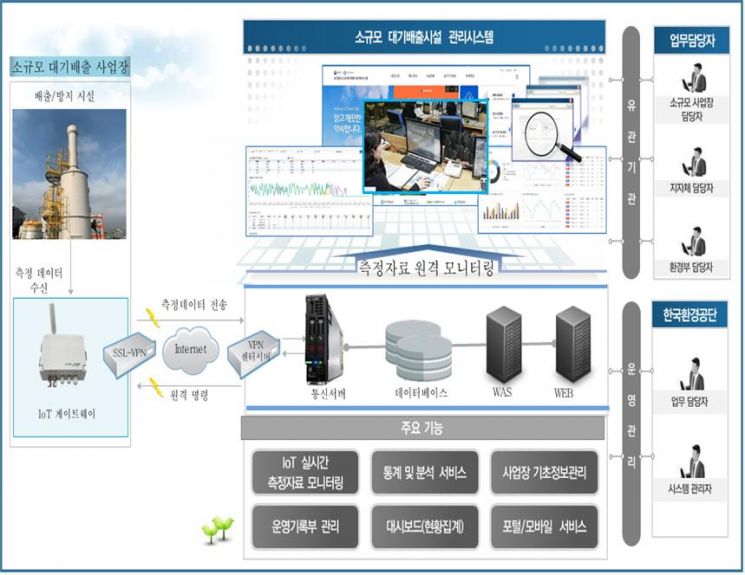
[Sejong=Asia Economy Reporter Joo Sang-don] From 2023, it will be mandatory to attach Internet of Things (IoT) measuring devices to small-scale air pollutant emission facilities (Category 4~5 facilities). This is intended to shift pollutant measurement, which has relied on on-site inspections, to a non-face-to-face system.
On the 3rd, the Ministry of Environment announced that it will publicly notify the amendment of the subordinate legislation (enforcement decree and enforcement rules) of the "Air Environment Conservation Act," which includes this content, for 40 days starting from the 4th.
So far, large-scale facilities (Category 1~3 facilities) with annual air pollution emissions of 10 tons or more have been managing pollutant emission concentrations in real time by attaching automatic stack measuring devices (TMS). However, small-scale facilities with annual emissions below 10 tons have found efficient management difficult as they relied on on-site inspections.
Accordingly, through the amendment of the enforcement decree to enable remote inspection of the operating status of prevention facilities without on-site visits, the attachment of IoT measuring devices to small-scale air pollutant emission facilities has been institutionalized. While TMS measures the concentration of emitted pollutants, the small-scale air pollutant emission facility management system monitors whether prevention facilities are operating normally when emission facilities are running. The installation cost of TMS is about 120 million KRW per unit, whereas IoT measuring devices cost around 3 to 4 million KRW.
The mandatory attachment of IoT measuring devices will be applied in stages according to the size of the facility. For newly installed facilities, Category 4 facilities will be subject to this from January 1, 2023, and Category 5 facilities from January 1, 2024. Existing Category 4 and 5 facilities operating before the enforcement of the amendment will be required to comply from January 1, 2025.
IoT measuring devices are classified into four types depending on facility characteristics: current, pressure, pH, and thermometer. Operating information (status information) measured by IoT measuring devices on emission and prevention facilities at the site is transmitted to the IoT management system every 5 minutes. Through this, management agencies can monitor the status of facilities under their jurisdiction, and facilities can enhance their autonomous environmental management capabilities by checking the status of prevention facilities, understanding consumable replacement cycles, and utilizing statistics such as prevention facility operation information.
The Ministry of Environment, considering the burden on facilities, is conducting a pilot project that supports 90% of installation costs for measuring devices and communication equipment in connection with the "Small-scale Prevention Facility Installation Support Project." Last year, 220 billion KRW was supported for the installation of small-scale prevention facilities at 4,000 facilities, and this year, 150 billion KRW will be spent.
The Ministry of Environment stated, "We plan to continue exploring ways to support installation costs in the future," and added, "We will discover additional support measures (incentives) for facilities attaching IoT measuring devices to encourage early adoption of the devices."
© The Asia Business Daily(www.asiae.co.kr). All rights reserved.
![Clutching a Stolen Dior Bag, Saying "I Hate Being Poor but Real"... The Grotesque Con of a "Human Knockoff" [Slate]](https://cwcontent.asiae.co.kr/asiaresize/183/2026021902243444107_1771435474.jpg)















