Market Growth Trend, 25 Trillion by 2030
Health Supplement Craze Among All Ages
New Ingredients Emerging, General Food Allowed
Diverse Types Like Krill Oil and Yeondubu
Personalized Health Supplements Trend This Year
[Asia Economy Reporter Lim Hye-seon] Office worker Kim Mijin (40, female) spends 450,000 won per month on health functional foods for her family. The Kim couple takes red ginseng on an empty stomach in the morning, sprays vitamin D inside their mouths, and heads to work. At the office, instead of coffee, they drink liquid probiotics and take vitamin C, lutein for eye health, krill oil with brain and anti-aging effects, and omega-3. They are also regularly taking noni, aronia, cacao nibs, and collagen. Their 7-year-old child consumes red ginseng and probiotics. This is the daily supplement regimen of the Kim family.
The Market Will Grow to 25 Trillion Won by 2030
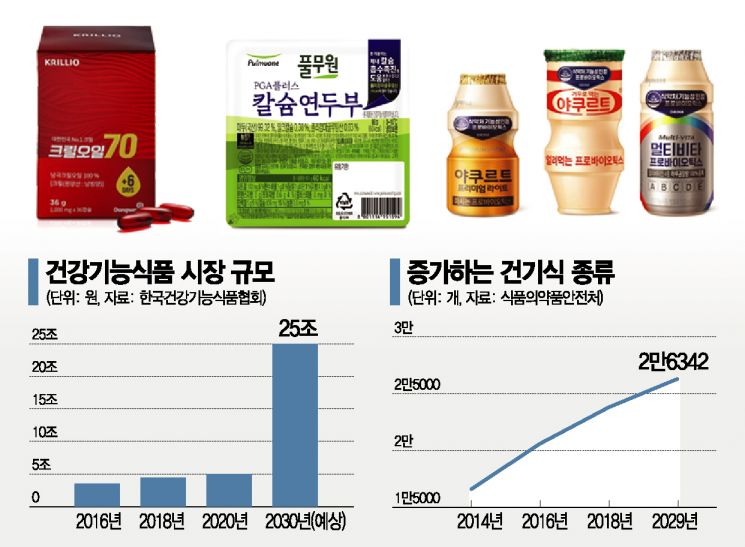
According to the Korea Health Supplements Association on the 25th, the domestic health functional food market, which was 3.5563 trillion won in 2016, reached 4.9805 trillion won last year, approaching 5 trillion won. The association forecasts that it will grow to 25 trillion won by 2030. According to a survey conducted last year by the market research firm Embrain, 93.1% of 1,000 respondents showed interest in health, and 84.5% reported taking health functional foods. By age group, the rates were 50s (90.9%), 40s (90.3%), 60s (88.4%), 30s (84.6%), and 20s (76.1%). The average spending per purchase was 69,000 won. Seniors aged 60 and above share places where they can buy good health functional foods at affordable prices with acquaintances. Middle-aged people in their 40s and 50s consume health supplements segmented by body parts. People in their 20s and 30s, who used to take whatever their parents gave them, now install the Challengers application and set goals to manage their supplement intake.
The three most commonly consumed health functional foods are red ginseng, probiotics, and vitamins. These three ingredients account for 60% of the total market. Among them, probiotics are the fastest-growing ingredient. Last year, probiotic sales recorded 885.6 billion won, a 19.4% increase from the previous year. Compared to 2016, four years ago (372.7 billion won), sales have increased 2.4 times. Market share grew from 10.5% in 2016 to 17.9% last year.
A New Lifeline for the Food Industry
Last year, the Ministry of Food and Drug Safety allowed probiotics to be manufactured in liquid form, prompting food companies to release related products. Until then, probiotics could only be produced in powder form. Korea Yakult obtained the Ministry of Food and Drug Safety’s ‘Functional Probiotics Certification’ for three types of liquid probiotics products earlier this year, the first in the industry.
As new ingredients continue to emerge, the number of registered health functional food types with the Ministry of Food and Drug Safety more than doubled from 12,495 in 2012 to 26,342 in 2019. Dongwon F&B’s ‘Krill Oil 70’ is a product that contains the nutrition of 70 crystal krill directly harvested from Antarctica in one capsule.
Since the end of last year, scientific evidence-based functional labeling has become possible even for general foods, and food companies are releasing products applying this. Twenty-one products have been newly launched under the ‘General Food Functional Labeling System.’ Pulmuone printed on the packaging of ‘PGA Plus Calcium Soft Tofu’ that it contains poly-gamma-glutamic acid (PGA), known to help promote calcium absorption in the body. CJ CheilJedang also labeled its ‘Balance Drink’ as containing inulin and chicory extract, known to aid bowel movements. Lotte Foods newly launched ‘Pasteur Quick Bowel’ with functional labeling information.
‘My Own Customized Health Functional Foods’
This year is expected to be the inaugural year of the ‘personalized’ health functional food market. The first domestic personalized health functional food store is Pulmuone Health & Living’s ‘Perfec.’ Perfec’s repurchase rate is about 20%, similar to the repurchase rate of health functional foods sold through the main distribution channel of door-to-door sales. Last month, in line with the untact (non-face-to-face) trend, they launched a healthcare app called ‘Personalized Nutrition’ that checks individual health status and recommends appropriate health functional foods, offering an online subscription service. The main customer base of Personalized Nutrition is women in their 30s and 40s.
Park Soyoung (35, female) said, “I was satisfied that I could conveniently take various products that I used to take one by one in a single daily pack and that I could receive continuous health management services through professional nutritionists.” CJ CheilJedang plans to strengthen its personalized health functional food business by partnering with a genetic analysis startup and aims to achieve sales of 250 billion won this year. Previously, CJ CheilJedang reorganized its health functional food division within the food business into a health business division. Binggrae introduced a health functional food subscription delivery service on its own health online mall ‘tft.’ Korea Yakult also plans to launch a personalized health functional food service using probiotics through its existing health functional food brand V Food. Among distributors, Lotte Mart has applied for the trademark ‘Viva Health Market’ and is considering entering the related market.
© The Asia Business Daily(www.asiae.co.kr). All rights reserved.
![Clutching a Stolen Dior Bag, Saying "I Hate Being Poor but Real"... The Grotesque Con of a "Human Knockoff" [Slate]](https://cwcontent.asiae.co.kr/asiaresize/183/2026021902243444107_1771435474.jpg)
















