2015 Constitutional Court: "No System to Fill Judicial Vacancies, Vacancies Directly Affect Verdicts"
Justice Lee Seok-tae Former Minbyun President and People's Solidarity Representative... Related to 2 of 3 Impeachment Grounds
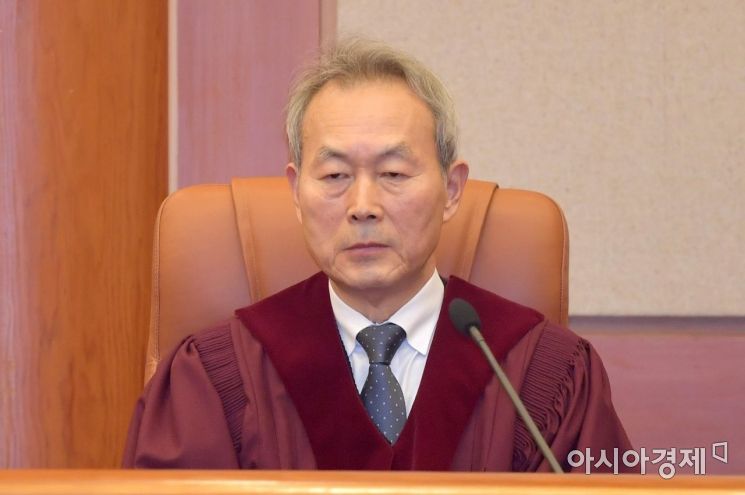 Presiding Justice Lee Seok-tae of the Constitutional Court in the impeachment trial of Im Seong-geun, Chief Judge of the Busan High Court./Photo by Kang Jin-hyeong aymsdream@
[Asia Economy Reporter Choi Seok-jin] Attention is focused on whether the Constitutional Court will accept the disqualification request filed by Im Seong-geun, Chief Judge of the Busan High Court, who is the first judge to be impeached, against Lee Seok-tae (68, Judicial Research and Training Institute class 14), the presiding justice of his impeachment trial case.
According to the Constitutional Court Act, at least six out of nine justices must agree to accept an impeachment trial petition, so if one justice is disqualified, the likelihood of acceptance inevitably decreases.
So far, there have been hardly any cases where the Constitutional Court has accepted a disqualification request against a justice. However, in this case, since the justice in question is related to two of the three trials that formed the basis for Chief Judge Im’s impeachment, there is room for controversy over fairness, and the Constitutional Court is expected to deliberate deeply.
Decision on ‘Disqualification Request’ Case Likely Before Start of Preparatory Hearing on the 26th
On the 24th, the Constitutional Court is reviewing the disqualification request filed by Chief Judge Im with the other eight justices excluding the justice in question. Article 24, Paragraph 6 of the Constitutional Court Act applies Article 48 of the Civil Procedure Act mutatis mutandis to disqualification requests, which means that the trial procedure is suspended until a decision on the disqualification request is finalized.
Therefore, it is expected that the Constitutional Court will make a decision on Chief Judge Im’s disqualification request before the first preparatory hearing scheduled for the 26th or at the latest before the hearing begins on that day.
In ordinary courts, if a party’s disqualification request is accepted, the panel changes, and in the case of the Ministry of Justice’s Prosecutor Disciplinary Committee, if a vacancy arises due to recusal or disqualification, another member replaces them. However, in the Constitutional Court, the remaining justices must proceed with the trial.
This is because there are only nine justices, and for this reason, Article 24, Paragraph 4 of the Constitutional Court Act restricts disqualification requests to no more than two justices for the same case.
Since acceptance of an impeachment trial petition requires the agreement of six or more justices, unlike a jurisdictional dispute trial which requires a majority of the participating justices, if a justice is disqualified, the possibility of acceptance inevitably decreases.
No Cases of Constitutional Court Accepting Justice ‘Disqualification Requests’... Strict Review Due to Impossibility of Filling Vacancies
Meanwhile, it appears that the Constitutional Court has never accepted a disqualification request on the grounds that “it is difficult to expect a fair trial.”
In 1994, Park filed a disqualification request against then-Justice Choi Gwang-ryul, claiming that he dismissed or rejected two constitutional complaint cases he had filed earlier as the presiding judge, but the request was dismissed. In the same year, Jang filed a disqualification request against then-Justice Han Byung-chae, stating that he was the presiding justice in a constitutional complaint case he filed on the same matter, but it was dismissed on the grounds that “being involved as the presiding justice in the previous case alone does not constitute circumstances that make it difficult to expect fairness in the subsequent trial.”
Also, in 2009, Kim filed a disqualification request against then-Justice Song Doo-hwan in a constitutional complaint case seeking cancellation of a prosecutor’s non-prosecution decision regarding suspect A, arguing that since A served as chairman of Kookmin Bank and Song had acted as an outside director supporting all proposals submitted by A, it was difficult to expect fairness in the trial, but the request was not accepted.
The reason the Constitutional Court strictly judges disqualification requests is due to the special nature of constitutional adjudication.
In a constitutional complaint case in 2015 challenging the constitutionality of the provision limiting disqualification requests to one justice, the Constitutional Court stated, “Unlike ordinary trials, constitutional adjudication mainly involves constitutional judgments on norms or state actions, and justices are appointed through a stricter procedure. Therefore, even if a justice has a certain relationship with the circumstances underlying a specific case, the possibility that it affects the fairness or independence of constitutional adjudication is relatively low compared to ordinary trials.”
It further pointed out, “The current constitutional adjudication system does not have a mechanism to supplement vacancies in the full bench, so a vacancy among justices results in outcomes equivalent to confirming opinions of constitutionality or dismissal.”
Former Heads of Minbyun and People’s Solidarity for Participatory Democracy, Who Have Raised Voices for Judge Impeachment... Also Worked in the Office of Senior Presidential Secretary for Civil Affairs with President Moon
However, in this case, it cannot be denied that the justice, who was uniquely designated as the presiding justice because he is not a judge by background, is recognized to have a close connection with the grounds for Chief Judge Im’s impeachment.
First, this justice is related to two of the three trials that formed the basis for Chief Judge Im’s impeachment: the case concerning former President Park Geun-hye’s “seven hours of whereabouts during the Sewol ferry disaster” and the case involving lawyers from the Lawyers for a Democratic Society (Minbyun) who were accused of assaulting police officers at the Ssangyong Motor rally.
This justice served as chairman of the Sewol Ferry Disaster Special Investigation Commission in 2015 and was president of Minbyun from 2004 to 2006.
Additionally, from 2011 for three years, this justice served as co-representative of the progressive civic group People’s Solidarity for Participatory Democracy, which, along with Minbyun, has consistently called for the impeachment of judges involved in judicial corruption.
Moreover, appointed as a justice by Chief Justice Kim Myung-soo in 2018, this justice also worked as a public service discipline secretary in the Office of the Senior Presidential Secretary for Civil Affairs during the Roh Moo-hyun administration in 2003, when President Moon Jae-in served as Senior Presidential Secretary for Civil Affairs, raising suspicions that the trial might be steered toward the conclusion expected by the current administration (acceptance of impeachment).
Amid strong pressure for the resignation of Chief Justice Kim, who last year refused to accept Chief Judge Im’s resignation citing the National Assembly’s impeachment push, the Constitutional Court’s final decision on Chief Judge Im’s impeachment trial case is expected to affect Chief Justice Kim’s position as well.
If the Constitutional Court dismisses the disqualification request against this justice and proceeds with the trial to accept the impeachment petition, or if it dismisses the case on the grounds that Chief Judge Im retired upon term expiration while declaring that his actions were unconstitutional acts infringing judicial independence, the dismissal of the disqualification request by the Constitutional Court is likely to become a major basis for controversy over fairness.
© The Asia Business Daily(www.asiae.co.kr). All rights reserved.
![Clutching a Stolen Dior Bag, Saying "I Hate Being Poor but Real"... The Grotesque Con of a "Human Knockoff" [Slate]](https://cwcontent.asiae.co.kr/asiaresize/183/2026021902243444107_1771435474.jpg)















