Ministry of Science and ICT to Announce Next Year's R&D Investment Direction at Public Hearing on the 18th
[Asia Economy Reporter Kim Bong-su] The government has outlined the basic directions for next year’s national research and development (R&D) as overcoming infectious disease crises, supporting technology development for materials, parts, and equipment (SoBuJang), supporting three core innovative growth industries including biohealth, future cars, and system semiconductors, accelerating the transition to a 2050 carbon-neutral society centered on renewable energy, and strengthening future innovation capabilities based on inclusiveness.
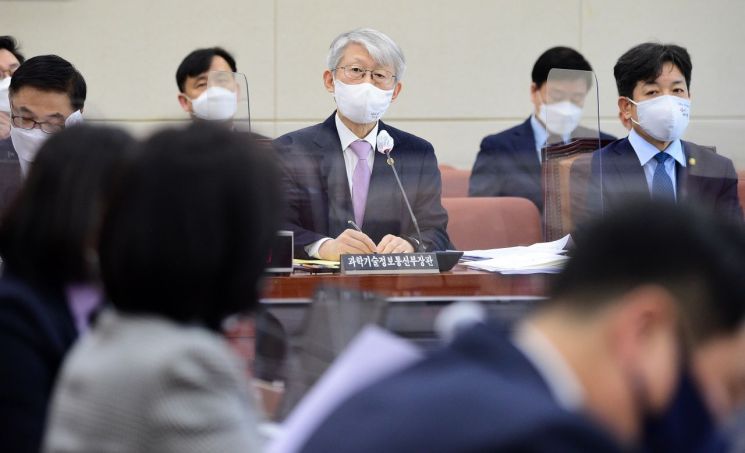
The Ministry of Science and ICT announced this on the 18th afternoon through an online public hearing held to prepare the “2022 National R&D Investment Directions and Standards (Draft).” According to the “Framework Act on Science and Technology,” the government sets such investment directions annually, which serve as strategic investment guidelines for the next year’s government R&D budget and are important references for budget allocation and adjustment.
At the public hearing, the Ministry of Science and ICT defined four basic directions for next year’s R&D: strengthening scientific and technological capabilities for crisis response, economic recovery and revitalization, leapfrogging to a leading nation through opportunity creation, and strengthening future innovation capabilities based on inclusiveness.
Strengthening scientific and technological capabilities for crisis response mainly focuses on infectious disease response and fostering the SoBuJang industry. The government aims to enhance short- and long-term capabilities to prepare for periodic outbreaks of new and mutant infectious diseases, while promoting overcoming infectious disease crises through securing core element technologies and linking and cooperating with field demands. In addition, in response to the global supply chain (GVC) restructuring occurring internationally due to conflicts such as between Korea and Japan and between the US and China, the government will continuously support technology development for core items in materials, parts, and equipment and strengthen support for developing innovative source technologies for future supply chains from a long-term perspective.
Economic recovery and revitalization is also a key direction. To realize innovative growth through creating and preoccupying future markets, the government plans to concentrate R&D budgets on the “three core innovative growth industries” of biohealth, future cars, and system semiconductors. It will support the development of core technologies and the creation of innovative services to activate the D.N.A (Digital, Network, Artificial Intelligence) ecosystem and the non-face-to-face economy, promoting digital economic transformation across all sectors, and enhance efficiency and stability through digitalization of public infrastructure.
Regarding leapfrogging to a leading nation through opportunity creation, the goal is to accelerate the transition to a 2050 carbon-neutral society by promoting energy transition centered on renewable energy, establishing a circular ecosystem based on carbon reduction and energy efficiency, and strengthening adaptability to climate change. Furthermore, strategic investments will be strengthened for technology development and infrastructure expansion in future core fields with high national and social demand and significant economic and social ripple effects, such as quantum technology, new mobility, and brain research.
The government will also enhance the innovation and challenge of R&D through continuous expansion of researcher-centered basic research, strengthening strategies by field, and supporting space technology and challenging projects. It will continuously nurture core science and technology talents in national strategic fields and new industries such as carbon neutrality and D.N.A, and focus support on expanding the foundation for securing future science and technology talents including youth, women, and academic successors.
To strengthen regional industrial and innovation ecosystems, strategic investments will be made in connection with regional New Deal projects and regional infrastructure, and promising small and venture companies in major policy fields will be discovered to support innovative R&D challenges. Growth of startups throughout their lifecycle and technology startups based on research achievements from universities, laboratories, and industry-academia-research cooperation will be supported, and commercialization linkage and support for excellent source research outcomes will accelerate the dissemination of research results.
Additionally, investments based on linkage, cooperation, and sharing to create and disseminate R&D outcomes will be strengthened, and the investment system will be advanced to improve investment efficiency. Specifically, a continuous public-private communication system will be established to strengthen full-cycle public-private cooperation in government R&D, and multi-ministerial collaborative R&D projects with high potential for outcomes will be prioritized to enhance performance-oriented multi-ministerial collaboration. R&D investment outcome creation will be promoted through cross-ministerial relay and innovation procurement linked to public demand, and the efficiency and success potential of large research facility construction projects will be improved through the introduction of a comprehensive project management (PM) system.
A Ministry of Science and ICT official stated, “After reviewing the opinions from this public hearing and consultations with related ministries, we will finalize the investment directions for next year by June 15 through deliberation and resolution by the operating committee under the National Science and Technology Advisory Council (chaired by the President) and notify related agencies.”
© The Asia Business Daily(www.asiae.co.kr). All rights reserved.
![Clutching a Stolen Dior Bag, Saying "I Hate Being Poor but Real"... The Grotesque Con of a "Human Knockoff" [Slate]](https://cwcontent.asiae.co.kr/asiaresize/183/2026021902243444107_1771435474.jpg)















