Record-Breaking Real Estate Supply, the Winner is Cement
The government announced a real estate supply expansion policy to provide an additional 836,000 households by 2025. The main point of the plan is to rapidly promote reconstruction and redevelopment projects, which have been led by the private sector so far, under public leadership, and to expand supply by developing areas around subway stations, semi-industrial zones, and low-rise residential areas. While the profitability of general construction companies may deteriorate due to the expansion of public-led projects, it is expected that the absolute supply and construction volume will increase. Investor interest in construction material companies such as cement is also rising. Asia Economy analyzed Ssangyong Cement and Sampyo Cement, leading companies in the cement industry.
[Asia Economy Reporter Park So-yeon] Ssangyong Cement is the number one company in the domestic cement market share. While focusing on cement and ready-mixed concrete manufacturing, it has diversified its business through subsidiaries in areas such as environment, limestone, shipping, aggregates, and leasing. Since April 2016, when the private equity fund (PEF) Hahn & Company acquired 77% of its shares, it has reorganized to focus on cement and waste treatment businesses. It has attracted attention for future management by establishing eco-friendly cement manufacturing facilities and an ESG (Environmental, Social, and Governance) management committee.
◆Reorganization Centered on Cement Business After Hahn & Company Acquisition
Hahn & Company holds 77.68% of Ssangyong Cement’s shares (common stock, as of the end of September 2020) through Hahn & Co Cement Holdings. Ssangyong Cement produces about 15 million tons of cement annually at four cement plants located in Donghae, Yeongwol, Bukpyeong, and Gwangyang, supplying nationwide. As of last year, it exported approximately 2.9 million tons to major countries including China, the United States, the Philippines, and Chile.
After the acquisition by Hahn & Company, affiliates unrelated to the cement industry were divested. Ssangyong Cement sold Ssangyong Enertech to Far East Petrochemical and Ssangyong Material to Unison. Last year, Ssangyong Information & Communication was sold to ITCEN. Currently, none of Ssangyong Cement’s affiliates are unrelated to the cement business. Last year, Ssangyong Cement executed a free reduction of common stock and a paid cancellation of preferred stock. The industry interprets this as a preparatory step to boost stock prices while preparing for a sale. The dividend yield over the past three years was 5.84% in 2018, 7.29% in 2019, and 6.32% in 2020.
◆Expectations for Real Estate Supply Expansion Policy
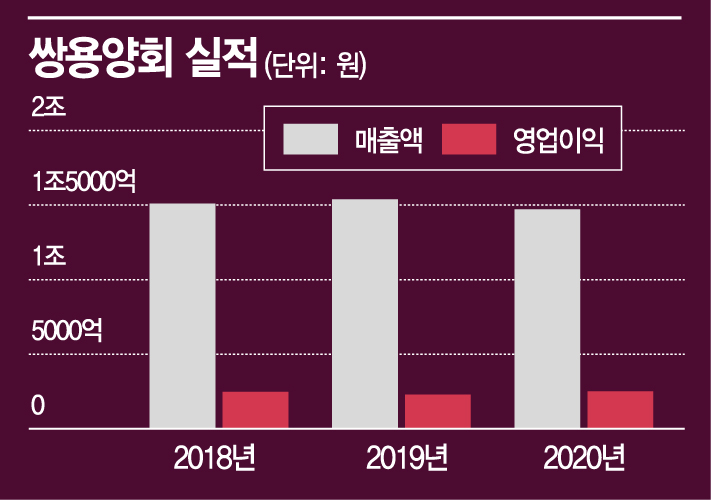
Ssangyong Cement recorded sales of 1.4708 trillion KRW and operating profit of 250.2 billion KRW last year. Although sales decreased by 4.4% compared to the previous year, operating profit increased by 9.2%. The operating profit margin also rose to 17% from 14.8% the previous year, showing resilience despite the economic downturn caused by the COVID-19 pandemic. It is the only company in the cement industry to have recorded double-digit operating profit margins for six consecutive years. Ssangyong Cement set its performance targets for this year at 1.56 trillion KRW in sales and 270 billion KRW in operating profit, representing increases of 6.1% and 7.9%, respectively, compared to the previous year.
The market expects Ssangyong Cement’s performance to rebound beyond expectations this year, in line with the government’s real estate supply expansion policy. The decline in cement shipments since 2018 due to reduced housing supply is expected to reverse, and the increase in the number of housing construction sites driven by government policies such as social overhead capital (SOC), public reconstruction, and redevelopment will naturally lead to increased cement shipments.
The full-scale development of the third phase of new towns and the expansion of SOC budgets are also positive factors. Cement price increases are anticipated. Rajin Sung, an analyst at KTB Investment & Securities, explained, "In December last year, a price increase request letter was sent to ready-mixed concrete companies, and after consultations with the main customers, including ready-mixed concrete companies and construction firms, price increases are expected to proceed. The turnaround in housing supply since 2018, with building permit areas trending upward, is also positive."
◆Ssangyong Cement Gaining Attention for ESG Management
Since the change of major shareholder to Hahn & Company, Ssangyong Cement has continued large-scale investments to reduce manufacturing costs, including the world’s largest waste heat power generation facility among cement plants and energy storage systems (ESS). Cement is typically produced by raising the temperature of a rotary kiln using fuels such as bituminous coal to melt limestone, clay, and iron ore. However, bituminous coal emits a large amount of greenhouse gases.
Hahn & Company, after acquiring Ssangyong Cement, turned its attention to cement manufacturing technologies that replace bituminous coal, which are common in advanced countries such as Germany. Since 2017, Ssangyong Cement has invested 115 billion KRW to build eco-friendly waste heat power generation facilities. This is a circular resource facility for remodeling and expanding cement production equipment. This facility reduces the use of bituminous coal, which is entirely dependent on imports as a primary raw material, and recycles waste plastics and other materials. Waste synthetic resins are superior as a heat source and reduce costs by recycling waste. This is a twofold strategy that generates profits through waste treatment while saving raw material and fuel costs. Last year, Ssangyong Cement replaced 30% of its fuel with circular fuel using waste plastics, aiming to achieve 45% this year. A Ssangyong Cement official said, "The circular resource processing facility is expected to reduce bituminous coal usage and increase income from circular fuel incineration fees, and the waste heat power generation facility is expected to reduce electricity costs."
Meanwhile, Ssangyong Cement is also planning to change its company name at the regular shareholders’ meeting scheduled for March. Earlier, at an extraordinary shareholders’ meeting at the end of last year, it amended its articles of incorporation to add environmental-related items to its business objectives. These include waste collection and transportation, comprehensive waste disposal such as landfilling, soil and groundwater environmental purification and restoration, greenhouse gas emission rights, waste heat power generation and other renewable energy, and environmental consulting businesses. It is also promoting the construction of a waste landfill site with an area 26 times the size of a soccer field at a limestone abandoned mine in Yeongwol, Gangwon Province, which is the third largest landfill scale in Korea.
© The Asia Business Daily(www.asiae.co.kr). All rights reserved.
![Clutching a Stolen Dior Bag, Saying "I Hate Being Poor but Real"... The Grotesque Con of a "Human Knockoff" [Slate]](https://cwcontent.asiae.co.kr/asiaresize/183/2026021902243444107_1771435474.jpg)
















