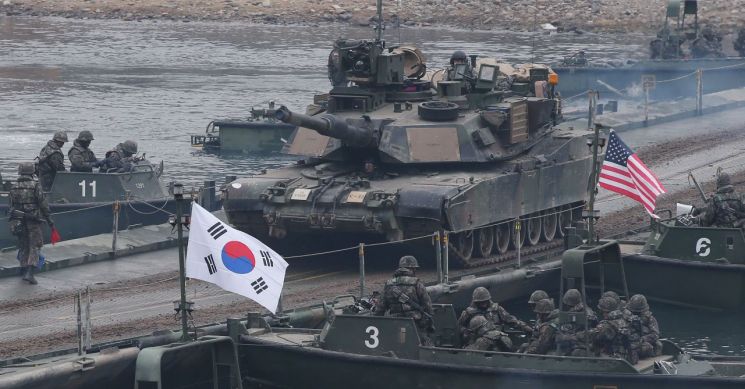
 It has been reported that South Korea and the United States will begin joint military exercises starting on the 5th. The photo shows a US 2nd Infantry Division M1A2 SEP tank crossing a pontoon bridge during the South Korea-US joint river crossing operation training held in December 2015 at the Hantan River in Yeoncheon-gun, Gyeonggi-do.
 [Asia Economy Yang Nak-gyu, Military Specialist Reporter] Concerns are emerging that the upcoming South Korea-U.S. joint military exercises next month may only provoke North Korea without achieving the intended effect of verifying the transfer of wartime operational control.
According to government officials on the 15th, due to the reduction in scale and duration of the South Korea-U.S. joint exercises, South Korean personnel will use the command post inside the Joint Chiefs of Staff building in Yongsan-gu, Seoul. If the exercises had not been scaled down, the ‘B1 bunker’ within the Capital Defense Command would have been utilized. The Joint Chiefs of Staff personnel are not moving to the B1 bunker as a measure to prevent COVID-19 infections during the exercise period. However, this means the exercises will not be conducted at the optimal location assuming wartime conditions, which could lead to various issues.
Immediately, South Korea’s plan to use this exercise as an opportunity to verify the ‘Full Operational Capability (FOC),’ a prerequisite for the transfer of wartime operational control, will not be realized. Initially, the South Korean military planned to conduct the exercise in two phases?defense and counterattack?using computer simulations to verify the FOC of the future combined forces command that will exercise operational control. However, as the U.S. side indicated difficulties in bringing in large numbers of reinforcements due to the spread of COVID-19, they proposed reducing the scale and duration. Ultimately, South Korea and the U.S. agreed to shorten the joint exercise period from the original 16 days to 9 days. The field training exercise (FTX), which involves actual troop deployment outdoors, was canceled altogether, making it insufficient to verify FOC elements.
Shin Jong-woo, Secretary General of the Korea Defense and Security Forum (KODEF), pointed out, "If Joint Chiefs personnel conduct the exercise at the Joint Chiefs building, which serves as a backup command post, it is questionable whether the training will be realistic."
The reduction in the exercise scale appears to be influenced not only by the COVID-19 situation but also by a plan to avoid provoking North Korea with large-scale military drills. Experts have advised both countries to manage the situation carefully to prevent unnecessary military tensions, as North Korea has been seeking justification for provocations as a way to assert its presence since the inauguration of the Biden administration.
However, it remains uncertain whether the decision to reduce the scale of the exercises will effectively quell North Korea’s backlash. North Korean Supreme Leader Kim Jong-un stated in his report at the Workers’ Party Congress earlier this year, "The South continues to ignore our repeated warnings to stop bringing in military equipment and joint military exercises with the U.S.," and warned that inter-Korean relations could revert to the "spring days three years ago" depending on the South’s attitude.
If North Korea resorts to provocations, it is feared that the government’s efforts to restart the peace process on the Korean Peninsula through the resumption of North Korea-U.S. dialogue will inevitably face setbacks.
Kim Dong-yeop, a professor at the Institute of Far Eastern Studies at Gyeongnam National University, said, "Regardless of the scale and format of the exercises, North Korea is highly likely to proceed with provocations under the pretext of strengthening national defense capabilities," adding, "If this year’s joint exercises had been canceled on a large scale, it could have been an opportunity to remove any pretext for North Korea to provoke."
On the other hand, Nam Sung-wook, a professor in the Department of Unification and Diplomacy at Korea University, criticized, "The reduced-scale joint exercises this time will neither perfectly verify the FOC nor prevent North Korea from having a pretext for provocations," calling it "an outcome where trying to catch two rabbits resulted in losing both."
© The Asia Business Daily(www.asiae.co.kr). All rights reserved.
![Clutching a Stolen Dior Bag, Saying "I Hate Being Poor but Real"... The Grotesque Con of a "Human Knockoff" [Slate]](https://cwcontent.asiae.co.kr/asiaresize/183/2026021902243444107_1771435474.jpg)















