The Only Domestic Company with In-House Design and Manufacturing Capability
Global Top-Level Satellite Development to Be Completed Soon
Hanwha Group Investment...Business Synergy Expected
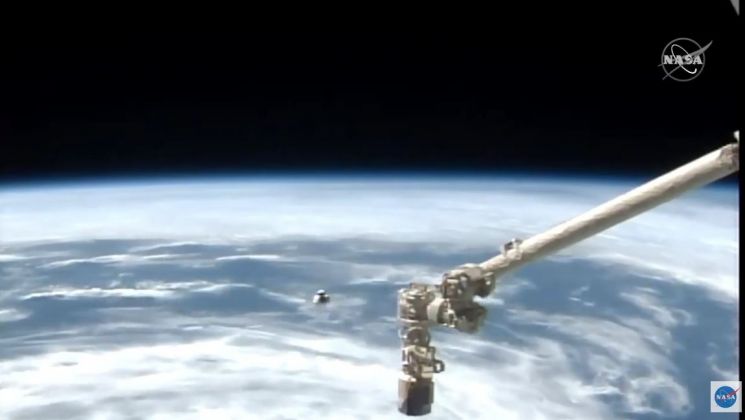
The gold rush toward space has begun. Despite repeated failures, Amazon founder Jeff Bezos and Tesla's Elon Musk have not given up on the space industry. The space exploration projects they are fiercely competing over have become a blue ocean with clear commercialization potential. The stock prices of companies related to the space industry also reflect this trend. The space industry encompasses a variety of fields, from space travel to satellite communication network construction, weather and location information collection, and space debris disposal businesses. In South Korea, there are excellent companies with the technological capability to capture the 500 trillion won space market. Intellian Technologies and Satrec Initiative are representative examples. These companies are recognized in the global market based on their independent technological capabilities. Asia Economy analyzed companies related to the space industry.
[Asia Economy Reporter Lim Jeong-su] Satrec Initiative is the only domestic satellite development company in South Korea with world-class technology. It possesses unique technology that allows it to design and manufacture most satellite components except for solar panels and batteries on its own. The company was founded in 1999 by the developers of the domestic satellite UriByul-1 and was listed on the KOSDAQ market in 2008.
◇World-class technology and cost-effectiveness... Growth is accelerating= Satrec Initiative is nearing the completion of the development of the satellite 'SpaceEye-T,' which boasts the world's highest performance (0.3m class). Earlier, it successfully developed the Earth observation satellite 'SpaceEye-X' with a 0.5m resolution, leading to large-scale orders.
Industry insiders expect that orders for SpaceEye-T will begin in earnest upon product launch. Compared to DigitalGlobe's 'WorldView-3,' which has the same performance, SpaceEye-T weighs only about a quarter (650kg) and costs about a third (100 million USD). Its excellent cost-effectiveness is expected to significantly increase order volumes.
With new product orders added, the growth trend in performance is expected to become even steeper. Satrec Initiative's consolidated sales grew at an average annual rate of 27%, from 34.2 billion won in 2016 to 89.3 billion won last year. The order backlog also increased from 56.9 billion won in 2018, 167.8 billion won in 2019, to 207.5 billion won accumulated by the third quarter of last year. As of the end of the third quarter last year, the order amount was about 2.6 times the sales of the most recent four quarters.
In October last year, the company secured an order worth 13.5 billion won from the Korea Aerospace Research Institute for the development of the next-generation medium-sized satellite 4 electronic optical system, and earlier in August, it won an 83.5 billion won order from the Korea Advanced Institute of Science and Technology for the development of a nanosatellite swarm system, increasing its order backlog.
As new product orders become visible, profitability is also expected to improve further. Satrec Initiative recorded an operating profit of 9.2 billion won last year, a 48% improvement from 13.7 billion won in 2019. Kim Jong-min, a senior researcher at Samsung Securities, said, "As orders for new products with an operating profit margin of 35% increase, the profit improvement will accelerate," adding, "The depreciation period for existing products will end in November this year, reducing cost burdens."

◇Growing value of subsidiaries= The corporate value of subsidiaries is also increasing. Satrec Initiative holds a 62.5% stake in SIIS, a satellite image sales subsidiary, and an 89.2% stake in SIA, a subsidiary specializing in AI-based image data analysis.
SIIS holds exclusive supply rights for satellite images supplied by Satrec Initiative, including those from the Korea Aerospace Research Institute's Arirang satellites. It generates revenue by providing satellite images related to climate change, ocean temperatures, and more for scientific, agricultural, and military purposes.
SIA sells image data analysis materials to developing countries without observation satellites, military and government agencies for surveillance and reconnaissance purposes, and private businesses. With the recent surge in demand for satellite data analysis, its performance is expected to improve significantly.
◇Business synergy expected with Hanwha partnership= On the 13th of last month, Satrec Initiative welcomed Hanwha Aerospace as its largest shareholder through a third-party allotment capital increase and convertible bond issuance. Hanwha's investment amounted to 58.9 billion won in equity investment and 50 billion won in convertible bonds (CB). Hanwha, having secured management rights, is reportedly planning to maintain the current technology-focused management team as is.
The company expects that the capital relationship with Hanwha will not only secure funds but also enhance mutual synergy. Hanwha already possesses manufacturing technology for satellite components, nanosatellites, and antenna launchers. Having operated in the defense industry for a long time, it is considered the company with the most experience and networking in related businesses domestically.
Lee Dong-heon, a researcher at Daishin Securities, predicted, "The combination of Satrec Initiative's Earth observation technology and Hanwha Aerospace's satellite business platform across its affiliates will expand opportunities."
© The Asia Business Daily(www.asiae.co.kr). All rights reserved.
![Clutching a Stolen Dior Bag, Saying "I Hate Being Poor but Real"... The Grotesque Con of a "Human Knockoff" [Slate]](https://cwcontent.asiae.co.kr/asiaresize/183/2026021902243444107_1771435474.jpg)
















