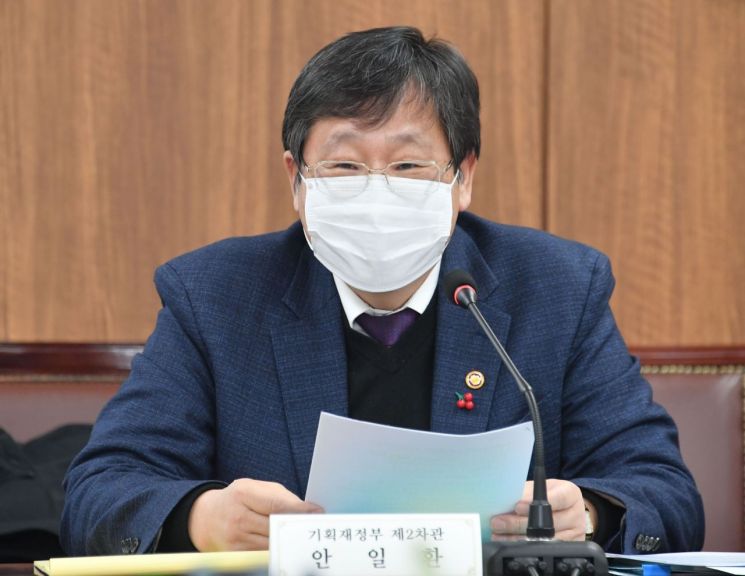
[Asia Economy Reporter Son Sun-hee] Ahn Il-hwan, the 2nd Vice Minister of the Ministry of Economy and Finance, said on the 4th, "In a situation where national debt, which is a burden on future generations, is rapidly increasing, it is necessary to once again recall the meaning of Japan's 'Crocodile Mouth Graph,' which warns of the irreversibility of fiscal spending."
This statement was made by the 2nd Vice Minister, who oversees the budget at the Ministry of Economy and Finance, the fiscal authority, amid ongoing tensions with the ruling party over the issue of the 4th disaster relief fund payment. The 'Crocodile Mouth Graph' mentioned by Vice Minister Ahn refers to a financial structure where national debt increases in the shape of a 'crocodile's mouth' due to continuous spending increases and tax revenue decreases. In Japan's case, the national debt-to-GDP ratio rose from 32% in 1977 to 220% in 2019, increasing more than sevenfold, making it a representative example of severe national debt.
On the afternoon of the same day, Vice Minister Ahn presided over the '2nd Public Institution Investment Execution Inspection Meeting' at the Government Seoul Office and said in his opening remarks, "To simultaneously achieve the tasks of overcoming the immediate COVID-19 crisis and maintaining a national budget that future generations can bear, the 'wisdom to efficiently allocate limited resources to the right places at the right time' is more important than ever." This aligns with the position of Deputy Prime Minister and Minister of Economy and Finance Hong Nam-ki, who argues that disaster relief funds should be distributed selectively if necessary.
Vice Minister Ahn also stated, "Facing the COVID-19 crisis, the role of fiscal and public sectors is increasingly emphasized, and demand is explosively rising across society. At this point, I want to reaffirm the mission of fiscal management." This was a reiteration of the importance of 'fiscal management' amid strong pressure from the ruling party to expand fiscal spending to overcome the COVID-19 crisis.
Meanwhile, at the meeting, the execution performance of major public institution investments last year was reviewed, and next year's investment plans and early execution measures were discussed. Last year, public institution investment performance amounted to a total of 61 trillion won, an increase of about 12.8% compared to the previous year's performance (54.1 trillion won). This was evaluated as an achievement despite difficult conditions such as domestic and international project cancellations, work stoppages due to COVID-19, and lack of investment funds.
Additionally, this year, the government and private sector announced a total investment plan of 110 trillion won. Among this, public institutions plan to execute a record-high investment of 65 trillion won. In particular, to realize the economic stimulus effect early, 53% of the investment will be concentrated in the first half of the year.
© The Asia Business Daily(www.asiae.co.kr). All rights reserved.
![Clutching a Stolen Dior Bag, Saying "I Hate Being Poor but Real"... The Grotesque Con of a "Human Knockoff" [Slate]](https://cwcontent.asiae.co.kr/asiaresize/183/2026021902243444107_1771435474.jpg)















