KIAF, Foreign Companies' Evaluation and Suggestions on Korea's Business Environment
Kaher Kazem, President of Korea GM: "Labor Rigidity Higher Compared to Competitors, Needs Alignment with International Standards"
AmCham Chairman: "Urgent Need to Improve Tax and Labor Flexibility"
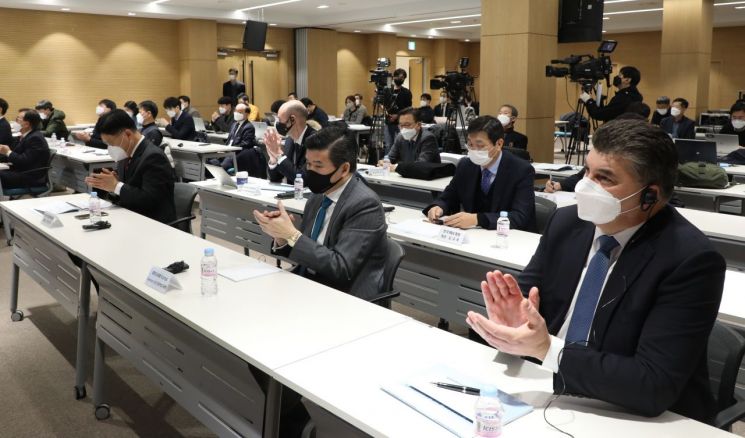
[Asia Economy Reporter Kim Hyewon] When foreign-invested companies decide to invest in Korea, frequent policy changes by the government and excessive regulations are the biggest concerns. Although there are many strengths for investment in Korea, such as world-class ICT penetration rates, trend-sensitive consumers, and macroeconomic stability, unfavorable corporate environments like tax systems, labor flexibility, and stringent regulations pose significant burdens on foreign-invested companies. ▶Related article on page 3
The Korea Industrial Alliance Forum (KIAF) and the Korea Automobile Industry Association held the 8th Industrial Development Forum on the 28th under the theme "Evaluation and Suggestions on Korea's Business Environment from the Perspective of Foreign-Invested Companies," announcing the results of a survey conducted on 155 foreign-invested companies with more than 100 employees.
The main concerns when foreign-invested companies decide to invest were "uncertainty due to frequent policy changes (25.9%)" and "excessive government regulations (24.9%)." Among foreign-invested companies that perceived a deterioration in the business environment after investing domestically, the causes were identified as "government regulatory policies (28.6%)," "wages and labor-management relations (17.9%)," and "taxes and various charges (10.7%)." Labor rigidity was attributed to "lack of autonomous regulation between labor and management and legal enforcement (48.0%)," "frequent institutional changes (24.0%)," and "unique Korean regulations (16.0%)." In particular, difficulties in legally dismissing regular workers, restrictions on dispatch industries, and prohibitions on worker reassignment were cited as uniquely Korean regulations.
At the lecture held that day, foreign-invested companies, including Kaher Kazem, President of Korea GM, voiced complaints about the worsening domestic investment environment. President Kazem stated, "Compared to competing countries, Korea has problems such as short negotiation cycles for wages and collective agreements, short terms for labor union executives, continuous strikes, frequent regulatory changes and uncertainties related to dispatched and contract workers, resulting in high costs and labor rigidity," and added, "There is also a need to harmonize regulations with international standards," urging the government.
James Kim, Chairman of the American Chamber of Commerce in Korea (AMCHAM), said, "Now that the spread of COVID-19 is slowing down, this is the perfect opportunity for Korea to attract global companies' Asia-Pacific headquarters," pointing out the urgent need to improve tax systems, labor flexibility, intellectual property (IP) protection, regulatory burdens, trade barriers, and digital economy-related regulations.
Jung Manki, Chairman of KIAF, emphasized, "The reason foreign-invested companies come to Korea is not because of past wage levels but because of technology-intensive comparative advantages," and stressed, "To attract foreign investment, economic-related systems must be certain and consistent rather than specific policies."
© The Asia Business Daily(www.asiae.co.kr). All rights reserved.
![Clutching a Stolen Dior Bag, Saying "I Hate Being Poor but Real"... The Grotesque Con of a "Human Knockoff" [Slate]](https://cwcontent.asiae.co.kr/asiaresize/183/2026021902243444107_1771435474.jpg)















