Nationwide Free Vaccination as Top Priority... Expansion of Testing and Epidemiological Investigation Capabilities
[Asia Economy Reporter Seo So-jeong] The government is taking an early approach to overcoming the novel coronavirus infection (COVID-19) with a three-pronged strategy of quarantine, vaccines, and therapeutics.
Starting vaccinations in the first quarter for workers at nursing hospitals, elderly medical welfare facilities, and high-risk medical institutions, the plan is to administer the first dose to 70% of the entire population by September. Quarantine capabilities will be enhanced through expanded PCR testing and increased epidemiological investigators, and 'social distancing' measures will be reorganized according to the vaccination situation.
The Ministry of Health and Welfare, the Ministry of Food and Drug Safety, and the Korea Disease Control and Prevention Agency announced on the 25th through the 2021 work plan that early introduction and development of COVID-19 vaccines and therapeutics and the implementation of nationwide free vaccination will be prioritized.
The government aims to achieve herd immunity by November by administering the first dose to 70% of the population by September. ▲In the first quarter, vaccinations will begin for workers at nursing hospitals, elderly medical welfare facilities, and high-risk medical institutions ▲In the second quarter, for those aged 65 and older, medical institutions, and home-based elderly welfare facility workers ▲In the third quarter, for chronic patients and adults (ages 19-64) ▲In the fourth quarter, second doses and vaccinations for those not yet vaccinated will be carried out.
The government is preparing to enable safe vaccinations at nearby locations. Depending on the vaccine characteristics, vaccinations will be administered at vaccination centers (about 250 locations) or medical institutions (about 10,000 locations). A visiting vaccination service will also be provided for elderly residents in group living facilities.
Additionally, by expanding testing and epidemiological investigation capabilities, the government aims to block the spread of COVID-19 early. Anyone can easily get tested through screening clinics, temporary screening testing sites, and respiratory clinics, and the current maximum daily PCR tests of 200,000 will be expanded to 240,000 by June.
The number of epidemiological investigators, which was 325 last year, will be increased by 60 to 385 this year, and information and communication technology (ICT) will be utilized to respond swiftly to infectious diseases.
Hospital beds and personnel will also be secured. To ensure smooth treatment of critically ill patients, secured beds will continue to be operated in the first quarter, and from the second quarter onward, sufficient intensive care beds will be secured, focusing on emergency treatment beds established since last year. Infectious disease-dedicated hospitals and living treatment centers will be gradually reduced during stabilization periods but can be flexibly operated through a standby designation system to allow immediate reactivation if necessary.
Special beds tailored to the characteristics of special patients such as the elderly, dialysis patients, and psychiatric patients will be expanded and operated. Furthermore, the government plans to actively support medical and care personnel by improving medical staff treatment, training nurses dedicated to severe patients, and supporting caregivers through social service agencies.
Reorganizing Social Distancing to be 'Activity-Centered' Reflecting Public Fatigue
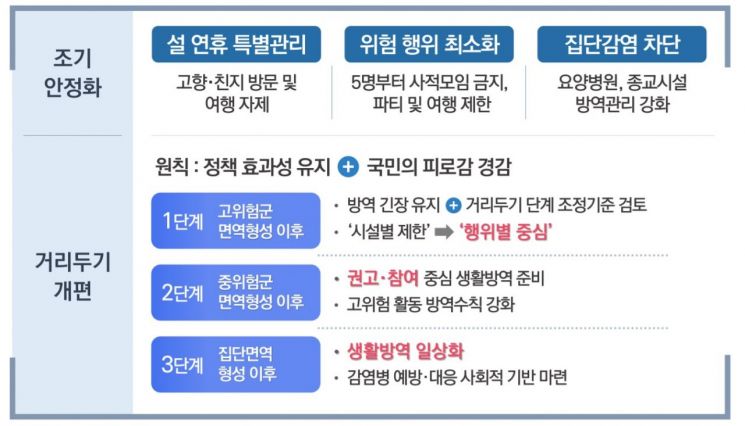
Social distancing will be reorganized more equitably. After COVID-19 stabilizes, the government plans to reduce public fatigue and reorganize distancing measures considering the vaccination situation. Until next month when vaccinations begin and until immunity is formed in high-risk groups, overall quarantine tension will be maintained, but distancing will be implemented by classifying risk according to activities rather than the previous facility-based restrictions. After immunity is formed in the medium-risk group, the system will shift to a recommendation and participation-based daily quarantine system, and after herd immunity is achieved, daily quarantine will be normalized.
Regarding the introduction and development of vaccines and therapeutics, safety will be thoroughly verified through strengthened expertise, including triple expert consultations. The COVAX Facility vaccines to be supplied domestically and internationally are currently under review by the Ministry of Food and Drug Safety, following the World Health Organization (WHO) international joint review request. Vaccine and therapeutic approvals are expected to be completed in February.
In particular, the Ministry of Food and Drug Safety plans to conduct national batch release approval concurrently with vaccine approval review and reduce the testing period from the current 2-3 months to within 20 days by reallocating testing personnel and securing additional staff, enabling vaccinations within February. Therapeutics are targeted for development by February, and vaccines within the year, with full support for domestic vaccine and therapeutic development.
Expansion of Child Allowance and Introduction of Infant Allowance... Strengthening Public Healthcare
Efforts will also be made to close the deepened gaps caused by COVID-19 through strengthening income, care, and medical and health safety nets.
The obligation system for supporters under the Basic Livelihood Security Program will be phased out, and income support for low-income groups will be expanded through increased emergency welfare support. To support elderly income, the monthly payment of up to 300,000 won will be expanded from the bottom 40% income group (3.32 million people) to the bottom 70% (5.98 million people), and senior job opportunities will increase by 60,000 from the previous year to 800,000.
Plans to expand child allowance and introduce an infant allowance of 500,000 won per month for ages 0-1 (starting in 2022) are under review, and preparations are underway to introduce sickness benefits (pilot project in 2022) to allow people to rest when sick, alongside reforms to income support systems.
Public healthcare will also be strengthened. By constructing new and expanded local medical centers, about 5,000 public hospital beds will be added by 2025. In particular, three new constructions (Daejeon, Seobusan, Jinju) are exempt from preliminary feasibility studies to support rapid expansion, and national subsidies will be increased to facilitate new and expanded local public hospitals.
Additionally, through medical-government consultations, plans to secure doctors in regional and essential medical fields will be established, and efforts will be made to nurture regional medical personnel by expanding resident assignments in local and national public hospitals and increasing active nurses by 10,000. By 2026, the National Medical Center will be modernized to expand from the current 485 beds to 800 beds, strengthening its role as a control tower for local public hospitals.
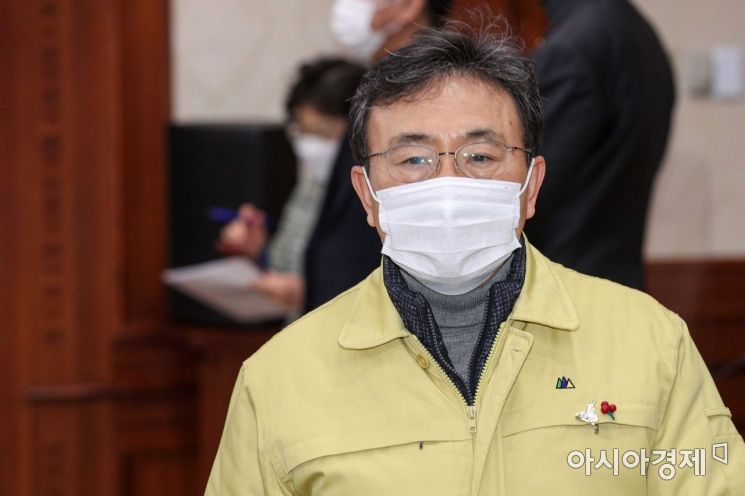
Minister of Health and Welfare Kwon Deok-cheol said, "This year, with the three-pronged approach of K-quarantine, vaccines, and therapeutics, we will surely overcome COVID-19 early and welcome a new normal."
© The Asia Business Daily(www.asiae.co.kr). All rights reserved.
![Clutching a Stolen Dior Bag, Saying "I Hate Being Poor but Real"... The Grotesque Con of a "Human Knockoff" [Slate]](https://cwcontent.asiae.co.kr/asiaresize/183/2026021902243444107_1771435474.jpg)
















