All Government Funds and Bank of Korea's Statutory Reserves Fully Mobilized
Expert: "It's Essentially the Same as Supporting with Taxes"
[Asia Economy Reporter Jang Sehee] The Democratic Party of Korea is eyeing government funds and the Bank of Korea's statutory reserves as sources for the profit-sharing system it is promoting to alleviate polarization after the COVID-19 pandemic. This approach uses funds to prevent controversy over the injection of taxpayers' money, but concerns are being raised that "it's ultimately just a superficial gesture" since taxes have already been injected into government funds.
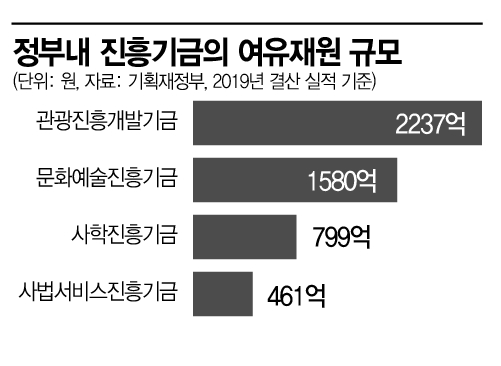
According to the Democratic Party on the 25th, the party's post-COVID inequality resolution task force (TF), led by Assemblywoman Yang Kyung-sook, is drafting a plan for a win-win cooperation fund. The Democratic Party intends to allocate some resources from relatively surplus funds such as the Tourism Promotion Development Fund, Judicial Service Promotion Fund, Private School Promotion Fund, and Culture and Arts Promotion Fund, and raise the rest through voluntary private donations.
A Democratic Party official said, "We are looking mainly at funds that have relatively surplus resources compared to others or have recently collected a lot of money." According to the Ministry of Strategy and Finance, as of the 2019 settlement, the Tourism Promotion Development Fund stands at 223.7 billion KRW, the Culture and Arts Promotion Fund at 158 billion KRW, the Private School Promotion Fund at 79.9 billion KRW, and the Judicial Service Promotion Fund at 46.1 billion KRW. This method was inspired by the Lottery Fund, which finances budgets related to youth and gender equality.
The remaining resources will come from reducing the Bank of Korea's government remittance ratio. According to Article 99 (Disposition of Profits) of the Bank of Korea Act, 30% of the net income is returned to the statutory reserve, and 70% is paid to the government as revenue. While the Bank of Korea cannot intervene in how the government uses the 70% revenue portion, it is concerned that the ratio of the statutory reserve may be affected later.
The Democratic Party also plans to establish an independent body called the "Social Consultative Body" based on voluntariness and transparency. This body will be responsible for both fundraising and fund execution.
The government holds the position that using funds with clearly designated purposes for other resources is unreasonable. A government official said, "Each fund has its own designated use, and since the burden varies each year, there must be a certain amount of surplus resources," adding, "If the fund allocated to the profit-sharing system later runs short, it may ultimately have to be supplemented with taxes."
According to Article 13 of the National Finance Act, accounting and funds can be mutually transferred or withdrawn within the scope that does not hinder the purpose of accounting and funds, allowing integrated use. If the Private School Service Promotion Fund, which is used for public defender support and legal aid organizations, is used to support small business owners, the target of support itself will change, potentially sparking controversy.
Professor Lee In-ho of Seoul National University’s Department of Economics said, "Utilizing various funds is ultimately the same as supporting with taxes," and added, "In the end, it is government money being used, but only the form changes, making it a kind of shell game."
© The Asia Business Daily(www.asiae.co.kr). All rights reserved.
![Clutching a Stolen Dior Bag, Saying "I Hate Being Poor but Real"... The Grotesque Con of a "Human Knockoff" [Slate]](https://cwcontent.asiae.co.kr/asiaresize/183/2026021902243444107_1771435474.jpg)
















