Teachers' Union, Collective Outcry Over 'Inability to Simultaneously Implement Emergency Care and Remote Classes'
City Education Office, Late Verbal Promise to Appoint Contract and Retired Teachers
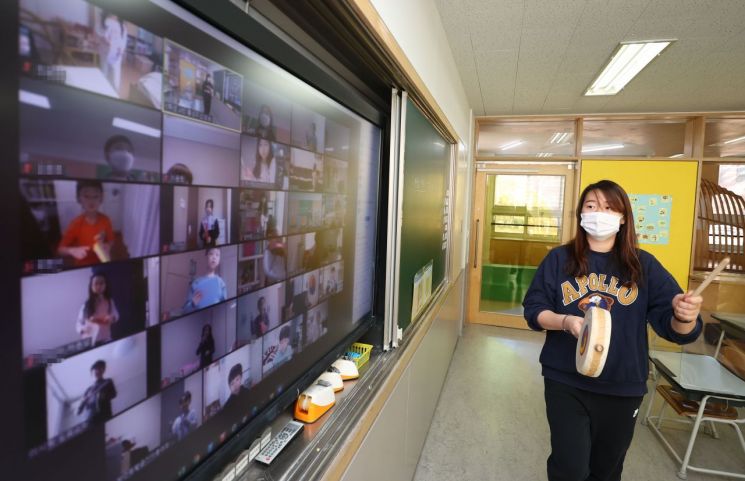 The photo shows remote classes taking place on the morning of December 15 last year at Hwarang Elementary School in Nowon-gu, Seoul.
 [Image source=Yonhap News]
[Asia Economy Yeongnam Reporting Headquarters, Reporter Park Dong-wook] The Daegu Metropolitan Office of Education, which announced a policy for interactive remote classes for all schools until the end of February, is causing confusion at frontline schools due to the lack of clear protection measures for students in emergency care.
According to the Daegu Metropolitan Office of Education on the 22nd, most elementary schools will finish their winter vacation by this week, and the academic schedule will begin next week, immediately switching to remote classes.
The problem lies with the 'emergency care' students who are unable to participate in remote classes alone at home. Until now, emergency care students have been supervised in the classroom in the morning and protected by 'emergency care helpers' in the afternoon.
However, the situation changed as on-site homeroom teachers protested that they could not simultaneously educate emergency care students while conducting remote classes via video in the classroom.
The Daegu Teachers' Union is currently conducting a solidarity signature campaign, claiming that the Office of Education is forcing interactive classes for all subjects and all sessions, infringing on teachers' autonomy in teaching. They particularly complain that if emergency care students use tablet PCs individually in the classroom, the 'howling' (echo) phenomenon makes it impossible to properly conduct video classes.
Since the remote class process is considered regular class time, emergency care helpers cannot be deployed, and if other subject teachers or separately contracted staff are hired, it directly affects the school budget, making schools reluctant to do so.
A Daegu Metropolitan Office of Education official explained in a phone call with a reporter, "We plan to support schools by appointing contract teachers or retired teachers at each school to assist with morning remote classes."
Regarding this, a school official complained, "Until recently, supervisors visited frontline schools and the Office of Education has been forcing only real-time interactive classes," adding, "There has been no official document from the Office of Education containing specific solutions to smoothly implement remote classes and emergency care."
© The Asia Business Daily(www.asiae.co.kr). All rights reserved.
![Clutching a Stolen Dior Bag, Saying "I Hate Being Poor but Real"... The Grotesque Con of a "Human Knockoff" [Slate]](https://cwcontent.asiae.co.kr/asiaresize/183/2026021902243444107_1771435474.jpg)
















