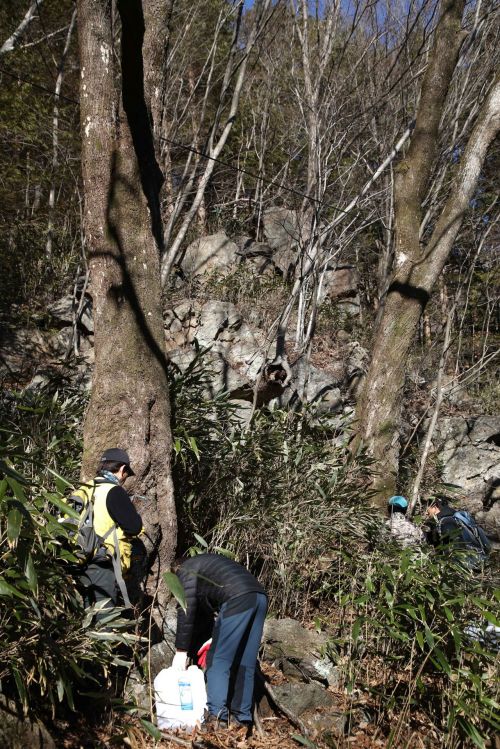
[Gurye=Asia Economy Honam Reporting Headquarters, Reporter Yuk Miseok] The thousand-year mystery of Gurye Gorosoe is a medicinal water with history and tradition, and according to historical records, sap collection began during the Three Kingdoms period.
Every year, when the Gorosoe sap collection season arrives, the daily life in the mountains of Gurye, surrounded by Jirisan and Baegunsan, becomes extremely busy.
Despite disruptions to the "Gorosoe Sap Collection Education," which was held every January 10th at the "Seomjin Art Hall" in Gurye-eup due to the impact of COVID-19, the sweat and passion of Gorosoe producers striving to extract high-quality sap seem unstoppable by the pandemic or the recent severe cold wave sweeping the nation.
According to Gurye County on the 19th, the area for sap collection covers 12,000 hectares around Jirisan and Baegunsan, with 270 farms producing 822,244 liters annually, generating approximately 2.6 billion KRW in income.
According to the sap component analysis conducted by the Jeollanam-do Health and Environment Research Institute, Gorosoe sap contains abundant nutrients such as calcium, magnesium, glucose, and minerals.
Gurye Gorosoe sap is collected from pristine high-altitude areas above 600m to 1000m, including Jirisan and Baegunsan, and is known to help with arthritis, neuralgia, and urinary diseases, as well as having excellent effects on diabetes, hypertension, fatigue recovery, and hangover relief.
Although sap is now collected nationwide, 30 to 50 years ago, it was produced only in certain areas like Jirisan and Baegunsan. Many people traveled on foot to Gurye, spending nights in ondol rooms, drinking Gorosoe sap accompanied by salty foods such as dried pollack and squid jerky to expel bodily wastes, which was one of the healing methods of that era.
How about experiencing the winter mountain atmosphere through a snowy white Hwaeomsa-Nogodan course hike and then enjoying Gorosoe medicinal water after the hike to wash away the fatigue accumulated from a tiring daily life?
Those who wish to collect sap must obtain permission under the "Act on the Creation and Management of Forest Resources," and unauthorized collection is punishable by "imprisonment of up to 3 years" or "a fine of up to 30 million KRW," so special caution is required.
For shared forests and private forests, permission from the local government head of the relevant area allows collection for three years, and for national forests, permission is granted annually by the head of the national forest management office under the "Act on the Management and Operation of National Forests."
When drilling for collection, the principle is to drill at a height of less than 2 meters from the ground surface, with a diameter of less than 0.8 cm, and a depth of less than 1.5 cm from the woody part.
Drilling and collection are done by dispersing holes horizontally outward from the tree trunk. For trees with a breast height diameter of 10-19 cm, one hole is drilled; for 20-29 cm, two holes; and for 30 cm or more, three holes. A hose is connected, and colorless, odorless drinking water pipes and double pipes are used to collect the sap into a collection container, which goes through a purification facility to produce the Gorosoe medicinal water we drink.
© The Asia Business Daily(www.asiae.co.kr). All rights reserved.
![Clutching a Stolen Dior Bag, Saying "I Hate Being Poor but Real"... The Grotesque Con of a "Human Knockoff" [Slate]](https://cwcontent.asiae.co.kr/asiaresize/183/2026021902243444107_1771435474.jpg)















