Concerns Over Management Vacuum Following Vice Chairman Lee Jae-yong's Detention... From Group Stocks to Related Companies' Shares Shaken
KOSPI Falters, Partially Recovers Previous Day's Losses
Experts Warn "Short-Term Correction Likely... Still, Excessive Chase Buying Is Risky"
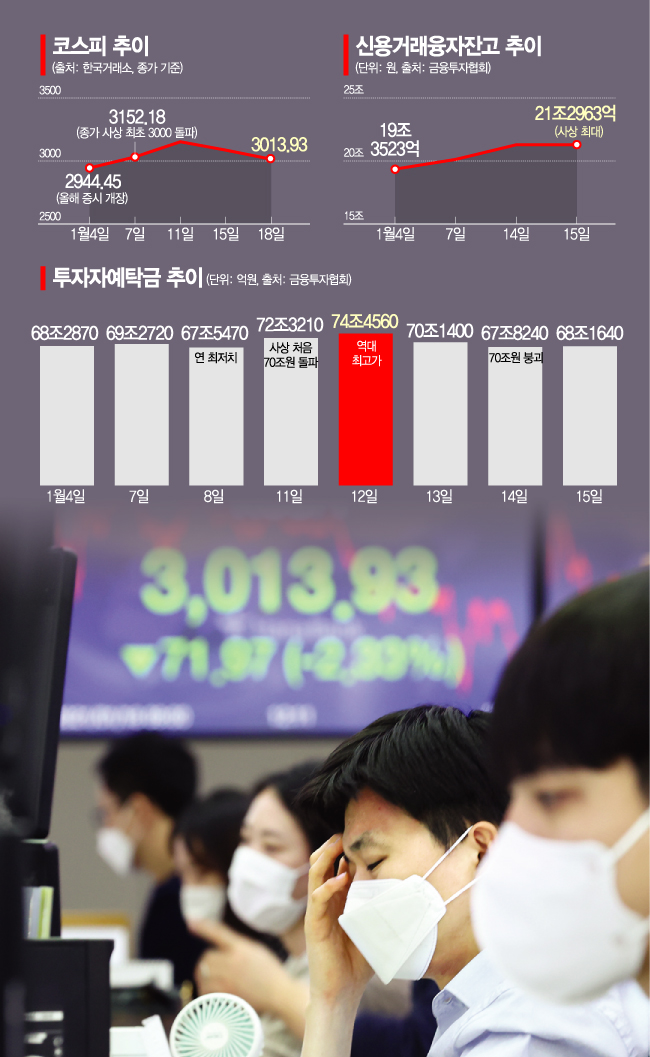
[Asia Economy Reporter Minwoo Lee] As Samsung Electronics Vice Chairman Lee Jae-yong was sentenced to prison, not only Samsung Group stocks led by Samsung Electronics but also related partner companies' stocks tumbled one after another. The stock market also faltered as the top-tier Samsung Group stocks by market capitalization wavered. As the stock market, which had been charging ahead like a locomotive without brakes, stalled, concerns arose about a possible breakdown of the 3000-point level and a market correction. However, there was also a considerable diagnosis that this was a calibration-type adjustment between the real economy and the stock market.
◆From Samsung Group stocks to related stocks, ‘staggering’= According to the Korea Exchange on the 19th, Samsung Electronics closed at 85,000 KRW, down 3.41% from the previous day. After Vice Chairman Lee Jae-yong, who was involved in the political scandal, was sentenced to prison, a flood of sell orders emerged amid concerns over a decline in corporate value due to management vacuum. However, as of 9:55 a.m. that day, a buying spree at the low price pushed the stock back up to 86,300 KRW.
Previously, the Seoul High Court Criminal Division 1 (Presiding Judges Jeong Jun-young, Song Young-seung, Kang Sang-wook) sentenced Vice Chairman Lee, who was indicted on charges including bribery, to 2 years and 6 months in prison and ordered his immediate detention. The court recognized the charges that Lee handed over 8.68 billion KRW of company funds to former President Park Geun-hye and Choi Seo-won (formerly Choi Soon-sil) in exchange for cooperation in Samsung Group’s management succession as guilty. Right after this news broke, Samsung Electronics’ stock price dropped to 84,100 KRW at around 2:32 p.m. the previous day.
Samsung Group stocks also fell one after another. This is interpreted as reflecting concerns about the group’s governance structure and overall management. Samsung C&T, which is effectively the holding company of Samsung Group and where Vice Chairman Lee is the largest shareholder, fell 6.84% from the previous day. Samsung SDI (-4.21%), Samsung Life Insurance (-4.96%), and Samsung Fire & Marine Insurance (-2.42%) also declined consecutively. Hotel Shilla, which had been in the red, surged vertically right after Lee’s sentencing, rising as much as 7% to 90,900 KRW at one point, but then gave up all gains and closed down. Hotel Shilla is led by Lee Boo-jin, Lee Jae-yong’s sister.
As Samsung Electronics’ stock price wavered, related partner companies’ stocks also staggered. PSK (-4.52%), Dongjin Semichem (-3.69%), Solbrain (-2.98%) all closed lower in succession. These declines were steeper than the KOSPI’s 2.33% drop the previous day. Amid expectations of a semiconductor super boom and supply shortages, concerns arose that various investments and business developments could be disrupted due to Vice Chairman Lee’s prison sentence.
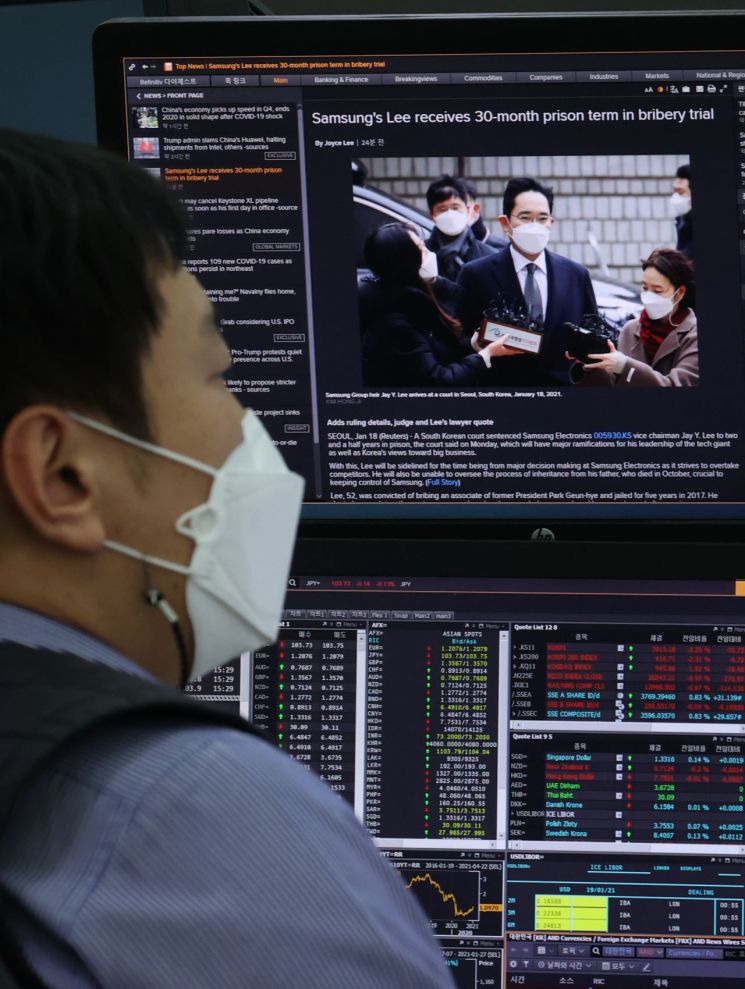 On the afternoon of the 18th, an employee at the Hana Bank headquarters dealing room in Euljiro, Jung-gu, Seoul, is displaying news related to the court-ordered detention of Samsung Electronics Vice Chairman Lee Jae-yong on a computer monitor.
 [Image source=Yonhap News]
◆Not a trend decline but a short-term correction… cautious investment needed= As of 9:55 a.m. that day, the KOSPI recovered about 1.1% to 3044.99 compared to the previous day. It appeared to have somewhat recovered from the sharp drop of more than 60 points in just one day. However, it still struggles to regain the 3100 level sustained last week. The KOSPI, which rose to 3266.23 intraday on the 11th, is now under threat of falling below 3000 due to continued weakness.
Experts view the recent volatility as a short-term ‘breather’ correction following a steep rise. Yoon Chang-yong, head of the research center at Shinhan Financial Investment, explained, “The previous rise was just a speed issue where prices rose too quickly; it cannot be seen as a bubble in terms of price level. Since the end of last year, the market has been moving on expectations that the nightmare of COVID-19 can be shaken off and that we can return to some normalcy.” He added, “These expectations were priced in starting November last year, leading to the rise. Because the current price level is higher than in the past, volatility may be greater, but its impact will gradually diminish.”
Lee Seung-woo, head of the research center at Eugene Investment & Securities, analyzed, “The rise of about 1000 points since the end of October last year was somewhat excessive, and there were many conditions for a correction. The increase in the 10-year U.S. Treasury yield and the government’s caution about the rapid rise in stock prices provided an excuse for the correction triggered by Vice Chairman Lee’s sentencing.” He explained that with COVID-19 vaccines released this year and corporate earnings outlooks positive compared to last year, the upward trend is expected to continue after a correction for the time being.
However, there are concerns that excessive chase buying targeting the recent market bottom is dangerous. This is based on the judgment that further corrections are quite possible. As the recent correction unfolded, individual investors’ buying momentum appears to have intensified. According to the Korea Financial Investment Association, investor deposits, which are standby funds for the stock market, reached a record high of 74.456 trillion KRW on the 12th. After the KOSPI dropped by up to 100 points in one day on the 15th, the deposits decreased to 68.164 trillion KRW. This suggests strong buying inflows, judging the market to be at a bottom. Margin loan balances, which represent credit transactions where investors borrow to invest in stocks, also hit a record high of 21.2963 trillion KRW that day. Individual investors net bought 2.1139 trillion KRW worth of stocks in the KOSPI alone on that day.
Economist Lee Jong-woo pointed out, “A full-scale correction may come in 1 to 2 months. Stock prices have risen a lot, and liquidity has been supplied as much as possible, but if economic indicators do not meet the expected levels, it will inevitably be reflected in stock prices.”
© The Asia Business Daily(www.asiae.co.kr). All rights reserved.
![Clutching a Stolen Dior Bag, Saying "I Hate Being Poor but Real"... The Grotesque Con of a "Human Knockoff" [Slate]](https://cwcontent.asiae.co.kr/asiaresize/183/2026021902243444107_1771435474.jpg)
















