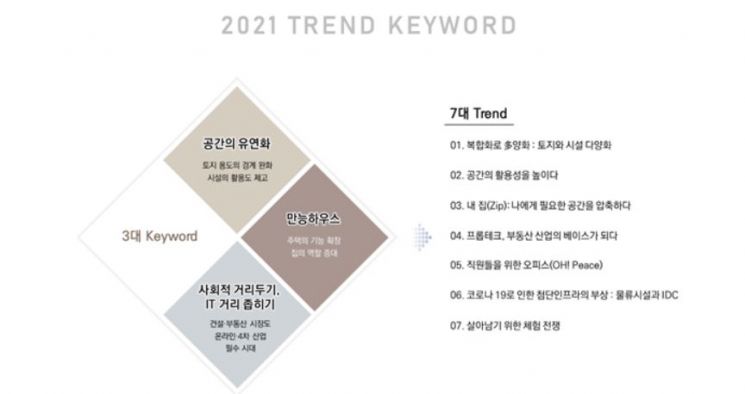
[Asia Economy Reporter Yuri Kim] The three major keywords for this year's real estate trends have been selected as 'flexibility of space,' 'all-purpose house,' and 'narrowing the gap between social distancing and IT distance.'
On the 13th, R2 Korea Real Estate Investment Advisory announced this through the 2021 Real Estate Trends jointly released with Heerim Architects· Korea Gallup. 'Flexibility of space' reflects the trend where the boundaries of land use, which form the foundation of modern urban planning, are relaxed, making spaces that were strictly divided into residential and commercial facilities more flexible. 'All-purpose house' focuses on the expanding functions of homes, which, due to the increased telecommuting and prolonged distancing caused by COVID-19, now serve not only as living spaces but also as workplaces and community hubs. 'Narrowing the gap between social distancing and IT distance' is a phenomenon emerging after COVID-19, where the integration of information and communication technology (ICT) is driving changes in various facilities such as offices, commercial, and logistics in the construction and real estate markets, making it a key keyword.
Based on these three major keywords, seven construction and real estate industry trends were derived. The selected trends are ▲ diversification through complexification ▲ expansion of space utilization ▲ home(zip), compression of necessary spaces ▲ proptech ▲ office for employees (OH! Peace) ▲ rise of advanced infrastructure ▲ experiential battles for survival. Although these seven trends became prominent due to COVID-19, R2 Korea stated that they began before the pandemic due to changes in social environment and economic conditions and will continue even after COVID-19 ends.
First, the preference for complex complexes combining apartments, offices, and cultural facilities is expected to increase. Convenience is prioritized over residential comfort, and mixed-use buildings with various functions can enhance the utility of urban land, creating a win-win situation for both demand and supply sides. The public sector also plans to expand public services through complex buildings combining various uses such as community centers, youth housing, and schools. Recently, shop-in-shop commercial spaces have also been increasing.
Along with complexification that incorporates various uses into one space, the utilization of space, which allows one space to be used in diverse ways, is also gaining attention. After COVID-19, the role of homes has expanded to include work and community functions, and with the increase of essential home appliances such as dishwashers, dryers, and clothing care devices, space utilization has become more important than ever. Designing and configuring customized storage spaces tailored to consumer needs and appropriate space arrangements considering various appliances are becoming increasingly crucial.
Although time spent at home has increased due to COVID-19, lifestyle patterns vary by age group. Young people enjoy digital life alone, have simple meals, and occasionally enjoy home parties with acquaintances. In contrast, middle-aged people value nature-friendly and nutritious meals and prioritize offline shopping and gatherings. Even apartments of the same size are expected to be compressed into completely different spaces depending on the residents. Along with this, the interior industry for unique spaces is rapidly growing.
In the traditional construction and real estate industry, the use of proptech has become an essential competitive edge. From drone-based construction site monitoring, AI design proposals, brokerage support through big data analysis, to cutting-edge logistics systems combined with IT, proptech research and adoption across all industrial sectors for systematic management, cost reduction, and competitiveness enhancement is becoming a trend.
With diverse work styles due to COVID-19 and the development of advanced industries emphasizing a few talented individuals, office space efficiency is becoming important. Moving away from traditional assigned seating, functional space configurations such as personal workspaces, recharge areas, and collaboration spaces are expected to maximize employees' concentration and ideas. Office management services are also anticipated to shift from facility management to care services for employee health and environment, as well as crisis response systems, becoming important trends.
The advanced logistics market is expected to boom due to the development of the online industry, but as competition among logistics centers intensifies, logistics facilities on the outskirts of cities are becoming large smart logistics centers equipped with automated systems, while urban logistics centers are becoming smaller hubs for faster delivery. Demand for communication infrastructure is also increasing with the growth of the online industry and the 4th industrial revolution, leading to an increase in large corporate data center construction and active competition among local governments to attract them. The rise of advanced industries is an unstoppable trend across all sectors, so fierce competition is expected in the construction and real estate industries for leadership in next-generation advanced infrastructure industries such as smart city construction.
Due to COVID-19, the shift to online industries, small-scale gatherings, and non-face-to-face outdoor activities in non-urban areas are increasing, threatening the survival of traditional commercial spaces. Instead of single-function commercial facilities, they are being organized into concept-type complex spaces that induce visitor activities, stay, and consumption, seeking breakthroughs through experiential stores that combine consumer demands and supplier marketing. In particular, experiential spaces, which were previously aimed at enhancing brand image, are now attracting consumers by integrating various new technologies such as augmented reality (AR), 5GX, and ICT content.
© The Asia Business Daily(www.asiae.co.kr). All rights reserved.
![Clutching a Stolen Dior Bag, Saying "I Hate Being Poor but Real"... The Grotesque Con of a "Human Knockoff" [Slate]](https://cwcontent.asiae.co.kr/asiaresize/183/2026021902243444107_1771435474.jpg)















