[Asia Economy Reporter Eunmo Koo] The weakness of the US dollar is deepening again as the new year begins. This is due to growing expectations for aggressive economic stimulus measures following the inauguration of US President-elect Joe Biden. As the dollar weakens, the returns of dollar inverse exchange-traded funds (ETFs), which profit when the dollar declines, are rapidly rebounding.
According to the Seoul foreign exchange market on the 5th, the won-dollar exchange rate closed at 1,082.1 won, down 4.2 won from the previous trading day's closing price. During the session, it fell to as low as 1,080.3 won, marking the lowest level in about two years and seven months since June 12, 2018 (intraday low of 1,072.7 won). The closing price matched last month's lowest level recorded last year.
The dollar appeared to strengthen last month but weakened again toward the end of the year. As the dollar weakens, inverse ETFs betting on the dollar's decline are rebounding. According to the Korea Exchange, KOSEF US Dollar Futures Inverse closed at 11,100 won, up 0.45% (50 won) from the previous trading day, continuing a five-day consecutive rise. This is a 52-week high based on the closing price.
TIGER US Dollar Futures Inverse 2X and KODEX US Dollar Futures Inverse 2X rose 4.6% over the past five trading days, while KOSEF US Dollar Futures Inverse 2X (synthetic) also showed a 4.5% return. During the same period, KODEX US Dollar Futures Inverse and KOSEF US Dollar Futures Inverse increased by 2.4% and 2.3%, respectively.
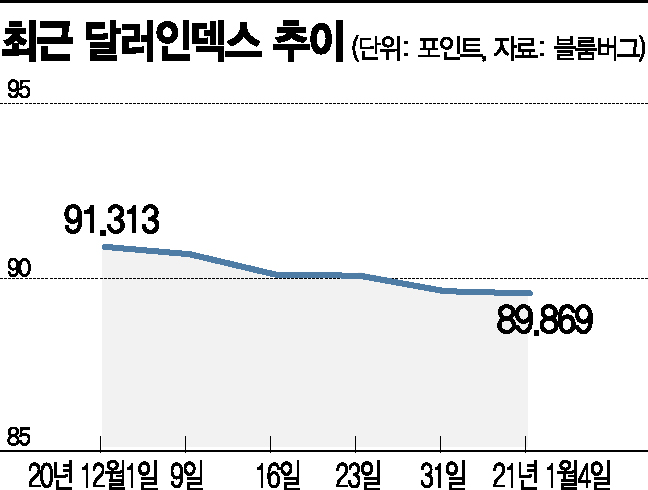
The recent expansion of downward pressure on the dollar is attributed to the unexpected signing of an additional economic stimulus package by US President Donald Trump, which removed the remaining uncertainty risks from last year and strengthened risk asset preference, including a global stock market rally led by the US. According to Bloomberg, the dollar index (DYX), which closed last year at 89.937 points, also closed below the 90 mark on the first day of this year, January 4.
The weak dollar trend is expected to continue for the time being. Although COVID-19 is still rampant, the dollar's weakness sentiment is likely to strengthen due to policy expectations following Biden's inauguration. Sanghyun Park, a researcher at Hi Investment & Securities, said, "Expectations for 'Bidenomics' following President Biden's inauguration this month are highly likely to further strengthen the dollar's weak sentiment," adding, "Moreover, the ultra-strong rally in the global stock market will enhance risk asset preference and increase expectations for further dollar weakness."
Particular attention should be paid to the runoff election for the Georgia Senate seats held on the 5th local time. If the Democratic Party wins both seats in the Georgia Senate election, the Democrats will control the Senate as well, potentially giving more momentum to Bidenomics.
However, the speed and extent of the dollar's weakness this year are expected to be moderate. Hyojin Kim, a researcher at KB Securities, said, "We expect the dollar to continue weakening this year due to expanding current and fiscal deficits and a accommodative monetary policy stance," but added, "Since the dollar index has already fallen by 7% since July last year, the pace of dollar weakness this year will be gradual."
© The Asia Business Daily(www.asiae.co.kr). All rights reserved.
![Clutching a Stolen Dior Bag, Saying "I Hate Being Poor but Real"... The Grotesque Con of a "Human Knockoff" [Slate]](https://cwcontent.asiae.co.kr/asiaresize/183/2026021902243444107_1771435474.jpg)















