Astrocytes Remove Unnecessary Synapses
Why the Adult Brain Maintains Memory
Potential Applications in Treating Brain Disorders
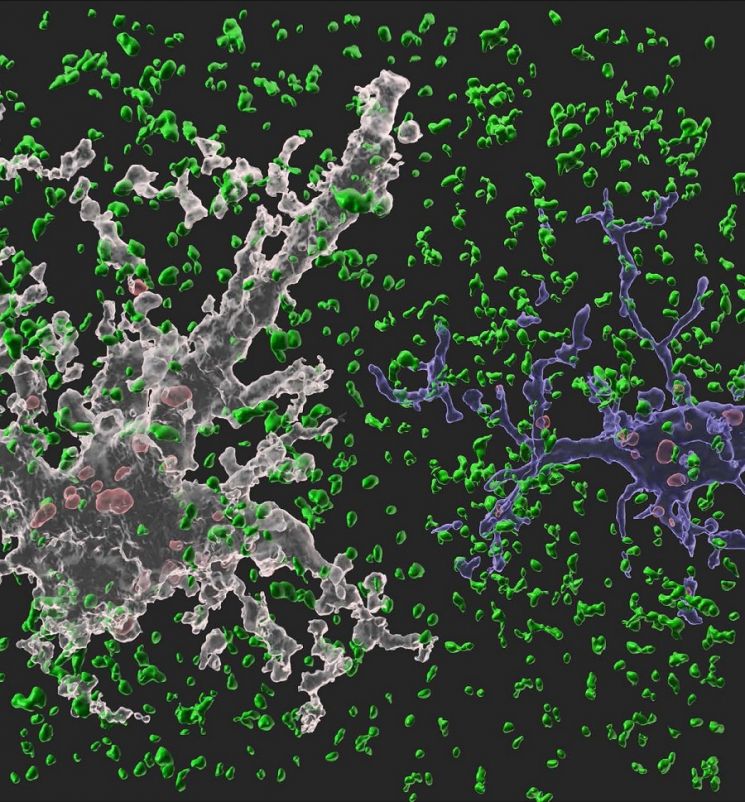
[Asia Economy Reporter Junho Hwang] A research team in South Korea has uncovered the principle by which the adult brain maintains memory. By elucidating how brain cells operate, they revealed the mechanism behind memory retention, which is expected to contribute to the treatment of brain disorders such as schizophrenia and dementia in the future.
The Korea Advanced Institute of Science and Technology (KAIST) announced on the 5th that Professor Won Seok Jeong and doctoral candidate Junhyuk Lee from the Department of Life Sciences, in collaboration with Dr. Hyungjoo Park and researcher Jiyoung Kim from the Korea Brain Research Institute, have for the first time identified a previously unknown brain homeostasis maintenance mechanism through their research, published in the international journal Nature.
In the hippocampus, responsible for learning, memory, and recognition in our brain, when learning or memory formation occurs, synapses?the junctions between neurons (nerve cells) or between neurons and other cells?disappear and new synapses form, a process called 'synapse remodeling.' However, how synapses disappear and what role this synapse elimination plays during learning and memory processes had not been understood.
The research team based their study on Professor Won Seok Jeong’s prior research (Nature, 2013), which showed that among the various neuroglial cells performing diverse roles in the central nervous system, the most numerous 'astrocytes' consume synapses during brain development. They discovered that astrocytes continuously remove unnecessary synapses even in the adult brain. Furthermore, they demonstrated that this phenomenon enables the maintenance of excitatory synaptic circuits in the hippocampus, which is crucial for learning and memory.
The team developed a virus-based synapse phagocytosis reporter that induces a combination of fluorescent proteins (mCherry and eGFP) capable of detecting acidification in synapses, bringing them closer to uncovering the secrets of memory. The fluorescent proteins they developed maintain their original fluorescence intensity in neutral (pH) environments. However, in acidic environments such as cellular digestive organelles, the eGFP protein rapidly disappears, while the mCherry protein degrades slowly, maintaining the signal. The researchers expressed this in excitatory or inhibitory synapses and later confirmed that synapses engulfed by neuroglial cells were observed as signals from mCherry protein alone, unlike synapses marked by both mCherry and eGFP. Notably, the team observed that astrocytes in the adult hippocampus continuously remove synapses, particularly eliminating more excitatory synapses.
The research team also confirmed through this study that astrocytes, known as brain immune cells, predominantly remove excitatory synapses in the normal hippocampus, more so than microglia. This overturns the existing theory that microglia are the main cells responsible for synapse removal.
Furthermore, they found that genetically modified mice with inhibited synapse removal function of astrocytes exhibited problems in synaptic connectivity plasticity and memory formation within the hippocampus. This indicates that if astrocytes do not remove unnecessary synapses, normal learning and memory abilities of the brain cannot be maintained.
Through these findings, the research team proposed that excitatory synapse remodeling by astrocytes in the adult brain is an essential mechanism for maintaining normal neural circuits and memory formation. The team stated, "Abnormal changes in synapse numbers are highly correlated with the prevalence of various neurological disorders such as autism spectrum disorder, schizophrenia, dementia, and various forms of seizures," adding, "Regulating the synapse-eating activity of astrocytes to restore synapse numbers to normal could be a new strategy for treating these brain disorders."
 Lee Junhyuk, PhD candidate at Korea Advanced Institute of Science and Technology (from left), Professor Jeong Wonseok, Dr. Park Hyeongju at Korea Brain Research Institute, and student Kim Jiyoung
© The Asia Business Daily(www.asiae.co.kr). All rights reserved.
![Clutching a Stolen Dior Bag, Saying "I Hate Being Poor but Real"... The Grotesque Con of a "Human Knockoff" [Slate]](https://cwcontent.asiae.co.kr/asiaresize/183/2026021902243444107_1771435474.jpg)
















