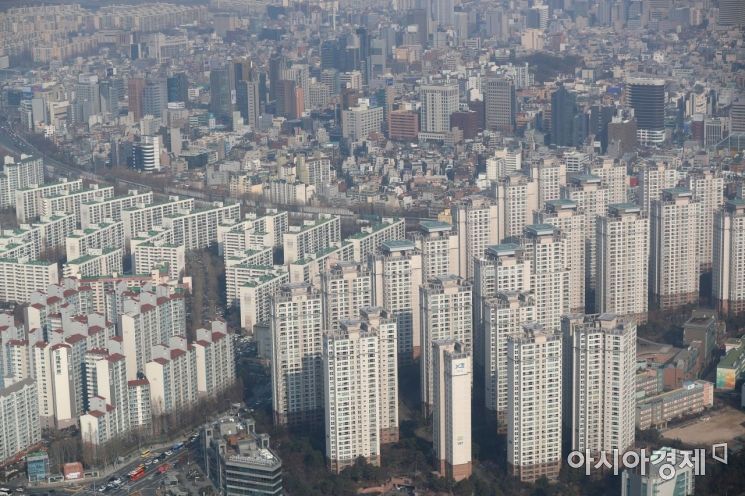
[Asia Economy Reporter Yuri Kim] After a period of stabilization, Seoul apartment sale prices are once again expanding their rate of increase. The upward trend is being led by outer Seoul areas densely populated with mid- to low-priced apartments. Amid ongoing rising home prices and growing anxiety that 'if not now, it won't be possible to buy,' combined recently with a rental housing shortage, the buying sentiment for low-priced apartments is showing signs of revival.
According to Real Estate 114 on the 6th, as of last week (December 4), Seoul apartment sale prices rose by 0.09% compared to the previous week. From late October (as of October 23), the increase rate hovered around 0.5?0.6% for about a month, then slowed to 0.08% in the last week of November, before expanding again to 0.09% last week. While Nowon-gu had surged previously, last week saw Dobong (0.19%), Gangbuk (0.16%), and Guro (0.14%) take over the top spots in the rate of increase.
The background to the rise in mid- to low-priced apartments involves a complex interplay of several factors, including years of rapidly increasing home prices and tightened loan regulations following the December 16 measures last year. As a result, the upward trend in outer Seoul areas has been clear since early this year. According to KB Real Estate Live On, among Seoul’s autonomous districts, Nowon-gu recorded the highest cumulative increase rate of 19.02% from the start of this year through November. Other outer Seoul districts such as Guro-gu (15.04%), Gangbuk-gu (15.02%), Seongbuk-gu (13.88%), and Geumcheon-gu (13.40%) also showed prominent upward trends.
As the price increase rate of mid- to low-priced apartments grew relatively larger, the 5-quintile ratio of Seoul apartment prices also narrowed the gap. According to an analysis of monthly housing price trends by Yang Ji-young R&C Research Institute and KB Real Estate Live On, the 5-quintile ratio of Seoul apartment prices was 4.0 as of November, down 0.2 from the previous month. The 5-quintile ratio is the average price of the top 20% (5th quintile) of apartments divided by the average price of the bottom 20% (1st quintile). A higher ratio means a larger price gap between the top 20% and bottom 20%. The Seoul apartment 5-quintile ratio had been rising since it recorded 4.0 in December 2015 but has now fallen back to 4.0 after five years.
In November last year, the sale price of 1st quintile apartments in Seoul rose 28% from 365.24 million KRW to 467.20 million KRW this November, whereas the 5th quintile rose only 10% from 1.71744 billion KRW to 1.88619 billion KRW in the same period. The price increase speed of mid- to low-priced apartments is significantly outpacing that of high-priced apartments.
Yang Ji-young, head of Yang Ji-young R&C Research Institute, said, "Recently, the 20s and 30s generation have been purchasing mid- to low-priced apartments in Seoul due to 'panic buying' and other factors, and with the recent severe rental housing shortage, the mood has strengthened to buy rather than rent." She added, "Since buying sentiment remains strong, the atmosphere of purchasing low-priced apartments, which are relatively free from loan restrictions, is likely to continue for the time being."
Yoon Ji-hae, senior researcher at Real Estate 114, also said, "As the burden of jeonse (long-term deposit lease) and monthly rent increases, some tenant demand is shifting to purchase demand. While the rise in jeonse prices has somewhat slowed, sale prices have increased for two consecutive weeks. Until a smooth supply of jeonse and monthly rental housing is secured, this current atmosphere is expected to continue for a considerable period."
© The Asia Business Daily(www.asiae.co.kr). All rights reserved.
![Clutching a Stolen Dior Bag, Saying "I Hate Being Poor but Real"... The Grotesque Con of a "Human Knockoff" [Slate]](https://cwcontent.asiae.co.kr/asiaresize/183/2026021902243444107_1771435474.jpg)
















