[Next Year's Comprehensive Real Estate Tax Saving Guide]
Individual Combined Taxation Applied
Exemption of 600 Million KRW Per Person Means No Comprehensive Real Estate Tax
Elderly and Long-Term Holders Benefit from Single Ownership
Up to 80% Tax Credit
To Reduce Capital Gains Tax for Multi-Homeowners
Dispose of Houses by May Next Year
[Asia Economy Reporter Lee Chun-hee] As the comprehensive real estate tax (종합부동산세) notices begin this year, both the tax amount and the number of households subject to the tax have increased, and the government plans to raise the tax rate to 6% next year, causing greater concern among homeowners.
In particular, multi-homeowners face even heavier burdens as capital gains tax is also increased, leaving them with few options. As a result, many owners of high-priced homes are adopting tax-saving strategies to minimize their tax burden and endure the situation for the time being.
We explored ways to save on next year's comprehensive real estate tax.
◇ The key to tax saving is ownership distribution = The comprehensive real estate tax applies a rate of 0.5% to 2.7% based on the taxable value for owners of two or fewer homes. For owners of three or more homes, a higher rate of 0.6% to 3.2% is applied.
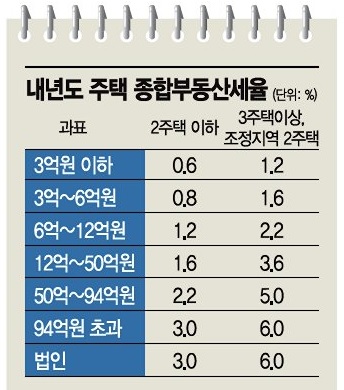
These rates will increase next year. Following the amendment of the comprehensive real estate tax law in August, the rates for owners of two or fewer homes will rise slightly to 0.6% to 3.0%, while those for owners of three or more homes will be significantly raised to 1.2% to 6.0%. Especially, owners of two homes in regulated areas will face the same heavy tax as general owners of three homes.
Experts advise that the key to saving on the comprehensive real estate tax is the 'name' on the ownership. This is because the tax is calculated on an individual basis rather than by household. For example, if a house with a publicly announced price of 1.1 billion KRW is owned solely by one person, a taxable value of 200 million KRW is set after excluding 900 million KRW, and a 0.6% tax rate will be applied next year. However, if a couple owns the property jointly with half shares each, each person's publicly announced price is 550 million KRW, so each can apply a 600 million KRW deduction, resulting in no comprehensive real estate tax.
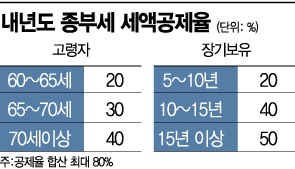
◇ Joint ownership can be disadvantageous for elderly and long-term owners = Joint ownership is not always advantageous. Currently, the comprehensive real estate tax offers tax credits to single-homeowners who have held the property for a long time or are aged 60 or older. In particular, the elderly tax credit, currently 10-30%, will increase by an additional 10 percentage points each from next year, raising the credit rate to 20-40%. Combined with the long-term holding credit, those aged 65 or older with ownership of 15 years or more can receive up to an 80% tax credit.
However, these tax credits apply only to single-name single-homeowners. The industry analyzes that for homes with a publicly announced price of roughly 1.5 billion KRW or more, holding the property under a single name with long-term ownership is more advantageous. However, even if a jointly owned home is converted to single ownership, the long-term holding period is calculated from the date of conversion to single ownership, not from the initial acquisition date.
◇ The calculation for multi-homeowners is more complex = Multi-homeowners need to consider more complex factors regarding ownership. A typical case is owning two homes in regulated areas and one home in non-regulated areas. If one spouse holds the ownership of all homes in regulated areas and the other spouse holds the ownership of the home in a non-regulated area, the two homes in the regulated areas will be subject to heavy taxation. To avoid this, it is more tax-efficient to hold each regulated area home under separate single ownership and hold the non-regulated area home under one person's single ownership or joint ownership.
If a portion of the home is inherited, this also requires careful review. When a home is inherited and jointly owned, if the share exceeds 20% or the share's publicly announced price exceeds 300 million KRW, it is counted as a separate home for tax rate application purposes.
◇ Disposing of surplus homes must be done by the end of May next year = To avoid these tax rate increases, it is advisable to consider selling before May next year. The comprehensive real estate tax is imposed based on properties held as of June 1 each year. Moreover, capital gains tax will also be significantly strengthened next year. For homes held less than two years, a separate tax rate of up to 70% will be applied, unlike the basic rate of 6-42%, to recoup short-term gains. Additionally, multi-homeowners in regulated areas will face an additional tax rate increase of up to 30 percentage points.
Experts advise that when preparing these tax-saving measures, one should consider not only the comprehensive real estate tax but also other taxes. Woo Byung-tak, team leader of Shinhan Bank's Real Estate Investment Advisory Center, said, "Although the comprehensive real estate tax calculation is complex, the cases are not complicated, so the tax-saving methods are simple. However, when changing ownership, joint ownership also has advantages such as reducing capital gains tax upon sale later, so one should not think solely about saving on the comprehensive real estate tax."
© The Asia Business Daily(www.asiae.co.kr). All rights reserved.
![Clutching a Stolen Dior Bag, Saying "I Hate Being Poor but Real"... The Grotesque Con of a "Human Knockoff" [Slate]](https://cwcontent.asiae.co.kr/asiaresize/183/2026021902243444107_1771435474.jpg)















