KOTI Researcher Han Jaehyun: "Air Passenger Demand Recovery, Earliest April 2022... If Late, After 2023"
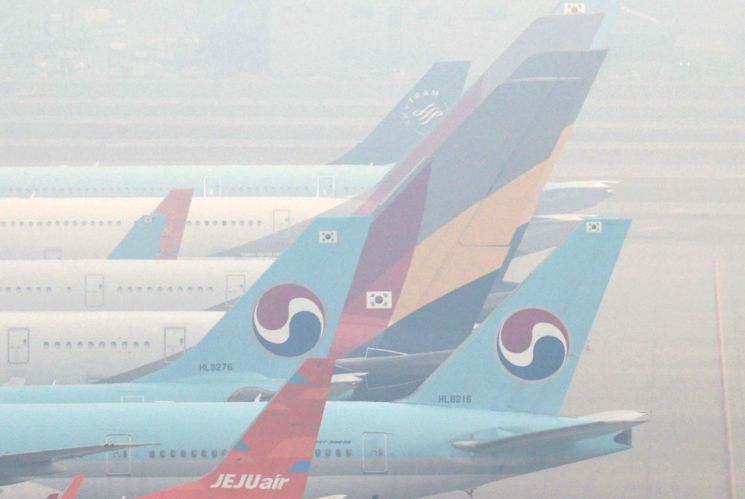
[Asia Economy Reporter Yoo Je-hoon] Although the restructuring of domestic airlines has been accelerated by Korean Air's push to acquire Asiana Airlines, it is forecasted that it will take at least two years for the aviation industry to return to normal due to the impact of the novel coronavirus disease (COVID-19) pandemic.
According to the aviation industry on the 27th, Jae-hyun Han, a research fellow (head of the Aviation Safety and Technology Team) at the Korea Transport Institute (KOTI), recently revealed this in a presentation titled "2021 Aviation Demand Forecast" at the Aviation Industry Outlook Seminar hosted by the Korea Air Transport Association.
In this study, next year's air passenger demand is predicted to grow by 34% for domestic flights and decrease by 51% for international flights compared to the performance from January to October this year. However, excluding the period of January to February this year when the impact of COVID-19 was minimal, international flights are also expected to show a slight recovery next year.
Despite the modest recovery forecast, it is expected to take considerable time to return to pre-COVID-19 levels. Based on the trend during the Severe Acute Respiratory Syndrome (SARS) outbreak that swept the aviation industry in the early 2000s, Han analyzed that the point at which air passenger demand recovers to the level of January this year will be as early as April 2022 or as late as June 2023. This is similar to the analysis by the International Air Transport Association (IATA), which predicts the recovery of air passenger demand to the 2019 level, before the COVID-19 pandemic, around 2024.
The key to demand recovery lies in the development and distribution of COVID-19 vaccines, but there is expected to be a time lag before demand fully recovers. Although overseas pharmaceutical companies are close to developing and mass-producing COVID-19 vaccines, this does not necessarily mean a 'V-shaped' demand recovery will follow.
In fact, according to a survey disclosed by the Korea Air Transport Association at the same seminar (conducted from October 14 to 29, targeting 2,500 people), when asked about the timing of resuming overseas travel after the development of a COVID-19 vaccine, 38% of respondents pointed to "about six months later," and 12.5% chose "about one year later." Research fellow Han noted, "The biggest variable in aviation demand recovery is the development of a COVID-19 vaccine," adding, "However, even after the vaccine is actually developed, there may be a time lag before it leads to demand recovery."
Meanwhile, as the COVID-19 pandemic prolongs, discussions on 'travel bubbles' (exemption or shortening of 14-day self-quarantine between countries with excellent quarantine systems) are actively taking place among some countries including Korea. Currently, travel bubble agreements have been signed between Hong Kong and Singapore, and between Australia and New Zealand. The aviation and tourism industries also requested the implementation of travel bubbles during a recent dialogue with Prime Minister Chung Sye-kyun. However, due to the resurgence of COVID-19, existing travel bubbles are struggling to find footing, making the success of such agreements uncertain.
© The Asia Business Daily(www.asiae.co.kr). All rights reserved.
![Clutching a Stolen Dior Bag, Saying "I Hate Being Poor but Real"... The Grotesque Con of a "Human Knockoff" [Slate]](https://cwcontent.asiae.co.kr/asiaresize/183/2026021902243444107_1771435474.jpg)















