
[Asia Economy Reporter Buaeri] "In recent years, the global trend has shifted from an ownership economy to a sharing economy and subscription economy." - Yeominsu, Co-CEO of Kakao
Kakao has kicked off its subscription economy business by partnering with home appliance and furniture companies to launch subscription services. On the 18th, Kakao unveiled new businesses including subscription services (content and products) and a digital ID wallet.
Kakao Starts 'Subscription Economy'
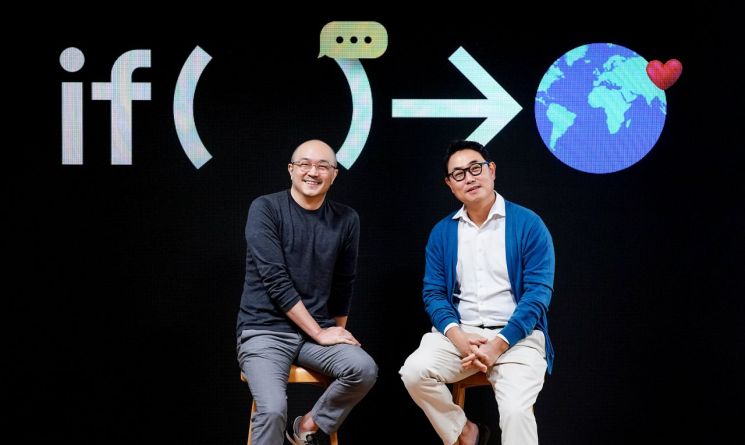
On the first day of the annual developer event 'if kakao 2020,' Kakao held a morning press conference and announced, "Starting tomorrow, we will launch KakaoTalk product subscription services in line with the subscription economy era."
The subscription economy refers to users paying a fixed amount monthly or annually to receive services regularly. As the content subscription model succeeded in online video services (OTT) like Netflix and expanded into other industries such as automobiles and home appliances, Kakao has taken its first step into this market.
Co-CEO Ye said, "Tien Zhuo of 'Zuora,' known as the founder of the subscription economy, said, 'If digitally connected, everything can be serviced and applied to a subscription model.'" He added, "Now, within KakaoTalk, users can easily select products, get verified, and conclude contracts just like online shopping."
From the 19th, users can subscribe to products via rental or regular delivery methods on KakaoTalk. Kakao will start with Winia Aid's 'Dimchae' kimchi refrigerator rental and plans to introduce subscription services for Bodyfriend massage chairs, Winix air purifiers, and Hanssem mattresses within the year. Users can handle the entire process on KakaoTalk, from membership registration, credit checks, electronic signatures and contracts, to payment.
Kakao plans to support various services in the future, including regular delivery of food and cosmetics and cleaning services, beyond home appliances and furniture. Co-CEO Ye stated, "We will expand services to home appliances, furniture, automobiles, and if there are services or areas where subscription models can be applied, we will keep the possibilities open and review them."
Kakao's subscription service is based on 'KakaoTalk,' the national messenger with 45 million monthly users in Korea. Kakao emphasizes a 'simple system' based on KakaoTalk as its differentiation strategy. Co-CEO Ye explained, "Manufacturers and brands lacked convenient subscription platforms. Subscription requires ERP (Enterprise Resource Planning) systems for periods, depreciation, and intermediary fees, and we built that. Not limiting products and expanding to services and various areas is also a point of differentiation from other subscription services."
Kakao will also introduce a 'subscription model' for content. It plans to launch a new content subscription platform in the first half of next year. Previously, Kakao provided curated news and content, but going forward, users will subscribe directly to news, music, posts, videos, and interact with them. Users can select subscription channels to create 'their own screen.' The market expects Kakao to apply the subscription economy model to digital content such as webtoons. Co-CEO Jo said, "There will be publishers who want to receive sponsorships or monthly fees in the relationship of publishing and subscribing to content. We are preparing a paid subscription model within content."
Growing to 40 Trillion Won Scale This Year
Naver has already adopted the subscription economy model, launching 'Naver Plus Membership' in June. Naver users pay 4,900 won monthly to earn up to 5% Naver Pay points based on purchase amounts in Naver Shopping and reservations. They also receive content such as 20 Naver Webtoon Cookies (currency) and 300 plays on the music platform 'Vibe.'
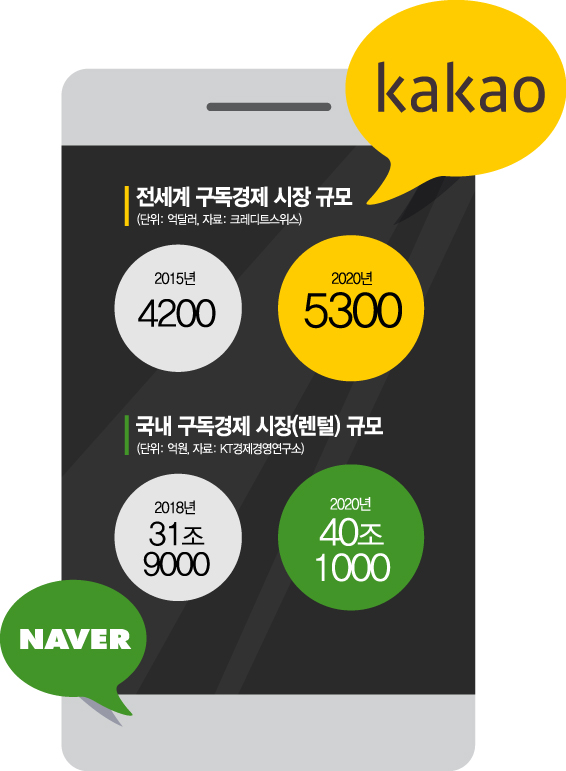
Kakao is entering the subscription economy market following Naver due to its growth potential. Global investment bank Credit Suisse forecasts the global subscription economy market to grow from $420 billion in 2015 to $530 billion in 2020. According to KT Economic Management Research Institute, the domestic market including rentals is expected to grow from 31.9 trillion won in 2018 to 40.1 trillion won in 2020.
The biggest advantage of the subscription economy model is the generation of regular income. For portals like Naver and Kakao, it offers a cash cow and the 'lock-in effect' of binding platform users through subscription services. It also suits the millennial generation (born early 1980s to early 2000s), who value 'experience' over ownership, which is why the two major portals focus on the subscription economy.
"KakaoTalk Becomes a Wallet"… Storing IDs, Certificates, and Documents
Kakao will launch a 'wallet' service within KakaoTalk by the end of the year that allows users to store and manage IDs, certificates, and documents. Users will be able to verify their identity without concerns about loss or damage.
The KakaoTalk wallet will sequentially include electronic entry logs like QR check-in and mobile driver's licenses. Regarding this, Kakao obtained ICT regulatory sandbox approval from the Ministry of Science and ICT in September. Yonsei University mobile student IDs and the Korea Industrial Manpower Corporation's national technical certificates will also be added. Co-CEO Jo said, "We focused on the inconvenience of proving identity in daily life and conceived the concept of a 'digital ID.' I think KakaoTalk could eventually completely replace physical wallets."
Kakao also introduced the 'Track Zero' service, which directly connects artists and users. 'Track Zero' means the creator's zero-th track or behind-the-scenes track, a space where artists freely upload unreleased songs to showcase to fans. Co-CEO Jo said, "We hope users build more diverse and valuable relationships through KakaoTalk, and partners expand their business through KakaoTalk. Kakao will continue to strive for a better life and tomorrow for everyone in a Kakao-like way."
© The Asia Business Daily(www.asiae.co.kr). All rights reserved.
![Clutching a Stolen Dior Bag, Saying "I Hate Being Poor but Real"... The Grotesque Con of a "Human Knockoff" [Slate]](https://cwcontent.asiae.co.kr/asiaresize/183/2026021902243444107_1771435474.jpg)

















