Meeting between Lee Nak-yeon and Kim Jong-in focuses on forced labor compensation... Parliamentary diplomacy signal replacing hardline cabinet
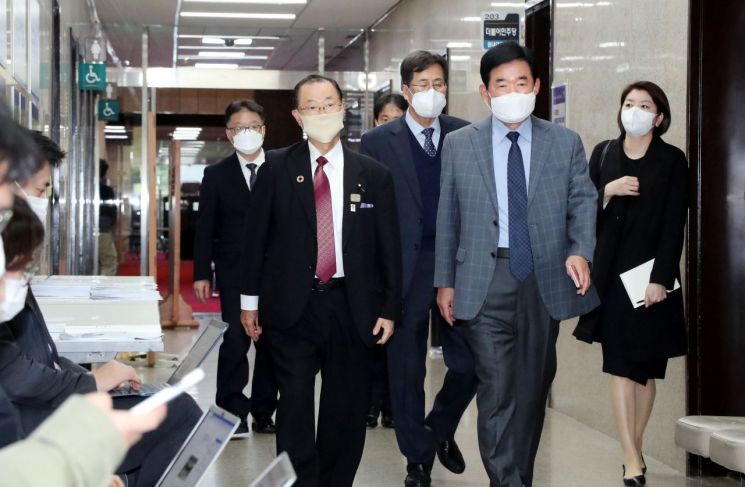
[Asia Economy Reporter Lim Cheol-young] Contacts between the political circles of South Korea and Japan are actively unfolding in search of a solution to Korea-Japan relations. Amid the renewed tension caused by Japan's unilateral actions, such as demanding the removal of the 'Statue of Peace' installed in Mitte District, Berlin, Germany, and linking the resolution of the forced labor compensation issue during Japanese colonial rule to Prime Minister Yoshihide Suga's visit to Korea, attention is focused on whether this political meeting will serve as a turning point for the restoration of bilateral relations.
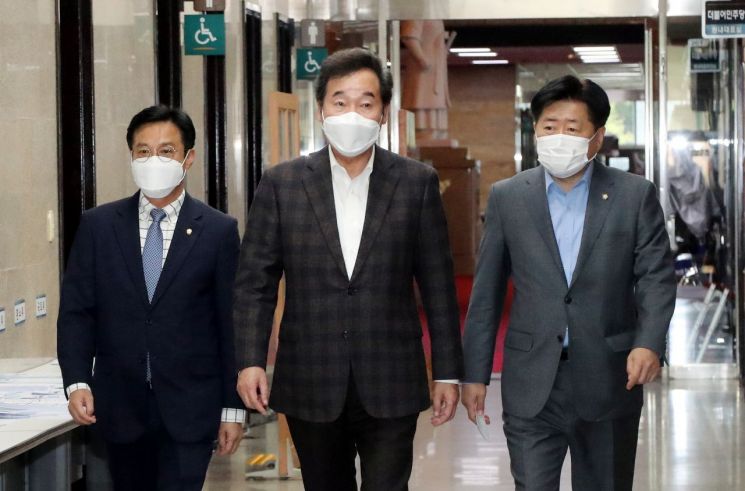
Kawamura Takeo, Secretary-General of the Japan-Korea Parliamentarians' Union, who visited Korea for three days and two nights from the 17th to the 19th to celebrate the inauguration of Kim Jin-pyo as chairman of the Korea-Japan Parliamentarians' Union, met with Lee Nak-yeon, leader of the Democratic Party of Korea, Kim Jong-in, emergency committee chairman of the People Power Party, and Park Jie-won, director of the National Intelligence Service, exchanging views on Korea-Japan relations. As Kawamura, a close aide to the Prime Minister and one of the leading pro-Korea figures in Japanese politics, met with Prime Minister Suga just before his visit to report on the visit plan, it is likely that he also conveyed messages from Prime Minister Suga.
Kawamura is believed to have focused on the issue of compensation for forced labor during Japanese colonial rule in meetings with Lee and Kim. Earlier, the Japanese side had stated that Prime Minister Suga's visit to Korea would only be possible after the Korean government made efforts to resolve the forced labor compensation issue, which is a prerequisite for the Korea-China-Japan summit planned within the year by the chair country. In response, on the 14th, Lee expressed his "deep disappointment" at the Supreme Council meeting.
In this meeting as well, both sides only confirmed a general intention that "active government-to-government consultations are necessary and that mutual wisdom should be pooled" regarding the forced labor compensation issue. Although various issues such as Japan's export restrictions and the termination of the Korea-Japan General Security of Military Information Agreement (GSOMIA) were discussed, the forced labor compensation issue appeared to be the main topic. After meeting with Lee, Kawamura explained, "We talked about creating an atmosphere for government-level talks," adding, "There are principles that both sides must observe, but under those principles, we agreed to strive to find solutions."
In particular, Kawamura reportedly mentioned the '1+1+α (alpha)' forced labor solution proposal suggested by former National Assembly Speaker Moon Hee-sang during successive meetings with ruling and opposition parties. However, the ruling party reportedly expressed the view that Moon's solution would be difficult to pass through the National Assembly before an atmosphere based on Korea-Japan cooperation is established. The bill proposed by Moon in the 20th National Assembly centers on establishing a foundation funded voluntarily by Korean and Japanese companies and citizens (1+1+α) to pay compensation to victims. The Japanese government has shown a positive view of this bill.
Regarding recent issues, both sides still revealed significant differences in perspectives. Especially concerning Prime Minister Suga sending offerings to Yasukuni Shrine, where 14 Class-A war criminals from the Pacific War are enshrined, on the 17th, the gap between the two sides was considerable. Kawamura told Lee, who expressed regret, "We are well aware of the criticisms from Korea and China, but this is a custom continued since former Prime Minister Shinzo Abe," adding, "We will accept the criticisms from both countries." This reconfirmed that Prime Minister Suga shares the same stance as former Prime Minister Abe regarding imperialist history.
Regarding the support request for Yoo Myung-hee, Director-General for Trade Negotiations at the Ministry of Trade, Industry and Energy, who advanced to the final round for the Director-General of the World Trade Organization (WTO), Kawamura gave an ambiguous response. The Korean government has resumed WTO dispute procedures against Japan's unilateral export restrictions, which have been in effect since July last year. The Japanese side has continuously opposed Yoo's election. Kawamura said, "The Japanese government has not yet decided what to do," and "I will acknowledge that there was a request from Leader Lee," avoiding a direct answer.
Choi Eun-mi, a senior researcher at the Asan Institute for Policy Studies, analyzed, "While the Suga Cabinet has not clearly shown its diplomatic stance, the relatively strong willingness for improvement in relations from the Japanese political circles is becoming more active," adding, "Given the difficulty for the Japanese side to show flexibility immediately, this visit aims to express the will to improve Korea-Japan relations through the Parliamentarians' Union and to urge a solution to the forced labor issue."
© The Asia Business Daily(www.asiae.co.kr). All rights reserved.

![User Who Sold Erroneously Deposited Bitcoins to Repay Debt and Fund Entertainment... What Did the Supreme Court Decide in 2021? [Legal Issue Check]](https://cwcontent.asiae.co.kr/asiaresize/183/2026020910431234020_1770601391.png)