Expansion of Fiscal Deficit Inevitable Regardless of US Presidential Election Outcome
Government Spending to Increase to WWI and WWII Levels... Positive Impact on Stock Market as Well
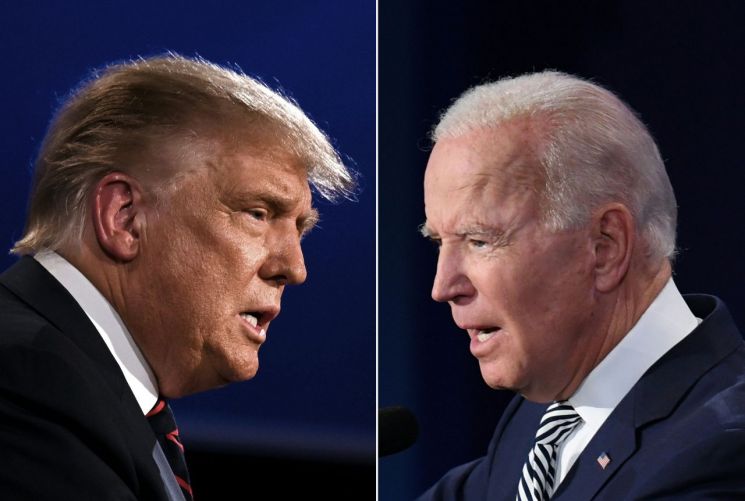 Donald Trump (left), President of the United States, and Joe Biden, Democratic presidential candidate, are having their first presidential candidate TV debate on the 29th of last month (local time) in Cleveland, Ohio. [Image source=Yonhap News]
[Asia Economy Reporter Minwoo Lee] Amid the uncertainty surrounding the U.S. presidential election and other factors, an analysis has emerged emphasizing the need to pay attention to the fiscal deficit. It is argued that fiscal and monetary policies being unleashed at wartime levels could serve as a positive signal for the stock market.
On the 17th, KB Securities stressed the importance of focusing on the U.S. fiscal deficit at this point in time. KB Securities researcher Hainhwan said, "With the prolonged COVID-19 pandemic and ongoing employment issues, economic stimulus measures are likely to pass regardless of the election outcome," adding, "From an election strategy perspective, the likelihood of the Republican Party agreeing with the Democratic Party's policy proposals is low at this stage, and the expansion of the fiscal deficit could bring significant changes to interest rates, exchange rates, and the stock market, so it deserves attention."
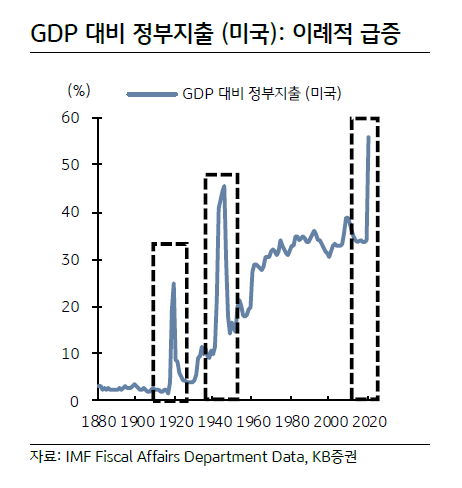
The current fiscal deficit situation was diagnosed as being close to wartime levels. Researcher Hainhwan analyzed, "To overcome the shock of COVID-19, coordination between fiscal and monetary policies has led to an exceptional increase in U.S. government spending," and added, "Comparable cases are only World War I and World War II." He continued, "Although the Democratic Party seems more proactive in expanding the fiscal deficit compared to the Republican Party, actual government spending increased more during Republican administrations," and predicted, "In other words, the determining factor for government spending is not whether it is the Republican or Democratic Party, but the economic situation, and even if President Donald Trump is re-elected, further expansion of the fiscal deficit is inevitable."
Researcher Hainhwan compared the bond and exchange rate market responses during the wartime periods of the 1910s and 1940s. Interest rates rose in the 1910s, while they remained flat in the 1940s. The limited interest rate fluctuations in the 1940s were explained as being due to Yield Curve Control (YCC). Hainhwan forecasted, "Currently, the Federal Reserve's accommodative stance is clear, but strictly speaking, it is not YCC. Based on this, if the fiscal deficit expands, interest rates are likely to rise, unlike in the 1940s, but the increase will be more limited compared to the 1910s."
The exchange rate analysis focused on the 1910s, as the 1940s had a fixed exchange rate system. Hainhwan explained, "At that time, the United Kingdom was the hegemonic power, so from the British perspective, the U.S. dollar was strong against the pound," and added, "If we replace the U.S. of that time with today's China, we can expect a weaker dollar and a stronger yuan now, which would translate into a stronger Korean won and be favorable for the Korean stock market."
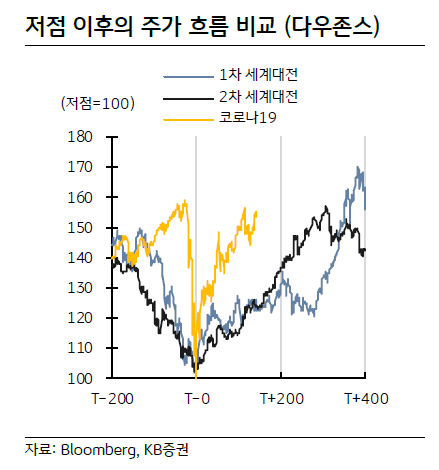
The impact on the stock market was also compared. The Dow Jones Index began rising during the war period and continued to rise for about a year after the war ended. Researcher Hainhwan said, "When comparing stock price trends from the low point, the high point after the low was about 13% higher than the previous high," and added, "This can be seen as an economic effect of the war, and since fiscal and monetary policies comparable to wartime are being deployed now, similar results can be expected in the stock market this time as well."
Therefore, while short-term corrections may occur, positive signals are continuously being confirmed. Researcher Hainhwan stated, "The expansion of the U.S. fiscal deficit is inevitable, and the resulting pressure for a weaker dollar will persist," citing "the rising KOSPI net profit forecasts since mid-September" as supporting evidence.
© The Asia Business Daily(www.asiae.co.kr). All rights reserved.
![Clutching a Stolen Dior Bag, Saying "I Hate Being Poor but Real"... The Grotesque Con of a "Human Knockoff" [Slate]](https://cwcontent.asiae.co.kr/asiaresize/183/2026021902243444107_1771435474.jpg)

















