UNIST and Energy Research Institute Joint Study Develops Material to Maximize Solar Cell Efficiency
Fluorine Resolves Moisture Vulnerability of Perovskite Cells
Reports Highest Efficiency Recorded in Paper and Demonstrates Durability
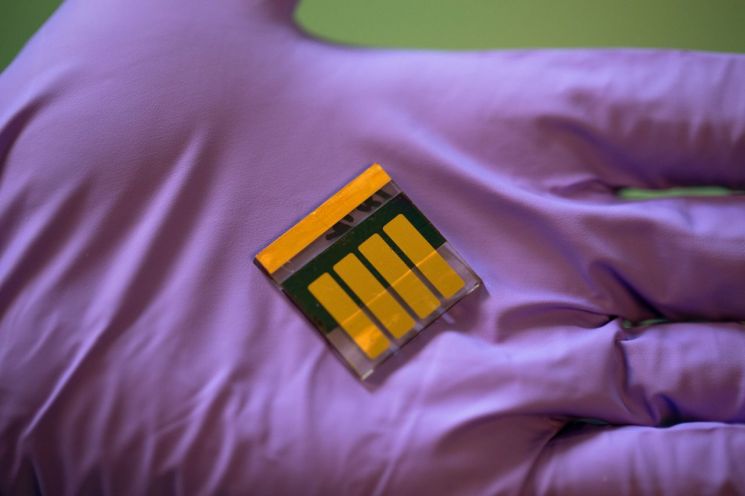
[Asia Economy Yeongnam Reporting Headquarters Reporter Kim Yong-woo] A groundbreaking material that simultaneously enhances the durability and efficiency of solar cells has been developed, attracting significant attention from academia and industry.
A material that maximizes the efficiency of the next-generation solar cell, the ‘perovskite’ solar cell, has been developed.
This material has been found to dramatically solve the moisture vulnerability issue, which has been a major obstacle to the commercialization of solar cells.
Solar cells using this material recorded the highest efficiency (24.82%) among perovskite solar cells reported in academic papers to date.
The groundbreaking research results, which achieved both moisture stability and efficiency, were published online on September 25 in the world-renowned scientific journal Science.
This research is expected to significantly accelerate the commercialization of perovskite solar cells.
 (Back row from the right, counterclockwise) UNIST Professor Gwak Sang-gyu, Professor Yang Chang-deok, Dr. Kim Dong-seok from Korea Institute of Energy Research, Researcher Choi In-woo, UNIST Researcher Jeong Min-gyu, Researcher Go Eun-min. [Provided by UNIST]
The joint research team of Ulsan National Institute of Science and Technology (UNIST, President Yong-Hoon Lee) and Korea Institute of Energy Research (KIER, Director Jong-Nam Kim) announced on the 25th that they developed an ‘organic hole transport layer material’ that prevents the perovskite solar cell’s photoactive layer from being exposed to moisture while enhancing cell efficiency.
The hole transport layer is a component of solar cells that transports holes (positive charge carriers) generated by the photoactive layer absorbing light to the electrode.
The joint research team developed a hole transport layer material that replaces the hydrogen in the existing hole transport layer (Spiro-OMeTAD, a material with a spiro structure) with fluorine, resulting in a high-performance material that does not absorb moisture.
The research team is known to have stabilized both the hole transport layer and the photoactive layer through a simple method called ‘fluorine incorporation.’
The developed hole transport layer material maintains the excellent performance of the existing hole transport layer while exhibiting strong hydrophobicity, meaning it does not mix with water like oil and thus does not absorb moisture.
This solves the problem of the existing hole transport layer absorbing moisture from the atmosphere, allowing the solar cell to maintain high efficiency for a long time.
The research team achieved a high-efficiency perovskite solar cell with 24.82% efficiency (24.64% certified) by using the developed material as the hole transport layer.
Additionally, moisture stability was resolved, maintaining over 87% efficiency even in a high-humidity environment for 500 hours.
In contrast, when using the existing material as the hole transport layer, efficiency decreased by more than 40% after 500 hours.
Notably, the certified cell showed a high open-circuit voltage of 1.18 V, which is very close to the theoretical maximum voltage that perovskite solar cells can generate.
The higher the open-circuit voltage, the greater the power output (Power = Voltage x Current), resulting in higher solar cell efficiency.
Dr. Dong-Seok Kim of KIER, who was responsible for cell fabrication, said, “We achieved an open-circuit voltage close to the theoretical value with a voltage loss of only 0.3 V, the lowest reported voltage loss to date for perovskite solar cells.”
He also explained, “Even when producing cells on a large area (1 cm²), the efficiency reduction was minimal (22.31%), indicating promising commercialization potential.”
Professor Sang-Kyu Kwak of UNIST’s Department of Energy Chemical Engineering theoretically analyzed why the developed material shows excellent performance.
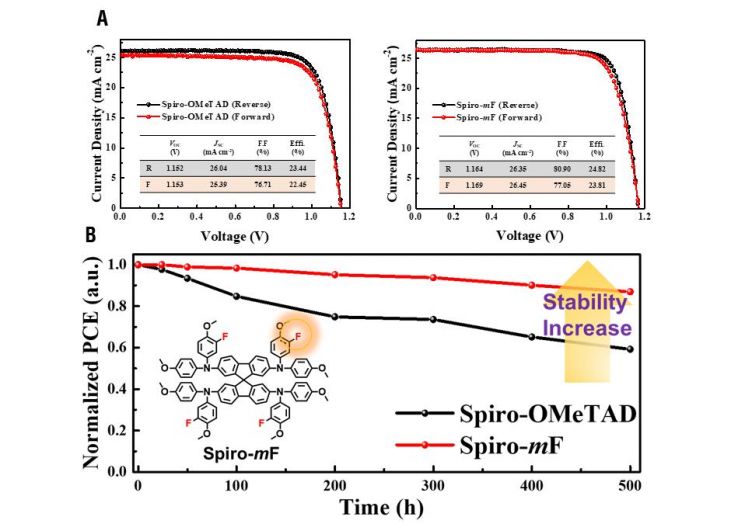 Performance comparison chart of solar cells applied with the developed material. [Provided by UNIST]
Professor Kwak explained, “Molecular simulation results show that the developed material, when adsorbed onto the photoactive layer, has an adsorption structure more favorable for hole transport than existing materials, and it also increases hole transport efficiency between material molecules.”
Professor Chang-Deok Yang of UNIST’s Department of Energy Chemical Engineering, who developed this material, stated, “Research on developing organic hole transport layers with high efficiency and stability has been ongoing for the past 20 years, but it has been difficult to find a material that satisfies both properties simultaneously.”
Professor Yang described the research as “a very groundbreaking study that simultaneously solved the previously conflicting issues of moisture stability and efficiency by introducing fluorine atoms into the existing spiro-structured material.”
This research was supported by the National Research Foundation of Korea, the Ministry of Science and ICT, Korea Institute of Energy Research, and Korea Institute of Energy Technology Evaluation and Planning.
© The Asia Business Daily(www.asiae.co.kr). All rights reserved.
![Clutching a Stolen Dior Bag, Saying "I Hate Being Poor but Real"... The Grotesque Con of a "Human Knockoff" [Slate]](https://cwcontent.asiae.co.kr/asiaresize/183/2026021902243444107_1771435474.jpg)

















