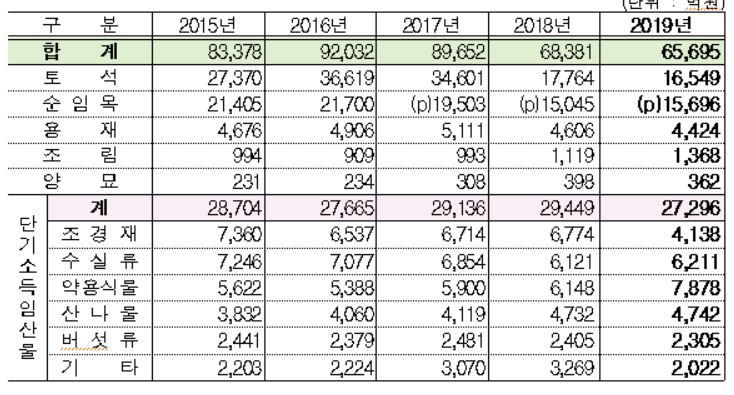
 Data on the production value of forest products by item derived from the annual forest product production survey from 2015 to 2019. Provided by the Korea Forest Service
[Asia Economy (Daejeon) Reporter Jeong Il-woong] The total production value of forest products in South Korea has been declining year by year. However, despite this trend, the production value of well-being medicinal plants and fruit-bearing plants has been steadily increasing for several years. This is attributed to the growing well-being culture and the rising demand for natural health supplements in society.
According to the Korea Forest Service on the 24th, the total production value of forest products over the past four years was ▲ 9.2032 trillion KRW in 2016 ▲ 8.9652 trillion KRW in 2017 ▲ 6.8381 trillion KRW in 2018 ▲ 6.5695 trillion KRW in 2019, showing a decline.
The Korea Forest Service analyzes that the overall decrease in forest product production value is due to a sharp drop in consumption of traditional forest products such as earth and stone materials, timber, and landscaping materials, influenced by the downturn in the construction market.
In fact, compared to 2018, earth and stone materials decreased from 1.7764 trillion KRW to 1.6549 trillion KRW in 2019, down 6.8%; timber from 460.6 billion KRW to 442.4 billion KRW, down 3.9%; and landscaping materials from 677.4 billion KRW to 621.1 billion KRW, down 1.5%, respectively.
However, despite the decline in total forest product production value, the production value of some forest products such as medicinal plants has steadily increased. The production value of medicinal plants rose from 533.8 billion KRW in 2016 to 590 billion KRW in 2017, 614.8 billion KRW in 2018, and 787.8 billion KRW in 2019.
The production value of clean forest products such as fruit-bearing plants and wild vegetables is also on the rise. For example, fruit-bearing plants increased from 406 billion KRW in 2016 to 411.9 billion KRW in 2017, 612.1 billion KRW in 2018, and 621.1 billion KRW in 2019, while wild vegetables rose from 406 billion KRW in 2016 to 411.9 billion KRW in 2017, 473.2 billion KRW in 2018, and 474.2 billion KRW in 2019.
In terms of regional forest product production, the production value of short-term income forest products was highest in Gyeongsangbuk-do at 691.7 billion KRW, followed by Jeollanam-do with 391.5 billion KRW, Jeollabuk-do with 305.1 billion KRW, and Gangwon-do with 290.7 billion KRW.
Meanwhile, the Korea Forest Service conducts an annual production survey of forest products produced from January to December of the previous year. The survey investigates the production volume and value of 147 items across 14 major types of forest products and serves as basic data for establishing various forestry policies.
Im Sang-seop, Planning and Coordination Officer at the Korea Forest Service, said, “Despite the decrease in total forest product production value, the production volume of medicinal plants such as goji berry, peony, and hemp, as well as clean forest products, shows an increasing trend every year. The Korea Forest Service will develop and implement forestry policies to ensure that healthy food from forests reaches the national dining table and to increase the income of forestry workers.”
© The Asia Business Daily(www.asiae.co.kr). All rights reserved.
![Clutching a Stolen Dior Bag, Saying "I Hate Being Poor but Real"... The Grotesque Con of a "Human Knockoff" [Slate]](https://cwcontent.asiae.co.kr/asiaresize/183/2026021902243444107_1771435474.jpg)
















