Government Announces Legislation on Class Action and Punitive Damages
Concerns Over 'Frivolous Lawsuits' Even for Legitimate Products
Worries About Business Contraction Amid Financial Sector's Successive Regulatory Tightening
[Asia Economy Reporters Oh Hyung-gil and Kim Min-young] "If a single product is poorly made or a sales employee makes even a minor mistake, even a large financial company can collapse. The purpose is consumer protection, but if a bank fails, who and how can take responsibility for the resulting chaos?" (Executive of A Financial Group).
The government’s decision to expand the 'class action system,' which was previously limited to securities, to all sectors and to include the 'punitive damages system' in the Commercial Act has become a pressing issue for the financial sector.
Since the 21st National Assembly began emphasizing consumer protection, a series of bills tightening regulations on the financial sector have been proposed. Adding class actions and punitive damages means excessive liability will inevitably be imposed on financial companies. If a listed financial company loses a class action lawsuit, it may have to pay damages to almost all shareholders, potentially resulting in astronomical compensation amounts.
According to the financial sector on the 24th, the 'Class Action Act' and 'Commercial Act Amendment' announced by the Ministry of Justice to be legislatively notified on the 28th are expected to become bills that tighten the overall management activities of all financial companies, along with the Financial Consumer Protection Act scheduled to take effect in March next year.
The main content of the Class Action Act shows that the class action system, which was previously limited to the securities sector, will be expanded to all industries. Introduced in 2005, the class action system allows all victims to be compensated through a lawsuit filed by some representatives of the victims.
With the introduction of the Class Action Act, all damage claims involving more than 50 victims will be eligible for class action. In this case, the judgment will apply to all victims who did not file an exclusion notice. In other words, many victims can receive compensation without directly filing or participating in the lawsuit.
As class actions become possible for collective consumer damage cases, a path to compensate consumer damages will open.
However, the financial sector points out that even products sold through normal procedures may face the side effect of rampant 'indiscriminate lawsuits.'
A B Bank official said, "If sales companies are sued or ordered to pay damages for losses on products sold after operating product selection committees or following normal procedures to prevent incomplete sales, management activities will inevitably shrink. This directly contradicts the principle of investor responsibility and may violate legal consistency," he complained.
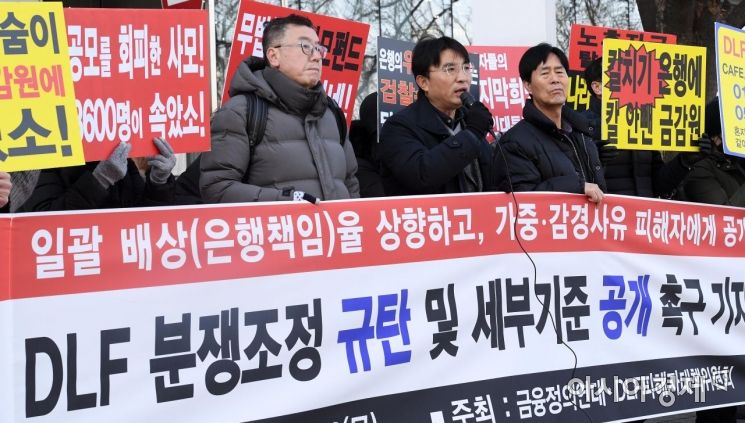 Representatives from the Financial Justice Solidarity and the DLF Victims Countermeasure Committee held a press conference on the 12th in front of the Financial Supervisory Service in Yeouido, Seoul, condemning the DLF dispute mediation and urging the disclosure of detailed standards. They demanded, "Raise the uniform compensation rate (bank responsibility) and disclose the reasons for increasing or decreasing the compensation rate to the victims." Photo by Kim Hyun-min kimhyun81@
Concerns Over Rampant 'Indiscriminate Lawsuits' Even for Properly Sold Products
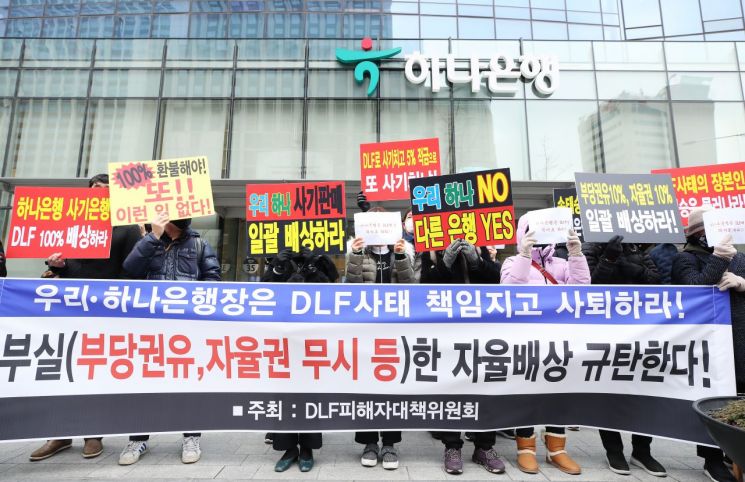
In particular, since retroactive application is planned even for issues that occurred before the law takes effect, it is expected to affect cases such as the Lime Asset Management scandal involving poor private fund sales and the derivative-linked fund (DLF) incident.
Along with this, the government has also prepared to introduce a punitive damages system into the Commercial Act. If a financial company causes damage to others intentionally or through gross negligence, it must compensate up to five times the damage.
The insurance sector, where disputes with consumers are frequent, is strongly opposing, saying that business activities from agent sales to insurance payments will be greatly restricted. With ongoing complaints about incomplete sales, the introduction of punitive damages could lead to closures due to compensation, sparking dissatisfaction.
An insurance company official said, "Regulations are increasingly tightening, such as granting one-sided binding force to recent dispute mediation committee decisions and the ruling party’s push for the Financial Group Integrated Supervision Act. Even when the insurance industry submits opinions to the government or ruling party, there is no atmosphere of accepting and improving them, which is frustrating," he lamented.
Meanwhile, some argue that as consumer rights increase, measures against 'black consumers' should also be strengthened. Currently, the Financial Services Commission plans to prepare institutional improvement measures to alleviate social burdens caused by financial black consumers.
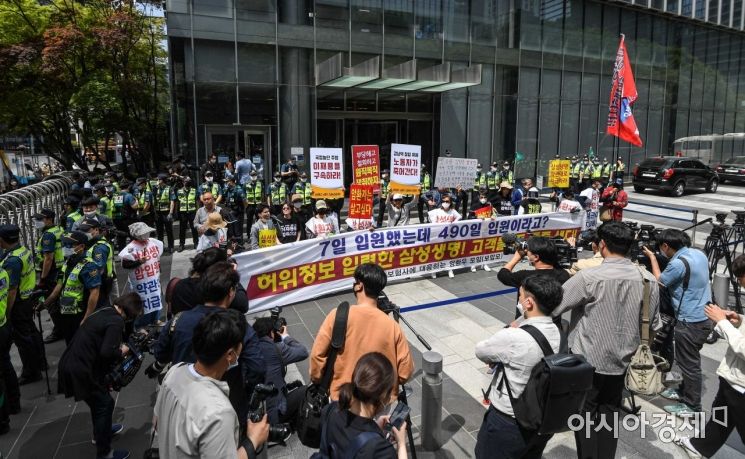 On the 7th, while the Samsung Compliance Committee meeting was being held, members of the Samsung Dismissed Workers' High-Altitude Protest Joint Committee staged a surprise protest in front of the Samsung Life Seocho Building in Seocho-gu, Seoul. Photo by Jinhyung Kang aymsdream@
© The Asia Business Daily(www.asiae.co.kr). All rights reserved.
![Clutching a Stolen Dior Bag, Saying "I Hate Being Poor but Real"... The Grotesque Con of a "Human Knockoff" [Slate]](https://cwcontent.asiae.co.kr/asiaresize/183/2026021902243444107_1771435474.jpg)

















