Ministry of Industry Announces 'August Monthly Trends in the Automobile Industry'
Decline Continues After First Half Export Drops Below 1 Million Units for the First Time in 11 Years Since Financial Crisis
Even the Previously Strong Eco-Friendly Vehicle Exports ↓... Electric Vehicles Show 'Plus'
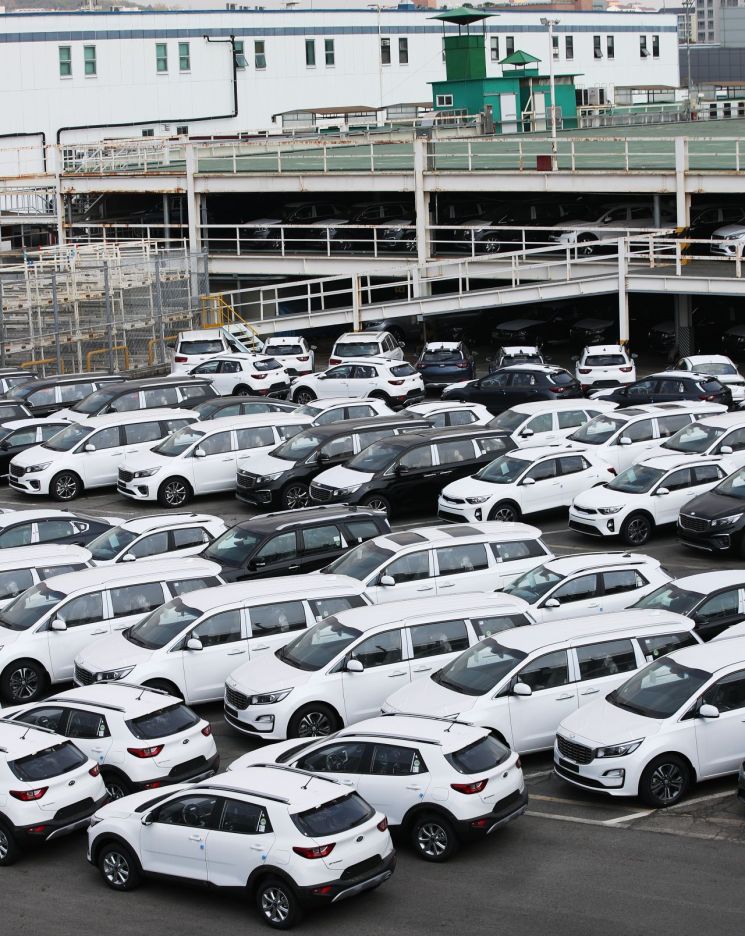
[Asia Economy Reporter Moon Chaeseok] Last month, South Korea's automobile exports recorded a negative growth for the 13th consecutive month. Both production and domestic sales shrank, resulting in a 'triple shock.' In terms of exports, the sluggish trend has continued since the first half of the year when the 1 million unit mark was broken for the first time in 11 years since the financial crisis in 2009. The main reason for the decline in car exports last month was the unsold inventory in major markets, which is evidence that the impact of the novel coronavirus disease (COVID-19) is directly affecting the poor performance of car exports. This implies the possibility of a prolonged slump depending on whether the COVID-19 pandemic becomes a global pandemic.
◆ 13 Consecutive Months of Negative Growth: "Impact of COVID-19"
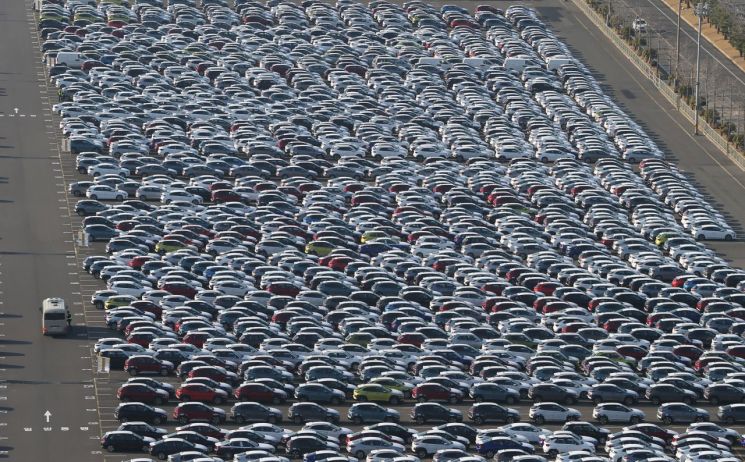
According to the 'August Automobile Industry Monthly Trend' released by the Ministry of Trade, Industry and Energy on the 18th, domestic automobile exports last month were 136,538 units, down 15.8% compared to the same month last year. After an 11.6% increase in July last year compared to the previous year, exports have been declining for 13 consecutive months. The monthly export changes were -3.4% in August last year, -4.8% in September, -10.2% in October, -8.6% in November, -6.7% in December, -28.1% in January this year, -1.6% in February, -10.3% in March, -44.3% in April, -57.6% in May, -37.4% in June, -11.7% in July, and -15.8% in August.
An official from the Ministry of Trade, Industry and Energy explained, "The unsold inventory in major local markets and the equipment construction on new car lines at Hyundai Motor and Kia Motors were the causes of the decline in car exports last month." This explanation is consistent with the one given in July, right after the 1 million unit mark was broken for the first time in 11 years in the first half of the year. At that time, the ministry said, "Due to the COVID-19 pandemic, major countries implemented lockdowns, and overseas sales plummeted, resulting in unsold inventory at local dealerships, which caused the decline in exports." The government has acknowledged that the prolonged COVID-19 situation is causing the slump in car exports. In the first half of this year, South Korea's car exports totaled 826,710 units, breaking the 1 million unit mark for the first time in 11 years since 938,837 units in 2009.
Looking at the regions, most areas except North America and Oceania showed negative export performance last month. By market size, exports decreased by 26.9% ($560 million) in the European Union (EU), 50.2% ($358 million) in the Middle East, 4.5% ($213 million) in Eastern Europe, 58.8% ($174 million) in Latin America, 36.3% ($168 million) in Asia, and 38.9% ($76 million) in Africa. North America increased by 12.3% ($1.25 billion), and Oceania rose by 0.5% ($172 million).
◆ Decline in Auto Parts Exports... Electric Vehicles Hold Up
Auto parts exports also decreased by 27% compared to the same period last year. Although the Ministry of Trade, Industry and Energy stated that recovery is underway, a closer look shows declines of -49.6% in April, -66.7% in May, -45.1% in June, -27.7% in July, and -27% last month. By region, the situation was 'devastating.' By market size, North America declined by 20.7% ($652 million), the EU by 20.9% ($330 million), Asia by 39.7% ($452 million), Eastern Europe by 25.3% ($163 million), the Middle East by 14.2% ($76 million), Latin America by 47.6% ($75 million), Africa by 22.5% ($16 million), and Oceania by 42.7% ($9 million). An official from the ministry said, "Local automakers adjusted production to reduce inventory, and the continued spread of COVID-19 in emerging markets caused the decline in auto parts exports."
Even the previously strong eco-friendly car exports have faltered. Narrowing down to electric vehicles, there was an increase. Last month, eco-friendly car exports decreased by 16.4% compared to the same period last year, totaling 16,490 units. Excluding hydrogen vehicles, which had a small sample size of 6 units and dropped by 84.6%, hybrid vehicles decreased by 26.8% (8,142 units), and plug-in hybrids by 52% (1,364 units), which are significant declines.
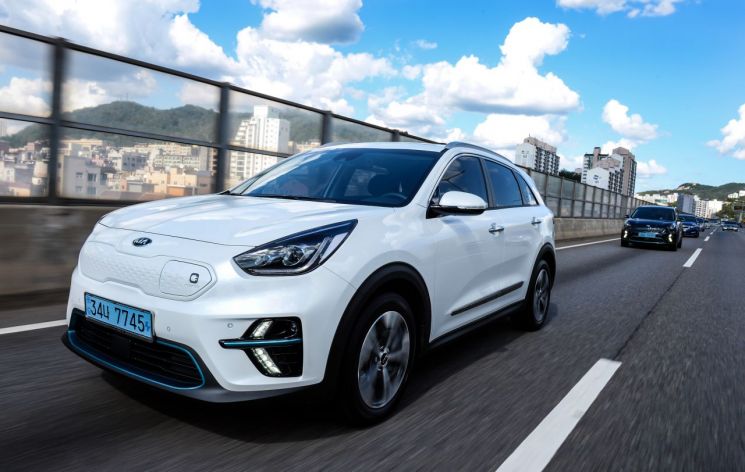
However, electric vehicles recorded 6,978 units last month, an increase of 22.2% compared to the same month last year, marking the 37th consecutive month of year-on-year growth. Notably, Niro EV exports surged from 0 units in August 2018 to 1,238 units in August last year, and 3,391 units this year (a 173.9% increase compared to the previous year). Hyundai Kia Motors' global electric vehicle market share rose from 3.1% in 2018 to 5% last year, and 7.4% from January to July this year. Earlier in July, the government announced a Korean New Deal comprehensive plan, aiming to supply 1.13 million electric vehicles and 200,000 hydrogen vehicles by 2025 and to launch more than 23 models of electric and hydrogen vehicles.
◆ Production and Domestic Sales Also Slump... Causes Include Adjustment of Individual Consumption Tax Reduction

Last month, car production decreased by 6.4% compared to the same month last year, totaling 233,357 units. The causes included the resurgence of COVID-19 and shutdowns due to equipment construction on new car lines at Hyundai Motor's Ulsan plants 1 and 4 and Kia Motors' Hwaseong plant 3. Production decreased by 12.6% at Hyundai Motor, 5.2% at Kia Motors, and 21.7% at Renault, while GM and SsangYong Motor increased by 19% and 16.9%, respectively.
According to the ministry, from January to July, South Korea's car production decreased by 17.4% compared to the same period last year, performing better than major countries. Except for China, which declined by 11.8%, most countries experienced larger decreases than South Korea. India declined by 51.1%, Brazil by 48.3%, France by 45.6%, Germany by 39%, Spain by 35.6%, Mexico by 35.5%, the United States by 33.1%, and Japan by 25.6%, all showing greater production decreases than South Korea.
Domestic sales also shrank. Last month, the car industry sold 135,349 units in the domestic market, down 1.2%. Domestic sales turned negative for the first time in six months. This was influenced by the adjustment of the individual consumption tax reduction, one less working day, and social distancing measures due to COVID-19. The domestic sales growth rates from March to July were 10.1% in March, 8% in April, 9.7% in May, 41.9% in June, and 8.9% in July. Domestic brand car sales increased by 4.9% compared to the same month last year, totaling 111,190 units. Imported car sales rose by 20.7%, with 24,159 units sold.
© The Asia Business Daily(www.asiae.co.kr). All rights reserved.
![Clutching a Stolen Dior Bag, Saying "I Hate Being Poor but Real"... The Grotesque Con of a "Human Knockoff" [Slate]](https://cwcontent.asiae.co.kr/asiaresize/183/2026021902243444107_1771435474.jpg)

















