K-Auction September Auction Estimated Total Price 12.2 Billion KRW, 152 Lots Offered
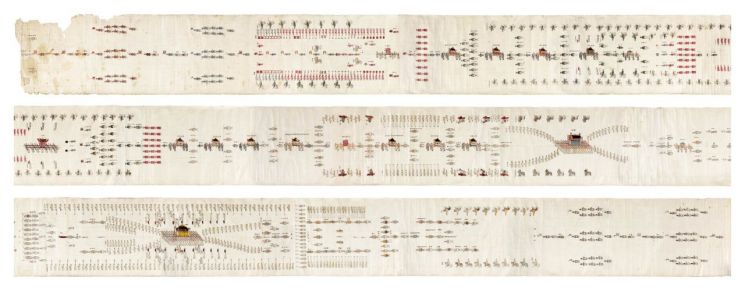 Hyomyeong Seja Balin Banchado (孝明世子發靷班次圖), woodblock print on paper, colored, 50.5×1370 cm, 1830, estimated price 600 million to 1 billion KRW
 Photo by K Auction
[Asia Economy Reporter Park Byung-hee] 'Hyomyeongseja Balin Banchado (孝明世子發靷班次圖)' will be featured in the K Auction September auction held on the 24th. The estimated price is 600 million to 1 billion KRW.
'Banchado' refers to paintings depicting key scenes of royal ceremonies, capturing vivid details of the event such as participants, the appearance of ceremonial flags, and the arrangement of palanquins. Generally, banchado included in Uigwe (official records detailing state ceremonies from start to finish for future reference) are well known, but there are also 'independent banchado' created for use during the preparation process on the day of the event. Independent banchado were drawn to minimize errors on the day of the ceremony by pre-identifying participants and arranging items accordingly.
The auction piece is an independent banchado used on the day of the event, depicting the funeral procession of Crown Prince Hyomyeong (孝明世子, 1809-1830), who died in 1830. Hyomyeong served as regent from the 27th year of King Sunjo’s reign (1827) and assisted King Sunjo, but passed away at age 22 in the 30th year of Sunjo’s reign (1830). In honor of his virtuous governance, he was posthumously honored as King Ikjong (翼宗).
The piece has been identified as 'Hyomyeongseja Balin Banchado' through comparison with the banchado included in the 'Hyomyeongseja Jangrye Dogam Uigwe (孝明世子葬禮都監儀軌)' held at the Kyujanggak. Both works primarily use stamping techniques with ink and coloring. Although there are slight differences in clothing colors, the main scenes of the funeral procession, such as the daeyeo (大轝), use identical coloring, and the number of figures and depicted objects are the same, allowing us to understand the relationship between the independent banchado and the uigwe banchado.
A notable point in this work is the name of the dogam (official bureau) shown in the banchado. Normally, when a king or queen dies, the dogam is called 'Gukjang Dogam (國葬都監)', and when a crown prince dies, it is called 'Yejang Dogam (禮葬都監)'. The dogam name appearing in this piece is not 'Gukjang Dogam', indicating that the subject is not a king or queen but a crown prince. Remarkably, this work does not use the term 'Yejang Dogam' but instead uses 'Jangrye Dogam (葬禮都監)'.
In the late Joseon period, only Su-bin (綏嬪, a concubine of King Jeongjo) and Crown Prince Hyomyeong used the term 'Jangrye Dogam' for their funerals, clearly identifying the subject as Crown Prince Hyomyeong. However, unlike Su-bin’s dogam, Hyomyeong’s funeral dogam was composed of three manufacturers, two supervisors, and six attendants, the same structure as the Gukjang Dogam, suggesting that the title was elevated to honor Hyomyeong’s funeral above other crown princes’ funerals. This special title for Hyomyeong’s dogam likely reflects King Sunjo’s filial feelings, as the funeral was held during his reign. The lack of opposition from officials at the time also indicates this was a unique case compared to other crown princes’ funerals.
Additionally, the iconography of this work closely matches that of the 'Hyomyeongseja Jangrye Dogam Uigwe'. The uigwe banchado appears to be based on the scroll-type funeral procession banchado used during the event but reflects the actual scenes with more detailed records. Another feature is that the mourners called 'Gokgungin (哭宮人)' are depicted identically in both banchado. The figures depicted in both the auction piece and the uigwe show typical 19th-century banchado styles, making these works important historical materials for understanding the format of banchado produced at the time.
The K Auction September auction held at the headquarters in Sinsa-dong, Gangnam-gu, Seoul, will feature a total of 152 works, including 'Hyomyeongseja Balin Banchado', with a total estimated value of 12.2 billion KRW.
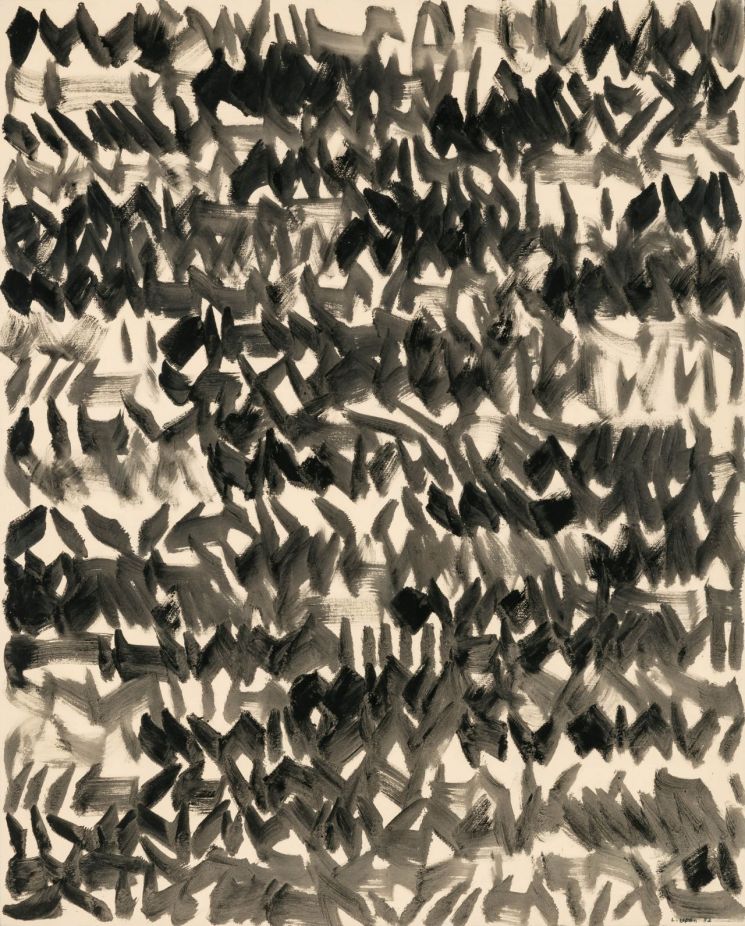 Lee Ufan 'From the Wind No. 82604', pigment suspended in glue, on canvas, 162.2×130.3 cm (100), 1982 [Photo by K Auction]
The highest estimated price work in this auction is Lee Ufan’s 'From the Wind No. 82604', estimated at 800 million to 1.2 billion KRW. The gradation of strokes and rough brush touches evoke the movement of strong wind. Additionally, seven works by Lee Ufan will be featured, including 'From Line' (1981), 'From Point No. 760134' (1976), and 'With the Wind' (1991), covering his series of point, line, and wind.
Other notable works include Park Soo-keun’s 'On the Road', three works from Kim Whanki’s New York period, three water drop paintings by Kim Chang-yeol, and Cheon Kyung-ja’s female portrait 'Woman in Pink Blouse'. 'Woman in Pink Blouse' exemplifies Cheon Kyung-ja’s 1990s style, featuring a woman with bright-colored blouse contrasting with dark skin, distinct facial features, and a somewhat rounded nose, creating a unique charm.
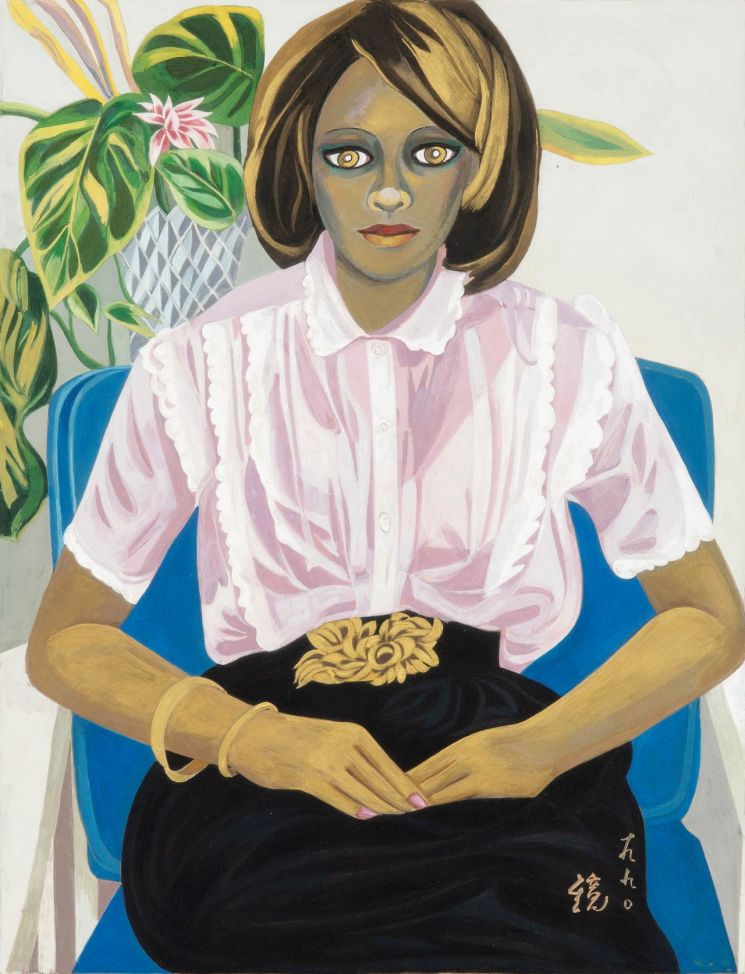 Cheon Kyung-ja, "Woman in a Pink Blouse," pigment on paper, 40.5×31.5 cm, 1990, estimated price 600 million to 800 million KRW
 [Photo by K Auction]
Unreleased works by Park Hang-seop, 'Eight Fairies of Geumgangsan' and 'Fairy and Woodcutter', also attract attention. While Park Hang-seop is known for literary themes such as fairy tales and myths expressed in a flat and abstract style, these auction pieces are exceptional as they depict Geumgangsan folklore in a realism style.
Park Hang-seop studied at Wabata Art School in Tokyo, Japan, and after liberation was included among five artists from Hwanghae Province selected by the communist regime. This suggests his excellence in realistic depiction. Most of his realism works were government-commissioned record paintings, and these auction pieces allow direct confirmation of Park Hang-seop’s realistic style, previously known only through records.
'Eight Fairies of Geumgangsan' depicts eight women bathing in a valley in the real location of Geumgangsan, not an imaginary space. 'Fairy and Woodcutter' is a landscape painting delicately portraying a flying fairy and a woodcutter reaching out his arms in sorrow. The balanced composition and clear depiction of idealized bodies in both works evoke an academic neoclassical style.
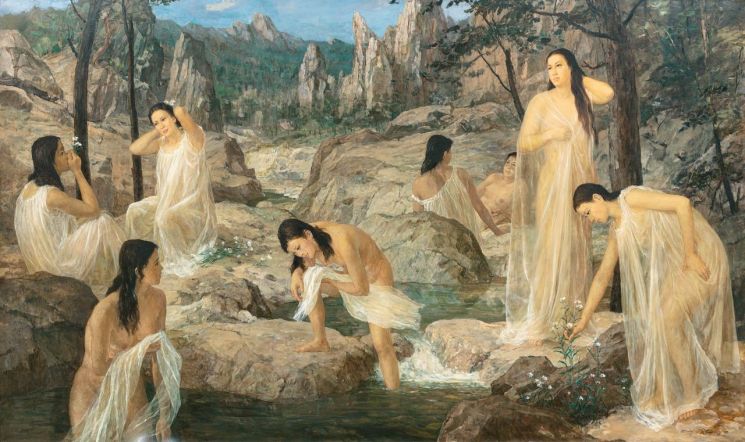 Park Hangseop 'Geumgangsan Palsonnyeo', oil on canvas, 191×320 cm, 1974,
 Estimated price 120 million to 250 million KRW
[Photo by K Auction]
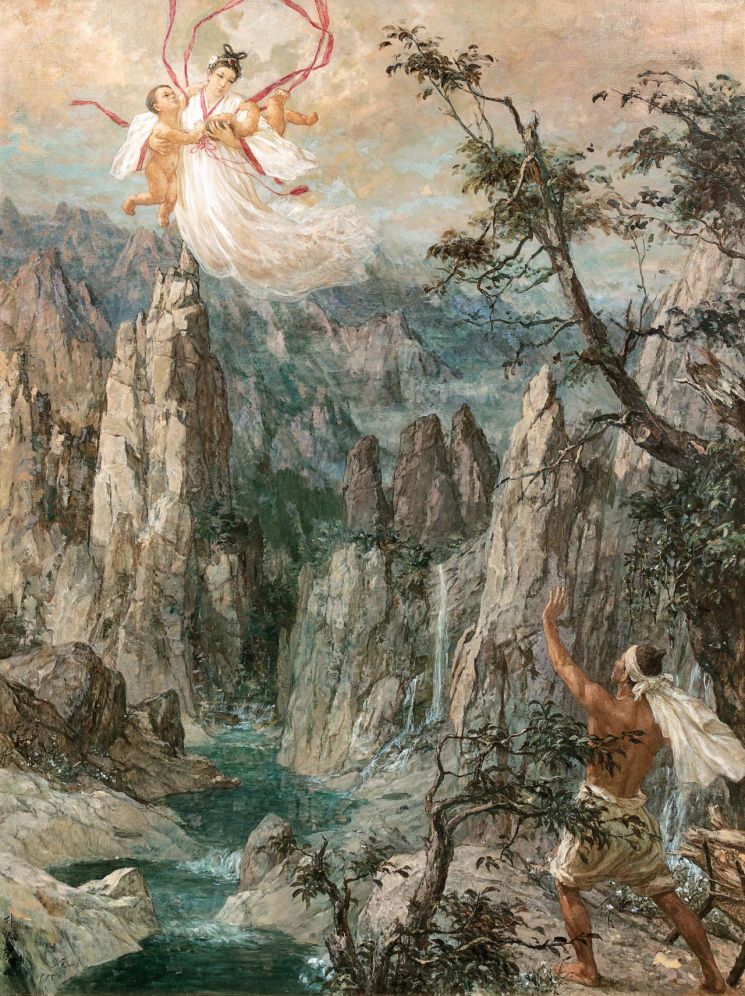 Park Hangseop 'The Fairy and the Woodcutter', oil on canvas, 261.5×196.5 cm, 1975, estimated price 100 million to 200 million KRW
 [Photo by K Auction]
Additionally, rarely seen in domestic auctions, Tracy Emin’s neon work 'I Promise to Love You' and Pierre-Auguste Renoir’s 'Still Life with Strawberries (Nature Morte aux Fraises)' will be exhibited. 'Still Life with Strawberries' is a circa 1905 work embodying characteristics of Renoir’s late period. The bright colors, as if soaked in sunlight, contrast with the simple white tablecloth and deep green leaves, creating a radiant and beautiful piece. The vermilion red in Renoir’s works of this period is a vibrant color symbolizing vitality, often used to depict girls’ cheeks or women’s lips. Emin’s neon work 'I Promise to Love You' was exhibited at the 2015 Seoul Museum of Art exhibition 'G-DRAGON - PEACEMINUSONE: IN THE MAKING OF PEACEMINUSONE'.
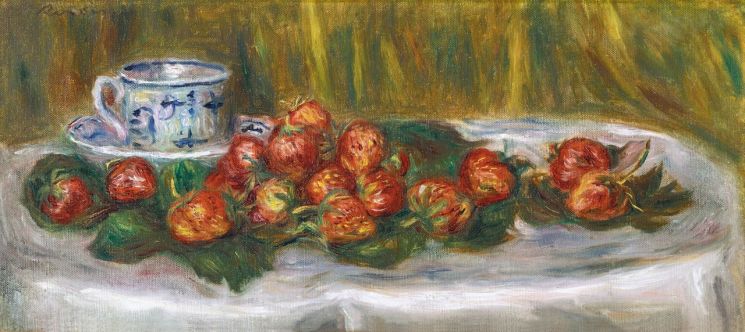 Pierre-Auguste Renoir 'Still Life with Strawberries (Nature Morte aux Fraises)', oil on canvas, 23.5×50.2 cm, circa 1905
Estimated price 690 million to 800 million KRW
[Photo by K Auction]
 Tracey Emin 'I Promise to Love You', neon, 145.8×143 cm (edition 3/3), 2010, estimated price 250 million to 300 million KRW
 In the category of traditional art, besides 'Hyomyeongseja Balin Banchado', a 'Gogancheop' featuring calligraphy by Joseon-era figures from the 15th to 19th centuries, including Hoejae Yi Eon-jeok, will be auctioned with an estimated price of 260 million to 400 million KRW. 'Gojido' (ancient maps), believed to be made after 1767, estimated at 50 million to 150 million KRW, and 'Joseon Wangguk Jeondo' (Map of the Joseon Kingdom) from the 18th to 19th centuries, estimated at 5 million to 10 million KRW, are valuable research materials for understanding the worldview and society of their times. Also, 'Four Seasons Landscape' paintings by Cheongjeon Lee Sang-beom, Sojeong Byeon Gwan-sik, and Unbo Kim Ki-chang will allow comparison of each artist’s characteristics.
The auction pieces can be viewed at the K Auction exhibition hall until the auction day on the 24th. Preview viewing is free, but to prevent the spread of COVID-19, visitors must make a reservation by phone in advance, wear masks, and undergo non-contact temperature checks at the entrance before entering. Those wishing to participate in the auction must register as K Auction members (free) and can bid in writing, on-site, or by phone. Notably, from this auction, online live bidding has been added to allow non-face-to-face participation through an online system without visiting the site in person.
© The Asia Business Daily(www.asiae.co.kr). All rights reserved.
![Clutching a Stolen Dior Bag, Saying "I Hate Being Poor but Real"... The Grotesque Con of a "Human Knockoff" [Slate]](https://cwcontent.asiae.co.kr/asiaresize/183/2026021902243444107_1771435474.jpg)

















