'Post Abe' VS 'Second Abe'
High Possibility of Succeeding Foreign Strategy... Transitional Cabinet Limitations, Expected to be Management-Type
Some View as Rational Thinking Compared to Far-Right Abe... Worth Expecting in the Long Term
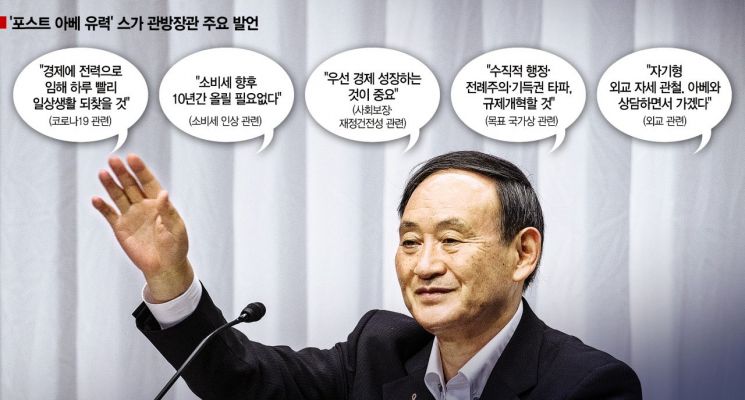
[Asia Economy Reporter Lim Cheol-young] The biggest point of interest in Japan's 'leadership change' phase is the future direction of Korea-Japan relations. Attention is focused on whether Yoshihide Suga, who is virtually set to become the new Prime Minister, will adopt a diplomatic strategy to untangle the complicated knot of Korea-Japan relations, which have deteriorated under the Moon Jae-in administration.
Prospects vary somewhat depending on Suga's domestic political standing. While there is considerable weight behind the view that he is likely to succeed Prime Minister Abe’s foreign policy as he is called the 'second Abe,' some analysts suggest that since Suga is regarded as more pragmatic and rational compared to the ultra-right-wing hardline Abe, it is worth waiting and hoping for some positive developments over time.
Korea-Japan relations, which had been strained due to the hasty 2015 Korea-Japan agreement on comfort women, worsened further following the November 29, 2018 ruling by the South Korean Supreme Court ordering compensation for forced labor during Japanese colonial rule. Japan has maintained its claim that the 1965 Korea-Japan Claims Agreement precludes such compensation under international law, and in July 2019 retaliated with unilateral 'export restrictions' banning exports of key semiconductor materials to South Korea.
Subsequently, the South Korean government notified the termination of the Korea-Japan General Security of Military Information Agreement (GSOMIA), citing Japan’s unfriendly measures. Although the termination was suspended on the premise of resuming dialogue between the two countries, there has been little progress in restoring relations over the past ten months. Additionally, in June, the South Korean government resumed World Trade Organization (WTO) proceedings against Japan’s export restrictions.
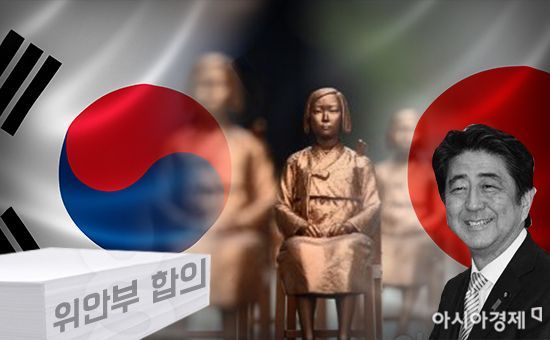
Experts generally view it as unlikely that newly appointed Prime Minister Suga will devise a breakthrough to restore or improve the accumulated issues between Korea and Japan. Given the inherent limitations of a transitional cabinet lasting until the remainder of Abe’s term in September next year, and considering Suga’s domestic political position, it is analyzed that he will find it difficult to attempt a dramatic reversal in Korea-Japan relations.
Suga has already officially declared his intention to "inherit all policies of the Abe administration," fully aware of this. In response, Prime Minister Abe expressed through Tomomi Inada, acting secretary-general of the Liberal Democratic Party, that he believes Suga will properly continue the policies.
Choi Eun-mi, a senior researcher at the Asan Institute for Policy Studies, explained, “Since Suga has clearly stated his intention to succeed Abe’s policies, it seems unlikely that Korea-Japan relations will change significantly under the new prime minister. For the issues between Korea and Japan to be resolved, a progressive attitude from Japan is necessary, but Suga’s weak political base and the unfavorable public opinion toward Korea within Japan make it unlikely that he will take such a step.”
Therefore, it is highly probable that both countries will focus on managing the issues to prevent further deterioration. Although Japan may take additional retaliatory measures following the sale of approximately 400 million won worth of domestic assets of Japanese companies facing forced execution for victim compensation, it is analyzed that Prime Minister Suga will not take the initiative. This implies a high likelihood of maintaining the existing line as Abe’s ‘faithful mouthpiece’ in his role as Chief Cabinet Secretary.
Professor Jung Dae-jin of Ajou University stated, “Suga will inherit Abe’s policies and lead a management-type cabinet. The cashing in of domestic assets of companies involved in forced labor during Japanese colonial rule will be a trigger for worsening relations, but to successfully host the Tokyo Olympics next year, he is expected to focus on managing the situation without exacerbating the problem.”
Senior researcher Choi Eun-mi added, “Regarding South Korea’s WTO complaint against Japan’s export restrictions, if Japan shows a conciliatory attitude first, it could be interpreted as a signal for improving relations, but fundamentally, Japan is unlikely to take the initiative in changing its stance.”
However, there is also a view that if Prime Minister Suga strengthens his domestic political position through dissolving the House of Representatives and holding an early general election, enabling long-term governance rather than a transitional cabinet, improvement in Korea-Japan relations could be expected. This is because, unlike Prime Minister Abe, who pursued revising the pacifist constitution aiming to become a ‘war-capable nation’ based on the US-Japan alliance, Suga is considered a relatively pragmatic and rational figure.
While Suga maintains a firm stance based on the 1965 agreement regarding historical issues such as forced labor during Japanese colonial rule, he is known to have opposed the export restrictions, unlike other close aides in the Abe cabinet.
Professor Hosaka Yuji of Sejong University said, “Suga, who can communicate with the coalition partner Komeito, is less likely to be ideologically driven compared to Prime Minister Abe. Although it is difficult to expect a change in Japan’s attitude in the short term, whether Suga can lay the groundwork for long-term governance through dissolving the House of Representatives and holding an early general election will be a key indicator for the future of Korea-Japan relations.”
© The Asia Business Daily(www.asiae.co.kr). All rights reserved.
![Clutching a Stolen Dior Bag, Saying "I Hate Being Poor but Real"... The Grotesque Con of a "Human Knockoff" [Slate]](https://cwcontent.asiae.co.kr/asiaresize/183/2026021902243444107_1771435474.jpg)
















