Cooperation in Semiconductors, Medical, and Energy Sectors... Intention to Provoke China
Taiwan Accelerates FTA by Allowing US Beef Imports
Steelwell, Deputy Secretary of State: "Significant Adjustment in China Policy"
Justification for Arms Sales to Taiwan
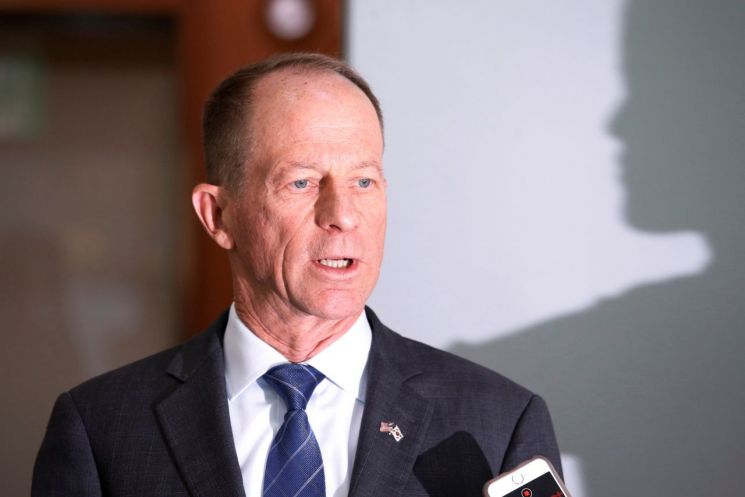 David Stilwell, U.S. Department of State Assistant Secretary for East Asian and Pacific Affairs
 [Photo by Reuters Yonhap News]
[Asia Economy New York=Correspondent Baek Jong-min] The United States, which is engaged in all-around conflicts with China, announced that it will establish an economic cooperation dialogue system with Taiwan, raising prospects of friction with China once again following the South China Sea dispute. Ultimately, there is a plan to even conclude a Free Trade Agreement (FTA) with Taiwan, which is expected to significantly elevate Taiwan's strategic position amid the US-China conflict phase.
David Stilwell, US Assistant Secretary of State for East Asian and Pacific Affairs, stated at a virtual seminar hosted by the Heritage Foundation on the 31st (local time), "The United States and Taiwan are starting a new economic dialogue," adding, "This dialogue will cover all areas of our economic relationship centered on technologies such as semiconductors, healthcare, and energy."
It is unusual for the US to establish an economic discussion channel with Taiwan, with which it does not have formal diplomatic relations. This can be interpreted as undermining the 'One China' policy that the US has maintained so far. A major foreign media outlet highlighted Stilwell's remarks that "While the US policy is not changing, there is a 'significant adjustment' in the long-standing One China policy maintained by Washington."
The US move to empower Taiwan is not unrelated to the Hong Kong situation. Stilwell said at the seminar, "We must act to restore balance. Looking at Hong Kong, it is clear that China is determined to ignore international obligations to extend its authoritarian regime."
Since Hong Kong, the frontline of free trade against China, has become part of China following the implementation of the National Security Law, the intention is reflected in firmly protecting Taiwan. The US recently conducted joint military exercises with Taiwan and sent high-ranking official Alex Azar, Secretary of Health and Human Services, to discuss cooperation measures, provoking China.
In particular, once the economic cooperation dialogue channel is fully operational, attention will focus on whether a US-Taiwan Free Trade Agreement (FTA) will be concluded. In the international community, an FTA effectively implies an alliance mediated by the economy, which could cause significant repercussions in US-China relations.
Taiwan President Tsai Ing-wen recently stated, "Strengthening relations with the US, Taiwan's major trading partner and arms supplier, is my top priority after re-election, and for this, we must start (FTA) negotiations," emphasizing that concluding an FTA with the US is a critical task. Stilwell also mentioned Taiwan semiconductor company TSMC's decision to build a new factory in Arizona as an example symbolizing the bilateral relationship.
The economic honeymoon between the US and Taiwan is progressing rapidly. When the US requested the removal of export barriers on pork and beef, Taiwan announced on the 28th of last month a policy to permit imports of US pork containing 'ractopamine' and beef over 30 months old. Taiwan had banned imports of US pork and beef containing the growth promoter ractopamine. Immediately after Taiwan's decision, US Secretary of State Mike Pompeo also stated that the door to economic and trade cooperation between the two countries would open.
The US also plans to continuously supply weapons to enhance Taiwan's defense capabilities. Stilwell referred to the Six Assurances made during the Reagan administration regarding Taiwan. The US Six Assurances mean: ▲The US does not set a deadline for arms sales to Taiwan ▲The US does not consult China in advance on arms sales to Taiwan ▲The US does not act as a mediator between the two sides of the Taiwan Strait ▲The US does not revise the Taiwan Relations Act ▲The US maintains a consistent position on Taiwan's sovereignty ▲The US does not pressure Taiwan to negotiate with China. On this day, the US declassified diplomatic documents related to the Six Assurances.
Regarding concerns that Taiwan will further escalate tensions between the US and China, Douglas Paal, a former Taiwan representative, evaluated, "The US administration wants to show toughness," adding, "They are approaching China's red line but do not seem willing to cross it."
© The Asia Business Daily(www.asiae.co.kr). All rights reserved.
![Clutching a Stolen Dior Bag, Saying "I Hate Being Poor but Real"... The Grotesque Con of a "Human Knockoff" [Slate]](https://cwcontent.asiae.co.kr/asiaresize/183/2026021902243444107_1771435474.jpg)















