Government Distributes Revised Housing Lease Protection Act Guidebook
Illegal to Falsely Refuse Renewal Without Intent to Reside
Liable Even if Leaving Vacancy Despite Losses
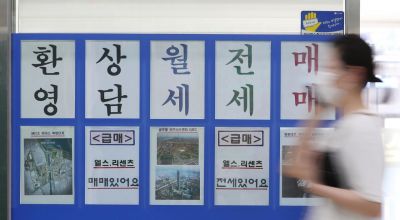 On the 19th, the government decided to lower the jeonse-to-monthly rent conversion rate from the existing 4% to around 2.5%. Hong Nam-ki, Deputy Prime Minister and Minister of Economy and Finance, stated at the meeting of ministers overseeing the real estate market that the current 4% conversion rate could accelerate the trend toward monthly rent and increase the burden on tenants, which led to this decision. The photo shows a real estate agency in Jamsil, Seoul on the same day. Photo by Moon Honam munonam@
[Asia Economy Reporter Moon Jiwon] If a landlord refuses a tenant's request to renew the lease on the grounds of actual residence and then leaves the house vacant, they may be held liable for damages under the Housing Lease Protection Act. Even if the landlord does not enter into a lease contract with a third party and bears the loss by leaving the property vacant, this will not be recognized. However, if the direct ascendant who was supposed to live in the house dies or if the house is inevitably left vacant due to interior construction, the landlord may be exempt from liability.
Also, even if the landlord and tenant agree to raise the rent by more than 5% at the time of lease renewal, such an agreement is considered unfavorable to the tenant and thus is not valid. Therefore, regardless of whether there was an agreement, the tenant can later claim a refund for the portion exceeding 5%. However, if the tenant does not exercise the right to request lease renewal and instead enters into a new contract with a rent increase exceeding 5%, this is fully recognized. In this case, the tenant can exercise the right to request lease renewal once later.
The Ministry of Land, Infrastructure and Transport and the Ministry of Justice compiled and distributed a commentary on the amended Housing Lease Protection Act on the 28th. Below are key issues that may arise between landlords and tenants.
Q. Is an agreement between landlord and tenant to not exercise the right to request lease renewal in advance valid?
A. No, it is an agreement unfavorable to the tenant and therefore has no effect under Article 10 of the Housing Lease Protection Act.
Q. If the tenant agreed to move out at the end of the lease but later reverses this and exercises the right to request lease renewal, is this allowed?
A. Yes, it is allowed. Even if the tenant agreed in advance to move out when the lease ends, they can request lease renewal from the landlord between six months and one month before the lease expiration.
Q. Must the tenant reside for a full two years after exercising the right to request lease renewal?
A. No. The tenant can notify the landlord of termination at any time. However, the termination takes effect three months after the landlord receives the notice. During these three months, the tenant must continue to pay rent.
Q. If the initial lease contract was for one year, can the tenant live for more than one year?
A. Lease periods set for less than two years are considered as two years. Even if the contract period was set to one year, the tenant can live for two years.
Q. If the landlord refuses the tenant's renewal request on the grounds that the landlord or their direct ascendants/descendants will move in, but then rents the property to a third party after a short stay, what happens?
A. If the landlord leases to a third party before two years have passed, they must compensate the previous tenant for damages. However, the landlord can be exempt from liability if there is a justifiable reason.
This includes unavoidable reasons that could not have been predicted at the time of refusal, such as the sudden death of a direct ascendant who was to reside or sudden overseas assignment during actual residence.
Q. What happens if the landlord refuses renewal citing actual residence but leaves the house vacant?
A. If it is judged that the refusal was false without the intention of actual residence, the landlord may be held liable for general tort damages.
However, if the vacancy was unavoidable due to interior construction or the death of a residing direct ascendant, the landlord may be exempt from liability.
Q. Can a corporation landlord refuse renewal on the grounds of actual residence?
A. No, because a corporation cannot actually reside in the property.
Q. Can the landlord and tenant agree to a renewal contract with a rent increase exceeding 5%?
A. This is only possible if it is a new lease contract, not a renewal. In that case, the tenant can exercise the right to request lease renewal once later.
Q. Can the landlord and tenant agree to a renewal contract exceeding 5% rent increase when exercising the right to request lease renewal?
A. No. The portion exceeding 5% is invalid. The tenant can claim a refund for the excess amount.
Q. What is the scope of housing covered by the Housing Lease Protection Act?
A. It applies to all residential buildings leased. Even if part of the leased house is used for non-residential purposes, the Act still applies.
Q. Does the Housing Lease Protection Act apply if the tenant is a corporation?
A. Generally, it does not apply if the tenant is a corporation unless there are special circumstances.
© The Asia Business Daily(www.asiae.co.kr). All rights reserved.
![Clutching a Stolen Dior Bag, Saying "I Hate Being Poor but Real"... The Grotesque Con of a "Human Knockoff" [Slate]](https://cwcontent.asiae.co.kr/asiaresize/183/2026021902243444107_1771435474.jpg)















