First Domestic Company to Establish a Health Supplement Manufacturing Plant in China, Accelerating Entry into the Chinese Market
Leading the Health Supplement Market through Bold Investment and R&D... Proactively Responding to Demand with Active Investment
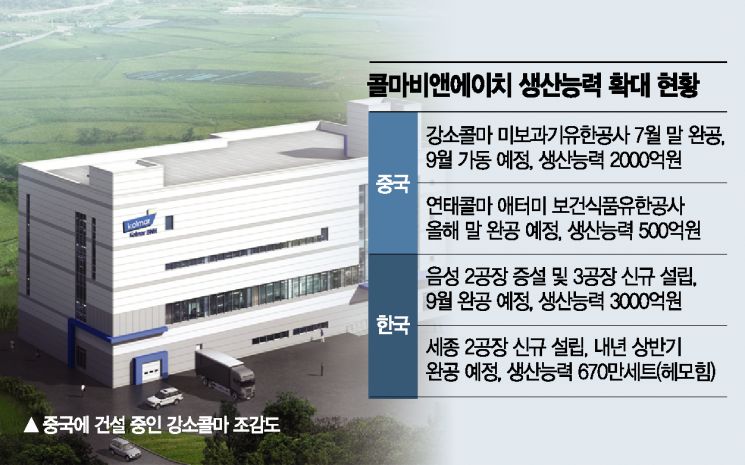
[Asia Economy Reporter Lee Seon-ae] Kolmar BNH, the No. 1 Original Development Manufacturing (ODM) company for health functional foods in Korea, has officially launched its global market expansion. Amid the surge in demand for health functional foods due to the impact of the novel coronavirus disease (COVID-19), the company aims to actively seize the opportunity to spotlight K-health functional foods. Kolmar BNH, which built the first domestic production plant in China?the world's second-largest health functional food market?plans to secure market dominance through proactive investment.
Proactive Investment in China, the World’s 2nd Largest Health Functional Food Market
According to the Kolmar Group on the 19th, Kolmar BNH is the first Korean health functional food ODM company to establish a production plant in China. The ‘Jiangsu Kolmar Mibo Technology Co., Ltd. (Jiangsu Kolmar),’ located in Yancheng City, Jiangsu Province, covers approximately 23,000 pyeong (about 75,900 square meters). It was completed at the end of July and is currently undergoing final preparations for operation in September. Jiangsu Kolmar will serve as a production base for the Chinese market, manufacturing powder, tablets, soft and hard capsules, and stick jelly formulations, with an annual production capacity of about 200 billion KRW.
‘Yantai Kolmar Atomy Health Food Co., Ltd. (Yantai Kolmar),’ established as a joint venture with Atomy, is under construction in Yantai City, Shandong Province, on a site of 6,500 pyeong (about 21,450 square meters), with completion targeted by the end of this year. Yantai Kolmar will primarily produce product lines supplied to Atomy and will gradually expand to manufacture products specialized for the Chinese market. Its annual production capacity is approximately 50 billion KRW. Once both Jiangsu Kolmar and Yantai Kolmar plants begin production, it is expected that Kolmar BNH will be able to aggressively expand its presence in the Chinese market.
Kolmar BNH anticipates a significant increase in export performance this year, leveraging the expansion of its Chinese business. Based on a systematic global market entry strategy, Kolmar BNH has expanded its export countries and export volume annually since 2010, starting with the United States and extending to Japan, Canada, Taiwan, Singapore, and a total of 14 countries worldwide. It has shown rapid growth in exports, with figures reaching 1 million USD in 2011, 5 million USD in 2013, 10 million USD in 2015, 20 million USD in 2016, 50 million USD in 2018, and 69 million USD in 2019. Exports in the first half of this year have already exceeded 70 million USD, bringing the company close to achieving 100 million USD in annual exports.
A Kolmar BNH official stated, "With the recent increase in demand for health functional foods and the company’s active investments and market strategies, sales are expected to grow further. Especially, as we fully enter the 40 trillion KRW Chinese health functional food market, Kolmar BNH is expected to strengthen its position as Korea’s representative health food company."
Consolidating No. 1 Market Position Domestically
Kolmar BNH also plans to solidify its No. 1 market position domestically. Given the high demand for health functional foods, the company is making large-scale investments to achieve record-breaking performance by the end of the year. Having entered a second growth phase this year due to market expansion, Kolmar BNH recently made significant investments to expand domestic and overseas manufacturing facilities. It invested a total of 29.7 billion KRW in its Eumseong plant in Eumseong County, Chungbuk Province, to expand the second plant and establish a new third plant. Once equipment installation is completed in September, the Eumseong plant will increase its production capacity by 50%, reaching a total annual production capacity of 300 billion KRW.
At the Sejong site, the company invested 13.8 billion KRW to begin construction of the second Sejong plant. Upon completion in the first half of next year, the Sejong plant’s annual production of Hemohim, currently about 2,000 tons, will increase to over 5,000 tons.
Kolmar BNH, which introduced the ODM method for the first time in Korea, was established in 2004 as Korea’s first research institute company. Korea Kolmar invested 62.2% of the capital, and the Korea Atomic Energy Research Institute contributed technology equivalent to 37.8% of the founding capital. From its inception, it attracted attention as a completely new business model combining the technological capabilities of a government-funded research institute with the management know-how of a private company. Starting with a capital of 1 billion KRW, Kolmar BNH has grown into a company valued at over 2 trillion KRW. Over the past three years, it has recorded growth exceeding 10% annually, with sales increasing 30% from 337.6 billion KRW in 2017 to 438.9 billion KRW in 2019, and operating profit rising about 52% from 48.8 billion KRW in 2017 to 74.1 billion KRW in 2019. Particularly in the first half of this year, sales surged due to COVID-19 and entry into the Chinese market, with sales and operating profit increasing 36% and 63%, respectively, compared to the same period last year.
The core drivers of growth are new material development and product lineup expansion. The company’s flagship product, Hemohim, is a natural herbal complex developed by the Korea Atomic Energy Research Institute by mixing three medicinal herbs: Angelica gigas, Cnidium officinale, and Paeonia lactiflora. It is the first ingredient recognized for immune function improvement among Korea’s individually approved health functional foods. Clinical trials have shown that Hemohim effectively prevents side effects of radiation and anticancer treatments, promotes recovery of immune cells, and activates hematopoietic functions, providing excellent supportive effects for anticancer therapy. It currently holds the top production record among individually approved health functional foods in Korea, generating sales of 175.5 billion KRW last year alone. In addition to Hemohim, the company has more than 10 new ingredient development pipelines through collaborations with government-affiliated research institutes and university laboratories. Last year, it received individual approval for a mixed powder of grape and blueberry extracts that helps improve memory, and this year, it plans to register more than two individually approved ingredients, including a new ingredient that helps alleviate menopausal symptoms in women.
© The Asia Business Daily(www.asiae.co.kr). All rights reserved.