[Asia Economy Reporter Woo Su-yeon] As government environmental regulations tighten, the domestic hybrid vehicle market is rapidly growing. The number of registered vehicles is approaching 600,000, and among eco-friendly cars sold domestically in the first half of this year, 7 out of 10 were hybrid vehicles.
According to the Korea Automobile Manufacturers Association on the 16th, among the 69,629 eco-friendly cars sold in the first half of this year, 76.1% (52,778 units, including plug-in hybrids) were HEV vehicles. This means that more than 7 out of 10 eco-friendly cars sold in the first half of this year were HEVs.
Domestic eco-friendly car sales increased by 42% in the first half of this year, and not only pure electric vehicles but also HEVs are so popular that there is a shortage of supply. For example, the best-selling domestic car, the Grandeur HEV, requires a wait of more than four months for delivery.

Looking at the brands, Japanese car brands, which were the absolute leaders in HEVs, have faltered due to the boycott movement, allowing Hyundai Kia Motors to aggressively increase its market share to 78%. This is due to actively expanding the HEV lineup in line with recently strengthened environmental regulations.
The government is implementing a low-emission vehicle mandatory sales system, requiring manufacturers selling more than 4,500 units annually in Korea to have 15% of their sales be eco-friendly vehicles. From this year, the scope of application has expanded from the metropolitan area to nationwide.
To meet regulatory requirements, Hyundai launched the small SUV Kona HEV in August last year, and this year Kia added an HEV lineup to the mid-size SUV Sorento. The existing HEV models Sonata and Grandeur continue their popularity with new model releases, and recently, the compact sedan Avante also launched an HEV model for the first time in 11 years.
As a result, Hyundai Kia Motors sold 52,978 HEVs in the first half of this year, capturing a 78% share of the domestic HEV market. In particular, the Grandeur HEV led the HEV market with sales exceeding 15,000 units, and Kia's Sorento sold nearly 7,000 units, driving a rebound.
On the other hand, HEV sales of Japanese car brands in the first half of this year dropped 53% year-on-year to 6,606 units. Lexus HEV sales fell 56% year-on-year to 3,509 units, Toyota dropped 43% to 2,350 units, and Honda sales decreased 57% to 747 units. Infiniti and Nissan, which sold 61 and 14 HEVs respectively in the first half of last year, recorded zero HEV sales this year.
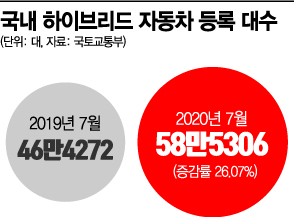
Thanks to government regulations and the eco-friendly car boom, the domestic HEV market is expected to surpass 600,000 units soon. According to the Ministry of Land, Infrastructure and Transport, as of July, the number of registered hybrid (HEV) vehicles in Korea was 585,306, a 26% increase compared to the same month last year. The industry expects that at the current pace, the market could reach 650,000 units by the end of the year.
© The Asia Business Daily(www.asiae.co.kr). All rights reserved.
![Clutching a Stolen Dior Bag, Saying "I Hate Being Poor but Real"... The Grotesque Con of a "Human Knockoff" [Slate]](https://cwcontent.asiae.co.kr/asiaresize/183/2026021902243444107_1771435474.jpg)















