Even with the Same Complex and Area, Price Differences of Hundreds of Millions
Realization of Price Distortion Due to Lease Protection Act
[Asia Economy Reporter Yuri Kim] "1.1 billion won vs. 630 million won." These are the two different jeonse (long-term lease) prices appearing for the same 84㎡ (exclusive area) apartment in the large Helio City complex in Garak-dong, Songpa-gu, Seoul, which is two years away from its move-in date. The former is the asking price recently set by a landlord looking for a new tenant, while the latter is the contract renewal price for an existing jeonse lease about to be renewed. A representative from nearby real estate agency A said, "There are over 9,510 households, but there are only about five jeonse listings for 84㎡," adding, "Many landlords are actually choosing to evict tenants and move in themselves rather than renewing contracts at prices more than 400 million won cheaper."
As the new Lease Protection Act enters its second week of enforcement, the confusion caused by the 'dual pricing'?where jeonse prices for the same area within the same apartment complex differ by hundreds of millions of won?is becoming a reality. While jeonse prices have been rising for 59 consecutive weeks, the supply of listings has dried up, triggering a red alert on the jeonse supply-demand index indicating 'supply shortage.' Additionally, the increase in half-jeonse (ban-jeonse), which is a form of monthly rent with a large deposit, is intensifying the financial burden on tenants, causing various side effects.
According to local real estate agencies on the 14th, there are currently only about 10 jeonse listings in Helio City, Garak-dong, Songpa-gu. Considering that the complex started occupancy in December 2018 and is still less than two years old, this is unusual given that it is a mammoth complex with nearly 10,000 households. Although 77 listings are registered on Naver Real Estate, most are duplicate listings, and actual available units are few, according to local agents. Most 84㎡ units in this complex were leased around 600 million won two years ago, so even a 5% increase would only raise the deposit by about 30 million won. A representative from nearby real estate agency B said, "Many landlords who can afford it have decided to move in themselves," adding, "There is steady demand from new tenants looking for jeonse, but we worry that there will be a serious jeonse shortage during the autumn moving season."
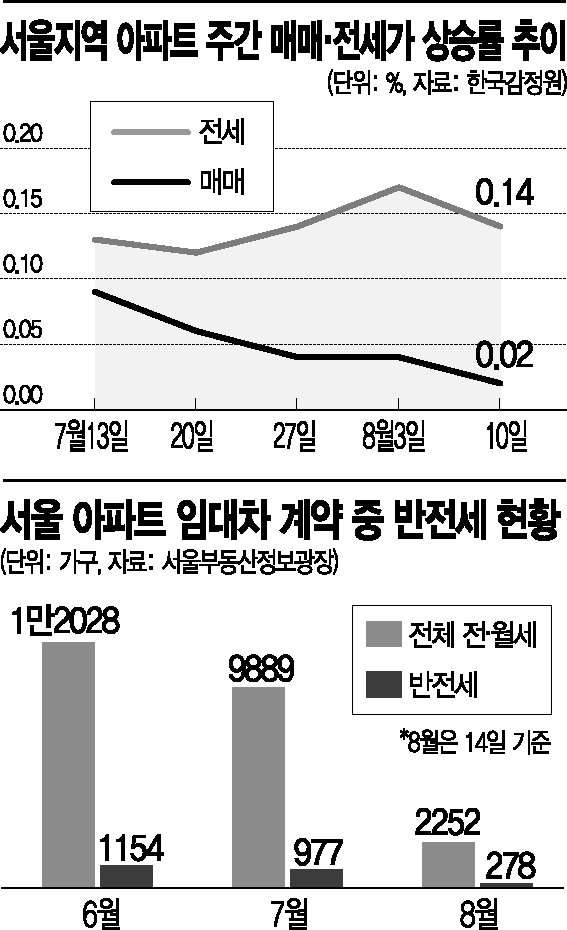
In this atmosphere, jeonse prices have been rising for 59 consecutive weeks. According to the Korea Real Estate Board, Seoul apartment jeonse prices (as of the 10th) rose by 0.14% compared to the previous week. Although the increase rate has slowed compared to last week's 0.17%, it still maintains a rise above 0.10%. A Korea Real Estate Board official said, "The lack of jeonse listings is causing ongoing supply-demand instability, and prices are unstable due to landlords asking for significantly higher deposits."
The jeonse supply-demand index, which gauges whether supply is sufficient or insufficient, has also soared. According to KB Real Estate Live On, Seoul's jeonse supply-demand index reached 186.9 this week (as of August 10). It has continued to rise since surpassing the 180 mark on July 20. A supply-demand index above 100 indicates a supply shortage, and the higher the number, the more severe the shortage. The monthly jeonse supply-demand index is also expected to exceed 180 this month, following last month's 174.6. The last time the monthly index surpassed 180 was in March 2016 (180.0). At that time, the ratio of jeonse prices to apartment sale prices was close to 75%, but as of last month, it is below 54%.
The proportion of half-jeonse (quasi-jeonse) contracts is also increasing. According to the Seoul Real Estate Information Plaza, as of the 14th of this month, half-jeonse accounts for 12.34% (278 out of 2,252) of all jeonse and monthly rent contracts in Seoul, up from 9.88% in July and 9.59% in June. Half-jeonse refers to contracts where the deposit exceeds the equivalent of 240 months of monthly rent.
Experts expect this turmoil in the rental market to continue for the time being. Yoon Ji-hae, senior researcher at Real Estate 114, said, "Even with the 5% rule, landlords are trying to raise prices, and the speed of switching to monthly rent is also fast," adding, "Newly occupied complexes are listing jeonse at prices higher than market rates with a four-year outlook, so there are many factors that will sustain the strong price trend for the time being."
© The Asia Business Daily(www.asiae.co.kr). All rights reserved.
![Clutching a Stolen Dior Bag, Saying "I Hate Being Poor but Real"... The Grotesque Con of a "Human Knockoff" [Slate]](https://cwcontent.asiae.co.kr/asiaresize/183/2026021902243444107_1771435474.jpg)















