Longest Monsoon Period in History... Impact of Global Warming
Floods, Heatwaves, and Other Extreme Weather Phenomena Worldwide
Experts: "Extreme Weather Events Will Become More Frequent"
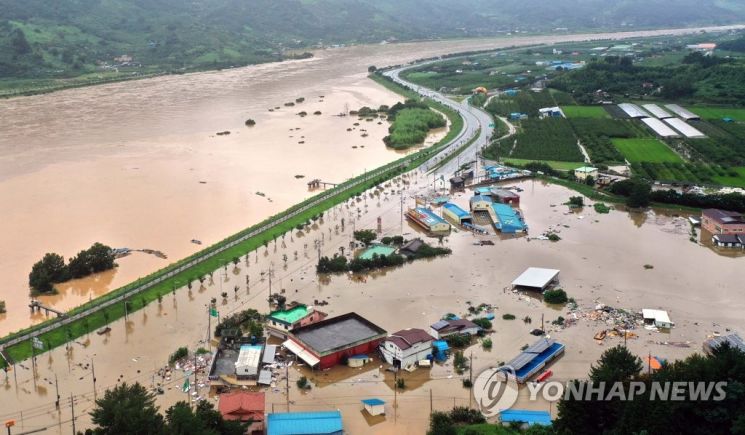 On the afternoon of the 8th, the area around Dugok Village, Dugok-ri, Hadong-eup, Hadong-gun, Gyeongnam, was submerged due to heavy rain that started the previous day. Photo by Yonhap News
[Asia Economy Reporter Han Seung-gon, Intern Reporter Kang Joo-hee] As the rainy season continues for over a month and record-breaking heavy rains cause widespread flooding damage nationwide, concerns about abnormal weather phenomena are growing amid analyses attributing the cause of this rainy season to global warming. Experts predict that abnormal climate events caused by global warming will become more frequent.
The rainy season, which began on June 24 in the central region, is expected to be recorded as the longest rainy season ever, continuing for 49 days until today (the 11th).
According to the Korea Meteorological Administration on the 10th, the longest rainy season in South Korea was 49 days in 2013, and the latest end date of the rainy season was August 10, 1987. This rainy season is expected to continue until mid-month, and on the 12th, one day later, it is likely to surpass the record for both duration and end date with 50 days.
The average precipitation during the rainy season has also increased significantly. According to the Korea Forest Service announcement on the 10th, the nationwide average precipitation from the start of the rainy season until the 9th of this month reached 750mm, double the 406.5mm recorded during the longest rainy season period (49 days) in 2013.
Due to the record rainfall and prolonged rainy season, casualties and property damage have also increased. According to the Central Disaster and Safety Countermeasures Headquarters announcement on the 9th, since the start of the rainy season, 38 people have died and 12 are missing due to heavy rains. Continuous heavy rains have weakened the ground, resulting in 1,079 landslide incidents nationwide from June to the present.
 Hashtags and images created by Climate Crisis Jeonbuk Emergency Action to raise awareness of the severity of the climate crisis among citizens. Photo by Climate Crisis Jeonbuk Emergency Action
The Korea Meteorological Administration analyzes that the cause of this rainy season is that the North Pacific High pressure system in the south has been unable to push away the cold air coming down from the north and has stagnated over the central region of the Korean Peninsula.
As the Earth's temperature rises and the average temperature in Eastern Siberia has increased by more than 10 degrees Celsius, warm air has accumulated, causing a blocking phenomenon that obstructs atmospheric flow. Additionally, the rise in Arctic temperatures has weakened the jet stream circulating around the polar region, allowing cold air to move southward to the mid-latitude region where South Korea is located, blocking the northward movement of the North Pacific High. This is also identified as a cause.
Ultimately, the fundamental cause of the heavy rains centered in East Asia is analyzed to be the global warming phenomenon.
Consequently, on social networking services (SNS) and online communities, a hashtag campaign titled '#The_name_of_this_rain_is_not_the_rainy_season_but_the_climate_crisis' is spreading to raise awareness of the seriousness of this rain and the climate crisis, reflecting growing concerns about abnormal climate phenomena.
Netizens are participating in the hashtag campaign with responses such as "We need to understand properly to reduce repeated damage," "This rainy season is an aspect of the climate crisis," and "The seriousness of the climate crisis must be recognized and related policies implemented quickly."
Not only in Korea but worldwide, cases of abnormal weather and resulting damages are occurring continuously.
According to Kyodo News and others, Japan experienced record heavy rains centered in the Kyushu region from the 4th of last month, resulting in about 70 deaths. Rivers overflowed in 105 locations across 14 prefectures, and approximately 15 million square meters of land were flooded. The Japanese government designated the heavy rain damage centered in Kyushu as a "Specified Emergency Disaster" at a cabinet meeting held on the 14th of last month.
In China, floods continuing for two months in the southern region have displaced over 50 million people. The Three Gorges Dam, which plays a key role in flood control along the Yangtze River basin?the longest river in China?is recording high water levels daily, raising concerns about the dam's safety.
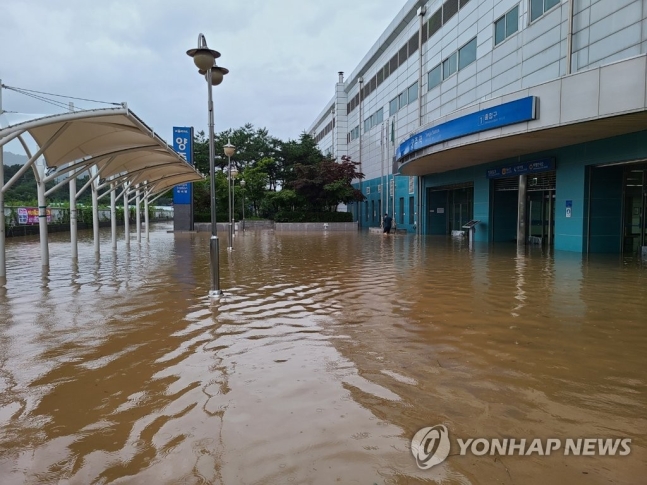 On the afternoon of the 10th, heavy rain in Yangju-si, Gyeonggi Province caused Yangju Station and nearby roads to be submerged in water. Photo by Yonhap News
Europe is suffering from unprecedented heatwaves day after day. According to AP News and others, on the 30th of last month (local time), the northern Spanish coastal city of San Sebasti?n recorded a temperature as high as 42 degrees Celsius. The Spanish National Meteorological Agency explained that this high temperature phenomenon is the highest level in 65 years since records began in 1955.
In the UK, Heathrow Airport in western London recorded 37.8 degrees Celsius on the 31st of last month, marking the hottest day of the year so far. Fourteen cities in Italy issued emergency heat warnings, and France issued alerts in 101 districts, accounting for one-third of the country.
As abnormal climate phenomena caused by global warming become more frequent, the World Bank (WB) forecasts that by 2050, the number of climate refugees will reach 140 million.
In a report released in 2018, the WB warned, "In addition to the millions already migrating within countries for economic, social, and political reasons, migrants due to climate change will be added."
Experts emphasize that abnormal weather phenomena caused by global warming will occur more frequently in the future and that efforts to prevent them are necessary.
Yoon Ki-han, a spokesperson for the Korea Meteorological Administration, said in a phone interview with Asia Economy, "Just as water boils and produces steam and temperatures rise, the Earth's temperature is increasing, accelerating atmospheric flows and causing abnormal weather phenomena in various places. This rainy season can also be seen as an abnormal weather event caused by the effects of global warming."
He added, "Abnormal weather caused by global warming can appear in various forms. In the summers of 2016 and 2018, it manifested as extreme heatwaves, and last summer, seven typhoons struck the Korean Peninsula. This year, due to various factors, it has manifested as heavy rains. Events that used to occur once a year now happen multiple times within a year. As five or ten years pass, the frequency will increase. With more frequent weather fluctuations, predicting and forecasting will become more difficult," expressing concern.
Regarding ongoing heavy rains and other abnormal weather phenomena, experts urge improvements in lifestyle, such as protecting green spaces. Ahn Byung-ok, a member of the National Climate and Environment Council, stated on CBS Radio's 'Kim Hyun-jung's News Show' in 2018, "We have sufficient methods to prevent climate change. We need to change our lifestyle and behavior by using renewable energy that saves energy and protecting green spaces around us," he emphasized.
© The Asia Business Daily(www.asiae.co.kr). All rights reserved.
![Clutching a Stolen Dior Bag, Saying "I Hate Being Poor but Real"... The Grotesque Con of a "Human Knockoff" [Slate]](https://cwcontent.asiae.co.kr/asiaresize/183/2026021902243444107_1771435474.jpg)

















