[Asia Economy Reporter Koo Chae-eun] Following LG Uplus, Netflix has partnered with KT, unleashing a 'Netflix-originated tsunami' in the domestic paid broadcasting market.
With LG Uplus IPTV subscribers at 4.36 million (13%) and KT adding 7.38 million (22%), a total of 11.74 million (35%) IPTV subscribers in Korea can now watch Netflix on their large home TV screens. This is why concerns are deepening over Netflix's encroachment into the online video service (OTT) market and the dependency on its content ecosystem. However, the content industry also holds expectations that Netflix's expansion as a 'platform' will positively impact content investment and exports.
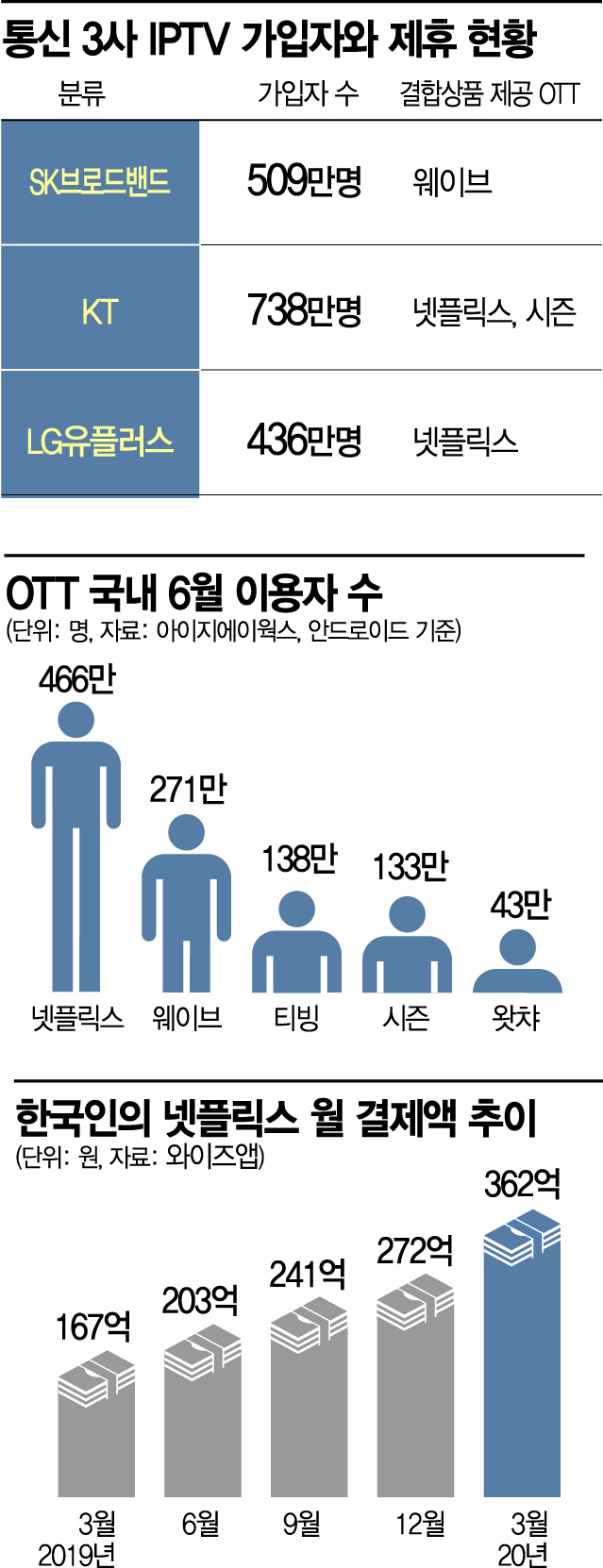
◆Will Netflix's Dominance Strengthen?
According to industry sources on the 10th, the partnership between KT and Netflix immediately converts 7.38 million IPTV subscribers into potential Netflix customers. Existing KT subscribers can enjoy Netflix on their TV screens simply by entering their email in the Olleh TV set-top box menu. For KT, this appears to be a measure to expand customer choice and strengthen subscriber lock-in effects as Netflix emerges as a major player in the domestic media market. Previously, LG Uplus, which signed an exclusive partnership with Netflix in 2018, saw its subscriber count surge from 3.87 million in the second half of that year to 4.36 million a year later.
However, there is criticism that KT, the number one paid broadcasting operator in Korea, has easily handed over its paid broadcasting platform to a global OTT giant. Professor Choi Sung-jin of Seoul National University of Science and Technology stated, "KT, which holds a significant share of paid broadcasting, has made it easy to access foreign content rather than fostering domestic content and creating an environment where content is properly valued. This is negative for the industry ecosystem," adding, "Broadcasting Program Providers (PPs), the foundation of Korea's content market, could be rapidly pushed out of the market."
Senior Specialist Ahn Jeong-sang of the Democratic Party also expressed concerns, saying, "Platform operators may reduce content investment and increase dependence on overseas content." Ahn particularly noted, "For example, if users access Netflix through affiliated platforms, they cannot watch Disney Plus, TVING, or Wavve content, leading to exclusive fragmentation of channels, which is negative from the perspective of user welfare," and added, "Additional consideration is needed regarding equal access rights to content."
◆Content and Platform Must Cooperate
On the other hand, the content industry expresses expectations that Netflix's financial power can produce high-quality content. The sequence is 'KT partnership → increase in Netflix viewers → increased Netflix investment in Korean originals → expansion of the content market,' making overseas market entry much easier. A content industry insider said, "In a situation where many domestic platform operators, including telecom companies, do not pay fair prices for content and exercise dominance as the 'gap' (甲), Netflix's expansion is positively viewed in reverse," adding, "They can make bold investments and help open overseas distribution channels."
Therefore, experts emphasize the importance of domestic platform operators' roles. Platform operators should join the ranks of paying fair prices for content to support the growth of Broadcasting Program Providers (PPs) while also forming alliances with foreign platforms on the basis of 'economies of scale' to grow the overall market. Otherwise, Netflix concentration will further reduce the ratings of existing PPs, intensifying the vicious cycle of 'sharp decline in advertising → decrease in content fees → concentration on foreign OTTs.'
Professor Choi Sung-jin said, "If platform operators such as telecom companies pay appropriate fees for content while partnering with Netflix, they can ultimately create a competitive structure comparable to foreign content."
There is also a view that 'alliances and realignments' among domestic platform operators are important. It is diagnosed that 'super cooperation' is needed to resolve conflicts between the platform and content camps. A representative case is the Ministry of Science and ICT mediating the conflict over program usage fees with CJ ENM, which nearly led to a 'blackout' (channel transmission suspension) incident.
Professor Shin Min-su of Hanyang University said, "Since both domestic platform operators and Netflix are increasing investments in content intellectual property (IP), strategic conflicts will inevitably arise," adding, "Platform operators need to establish vertical integration strategies covering content, IP, distribution, commerce, and management, while cooperation and coexistence between platform operators and content providers are necessary."
© The Asia Business Daily(www.asiae.co.kr). All rights reserved.
![Clutching a Stolen Dior Bag, Saying "I Hate Being Poor but Real"... The Grotesque Con of a "Human Knockoff" [Slate]](https://cwcontent.asiae.co.kr/asiaresize/183/2026021902243444107_1771435474.jpg)















