Review of Lowering and Mandating Jeonse-to-Wolse Conversion Rate
Bill Proposed to Impose Fines for Violations
Distortion of Market Price-Setting Function
"Regulation Infringing Property Rights Should Be a Last Resort"
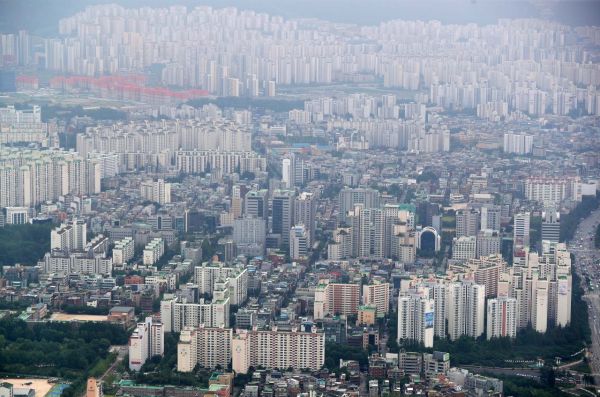
[Sejong=Asia Economy Reporter Joo Sang-don] As the government formalizes the policy to lower the 'Jeonse-to-Wolse conversion rate' applied when switching from Jeonse (lump-sum deposit lease) to Wolse (monthly rent), voices of criticism are emerging. Economists warn of 'market distortion,' while legal scholars express concerns about 'constitutional controversies due to infringement of private property rights.'
The spark for the controversy over the Jeonse-to-Wolse conversion rate was ignited by Kim Hyun-mi, Minister of Land, Infrastructure and Transport. On the 4th, she appeared on a broadcast and stated, "I think the 3.5% plus over the base interest rate is somewhat excessive, so I am considering lowering the Jeonse-to-Wolse conversion rate." The ruling party immediately responded the next day. Kim Tae-nyeon, floor leader of the Democratic Party of Korea, said, "We will consider measures to minimize landlords switching from Jeonse to Wolse." There is discussion about lowering the current 4% conversion rate to the 2% range and making it mandatory rather than advisory. Independent lawmaker Lee Yong-ho has proposed a bill to impose fines up to 20 million KRW if landlords charge Wolse higher than the conversion rate.
On the 6th, Hong Ki-yong, professor of Business Administration at Incheon National University, told Asia Economy in a phone interview, "Lowering and mandating the Jeonse-to-Wolse conversion rate is a measure that deviates from market economy principles," adding, "It eliminates the market function determined by supply and demand, which will ultimately accelerate the contraction and shrinkage of the rental market."
Professor Park Ji-soon of Korea University Law School sees a constitutional issue with the mandatory application of the Jeonse-to-Wolse conversion rate. Professor Park said, "The basic spirit of the constitution allows some restrictions on property rights if it contributes to public welfare," and noted, "The government enforces various real estate regulatory policies based on this, but both the regulatory grounds and the expected effects lack relevance."
There must be a premise that "Jeonse or Wolse is a major social problem or fundamentally obstructs the exercise of private property rights, or that the fundamental order of housing policy is being shaken," but such justification or grounds are lacking. Especially, the lowering and mandating of the Jeonse-to-Wolse conversion rate started with the intention to 'control housing prices,' but there is doubt whether 'stabilizing Jeonse and Wolse prices leads to housing price stabilization,' so it does not align with its purpose.
Professor Park emphasized, "Even if the constitution permits restrictions on property rights, it does not mean 'use it first' or 'use it whenever the government thinks necessary,'" adding, "Direct intervention and infringement on citizens' property rights should be a last resort."
Song In-ho, head of the Economic Strategy Research Department at the Korea Development Institute (KDI), advised that incentives rather than penalties for landlords are needed to stabilize the Jeonse and Wolse market. Song said, "The rental market is diverse and complex, including one-room apartments, officetels, apartments, and villas, so it is not easy to operate by uniformly setting numbers," and added, "In the current low-interest-rate environment, the shift from Jeonse to Wolse is natural, so it is better to provide tax benefits to landlords who maintain Jeonse or convert Wolse back to Jeonse."
© The Asia Business Daily(www.asiae.co.kr). All rights reserved.
![Clutching a Stolen Dior Bag, Saying "I Hate Being Poor but Real"... The Grotesque Con of a "Human Knockoff" [Slate]](https://cwcontent.asiae.co.kr/asiaresize/183/2026021902243444107_1771435474.jpg)















