Nearly Double Floor Area Ratio Increase
Shortened Review Period for Relaxed Floor Limit Regulations
Negative Participation in Gangnam Area Despite Incentives
More Than Half of Donations Are Public Rentals
Excessive Proportion of Rental Households Also a Problem
[Asia Economy Reporters Donghyun Choi, Onyu Lim] "Are they now trying to blame the reconstruction complexes for not cooperating if the supply doesn't increase?" (A representative from Yeouido A Reconstruction Association)
The response from major reconstruction complexes in Seoul to the government's 'Public Participation High-Density Reconstruction (Public Reconstruction)' plan, presented as a key measure to expand housing supply in Seoul in the August 4 real estate policy, was colder than expected. Despite various incentives such as nearly doubling the floor area ratio (FAR), easing height restrictions, and shortening review periods, complexes in the Gangnam area showed a negative stance toward participating in the project. However, some complexes with existing FARs exceeding 200%, where profitability is low, expressed that they might consider it if the government presents specific plans.
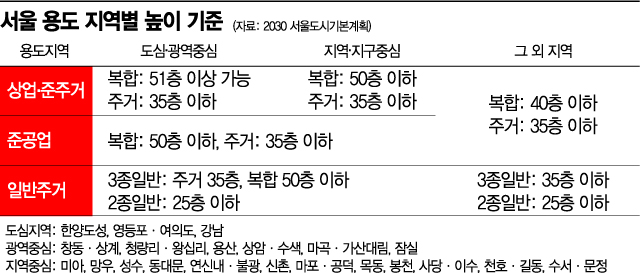
According to the opinions gathered on the 5th from major reconstruction complexes in Seoul, the main reasons for reluctance to participate in public reconstruction are summarized as ▲excessive donation requirements ▲high proportion of rental units ▲excessive profit recovery. Compared to the carrot of allowing reconstruction with a maximum FAR of 500% and up to 50 floors if public enterprises such as Korea Land & Housing Corporation (LH) and Seoul Housing & Communities Corporation (SH) participate as project operators, the trade-offs are considered too large.
◆General sales increase by 36% but donation increases fivefold = The donation required by public reconstruction is about 50-70% of the increased FAR. For example, if a complex with 500 households applies the existing method with a FAR of 300% (the ordinance cap of 250% for donation), there would be 550 households for association members and general sales, and 50 households for donation. However, if the FAR of 500% is applied through public reconstruction, the number of association members and general sales households increases to 750, while donation households increase to 250. While the number of association members and general sales households increases by 36.3%, the donation increases fivefold. A representative from the Yeouido Sambu Apartment Reconstruction Promotion Committee said, "Public reconstruction should be done on national or public land, so I question why it is done on private land," adding, "There is no interest because the existing project plan is sufficient."
◆Resistance to excessive rental units = There is also concern that the proportion of rental units is excessively high. The government plans to use more than half of the recovered units through donation as long-term public rental housing and supply the rest as public sales. Taking Eunma Apartment, a major reconstruction complex in Gangnam-gu, as an example, this complex currently has a FAR of 202% and 4,424 households. If a FAR of 300% is applied, it would increase to 6,570 households, and with 500%, to 10,950 households. Although this is a simple calculation without considering area weighting, participating in public reconstruction would add about 4,380 households. Of these, up to 70%, about 3,000 households, would be donated, and more than half of those must be rental units. Lee Jung-don, chairman of the Eunma Apartment Reconstruction Promotion Committee, said, "The costs such as construction costs due to the increase in households are borne by the association members," adding, "The increased density within the complex reduces residential comfort, so association members pursuing a premium complex will not welcome this."
◆90% of expected profits recovered... the idea of 'building rentals with private money' = Some complexes raised their voices, saying that costs have already increased due to strengthened safety inspections, the reconstruction excess profit recovery system, and the price ceiling system, and they cannot bear additional costs. Hong Nam-ki, Deputy Prime Minister and Minister of Economy and Finance, stated the day before, "More than 90% will be recovered based on the expected rate of return from the FAR increase." Jung Bok-moon, chairman of the Jamsil Jugong 5 Complex Reconstruction Association, emphasized, "If the donation ratio is about 50%, it can be considered, but if they ask for a higher ratio under regulations such as the price ceiling and excess profit recovery system, there will be strong opposition from association members."
◆Concerns about asset value decline due to high density = There were also many voices opposing in mid-rise complexes in Mokdong and 1-to-1 reconstruction complexes in Gangnam due to traffic congestion, lack of profitability, and inconsistency with the development direction of the complexes. Choi Seok-gu, vice president of the Yangcheon Development Citizens' Coalition, said, "I think even the current FAR of 300% requires additional traffic measures such as the Mokdong Line to proceed smoothly, so increasing it to 500% would be unmanageable." A representative from a real estate agency near Apgujeong Hyundai Apartment (3rd district) said, "Apgujeong Hyundai has many medium and large units, so they do not want many small rental units," adding, "The association members plan a 1-to-1 reconstruction, so it will be impossible to get more than two-thirds consent for public reconstruction participation."
However, some outer Seoul areas such as Sangye-dong in Nowon-gu showed responses that they might consider participating in public reconstruction. This is based on the judgment that, with the FAR close to 200% and low reconstruction possibility, profitability can be increased by expanding the supply volume through FAR increase. A resident of Sangye Jugong 7 Complex said, "Since it is still in the early stage and has not passed the safety inspection, we plan to calculate the cost-benefit including participation in public reconstruction."
© The Asia Business Daily(www.asiae.co.kr). All rights reserved.
![Clutching a Stolen Dior Bag, Saying "I Hate Being Poor but Real"... The Grotesque Con of a "Human Knockoff" [Slate]](https://cwcontent.asiae.co.kr/asiaresize/183/2026021902243444107_1771435474.jpg)















