274 Bills Proposed in Two Months of the 21st National Assembly
41 Amendments Related to the Labor Standards Act
Regulations on Large Stores Also Frequent Bills
"Urgent Need for Checks on Legislative Dominance"
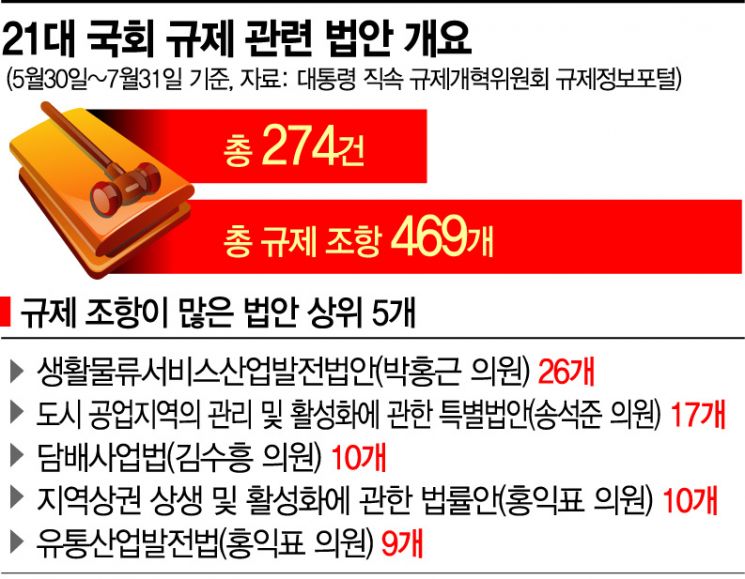
[Asia Economy Reporter Kiho Sung] It has been revealed that during the two months since the start of the 21st National Assembly's term, an average of 6 regulatory bills were proposed per day, totaling 274 bills. This accounts for 11.6% of the total 2,354 bills proposed in the form of member legislation over two months. This is analyzed as a result of competitive flooding of 'corporate tightening' regulatory bills centered on the ruling party. The business community expresses concern over the continuous proposal of regulatory bills that run counter to the policy direction of revitalizing the economy and creating jobs, despite the growing economic crisis theory due to the novel coronavirus infection (COVID-19) situation.
According to the Regulatory Reform Committee's Regulatory Information Portal under the President's Office on the 3rd, a total of 274 regulatory bills were proposed over 45 days excluding weekends and holidays when bill submissions were not made, from May 30 to July 31 during the 21st National Assembly period. The total number of regulatory provisions included in these bills was 469. The Regulatory Information Portal publicly discloses the processing status in real-time by the Legislative Affairs Office for bills proposed by members that include new or strengthened regulations. The field with the most regulatory bills submitted is labor. Since the start of the 21st National Assembly, 41 bills to partially amend the Labor Standards Act have been proposed. There are 24 bills to partially amend the Fair Trade Act and 9 bills to amend the Commercial Act awaiting review. Of the 8 bills to partially amend the Distribution Industry Development Act, 6 were proposed by ruling party members.
By standing committee, 37 regulatory bills were proposed in the Industry, Trade, Energy, Small and Medium Business Committee, where the Distribution Industry Development Act is discussed. This is followed by the Environment and Labor Committee related to labor with 27 bills, and the Planning and Finance Committee, which handles the Basic Act on Service Industry Development, with 22 bills. It is not only member legislation. The government is also preparing for parliamentary review after completing legislative notice for the Fair Trade Act and Commercial Act amendments, classified as part of corporate regulatory bills. These two bills are expected to be submitted to the National Assembly in the form of government legislation as early as this month. Although leading domestic economic organizations such as the Federation of Korean Industries and the Korea Employers Federation have jointly submitted opinions opposing these two bills, they are expected to pass smoothly through the National Assembly and be implemented.
The business community points out the need for mechanisms to check the legislative dominance of the government and the ruling party. The United States' 'two-for-one rule,' which eliminates two regulations for every new one introduced, is a representative example. This system, strongly enforced by former President Donald Trump, achieved the result of abolishing 7.6 existing regulations for every new regulation introduced during his three years in office. Through this, regulatory costs were reduced by a total of $44.6 billion (approximately 53.4 trillion KRW). In the UK, the House of Lords and the House of Commons currently operate the Regulatory Reform Committee (RRC) and the Deregulation and Regulatory Reform Committee (DPRRC), respectively, to guide the government's regulatory reform direction.
© The Asia Business Daily(www.asiae.co.kr). All rights reserved.
![Clutching a Stolen Dior Bag, Saying "I Hate Being Poor but Real"... The Grotesque Con of a "Human Knockoff" [Slate]](https://cwcontent.asiae.co.kr/asiaresize/183/2026021902243444107_1771435474.jpg)















