Player Choi reports damage... Investigator repeats "Evidence needed"
Civic group "Failing to protect players' human rights... Deserved criticism"
Expert "Complacent response worsens violence issues in sports community"
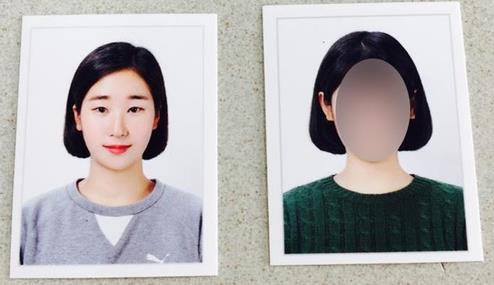 A 2016 ID photo of the late athlete Choi Sook-hyun, who took her own life due to abuse. Photo by Yonhap News
[Asia Economy Reporter Kim Suwan] Amid ongoing investigations into the case of the late Choi Sook-hyun, a triathlon athlete who took her own life due to harsh treatment within her team, the Korea Triathlon Federation, Gyeongju City Sports Council, and the National Human Rights Commission have all consecutively taken measures. However, these efforts have been met with criticism as 'belated responses.' These organizations are being accused of neglecting the situation despite being aware of Choi's circumstances.
In particular, since issues such as verbal abuse and physical violence within the sports community have long been pointed out as human rights violations, there are growing calls for the institutions that failed to respond actively to take responsibility. Experts analyze that the problem lies in the institutions and organizations receiving reports or complaints not taking abuse and verbal violence seriously. They are criticized for focusing more on covering up incidents than on victim relief.
On the 8th, the Gyeongju City Sports Council filed a complaint with the Daegu District Prosecutors' Office, Gyeongju branch, accusing An Juhyun, a sports therapist known as the team doctor, of sexual harassment and assault, based on testimonies from triathlon team athletes affiliated with Gyeongju City Hall.
On the same day, the Gyeongbuk Provincial Police Agency's Metropolitan Investigation Unit announced that they had secured victim testimonies regarding harsh treatment from more than 15 of the 27 current and former triathlon athletes and were verifying facts concerning two individuals.
The Human Rights Commission decided on the 7th to issue a recommendation to the President emphasizing a more fundamental national responsibility. Alongside this, they stressed that detailed improvements would be supplemented to ensure the current system for preventing and protecting athletes' human rights functions properly, and these detailed recommendations would be officially announced.
On the 6th, the Triathlon Federation held a Sports Fairness Committee meeting and imposed permanent expulsion as a severe disciplinary action on Kim Gyubong, the Gyeongju City Hall coach, and key senior athletes identified as perpetrators in Choi's case.
Earlier, before her death, on March 5th, Choi had filed a complaint with the prosecution against Coach Kim of Gyeongju City Hall, sports therapist An, and senior athletes, stating that "harsh treatment continued during training." Choi also appealed multiple times to the Human Rights Commission and sports councils, but no one properly listened to her.
Additionally, although she reported the assault to the police, the police reportedly maintained a lukewarm investigation, citing the perpetrators' denials as the reason.
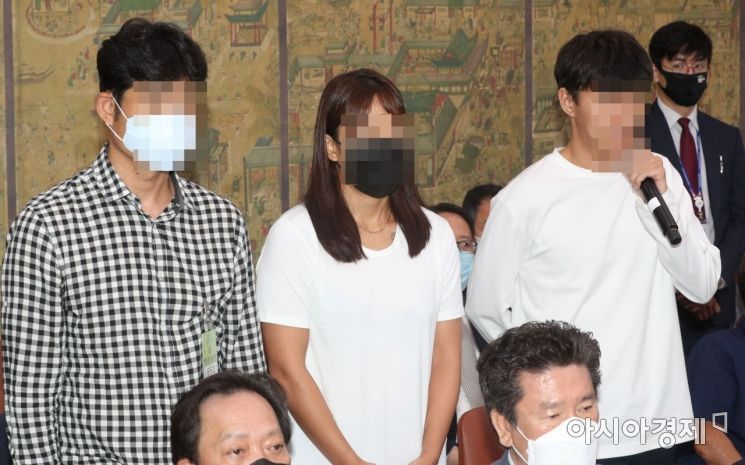 The coach and senior athletes of the Gyeongju City Triathlon Team appeared on the 6th at the National Assembly for an urgent inquiry regarding the late athlete Choi Sook-hyun's death, responding to questions from lawmakers. Photo by Dongju Yoon doso7@
Ultimately, after filing six complaints with five institutions without resolution, Choi became despondent. This was clearly revealed in a phone call she had with an investigator from the Korea Sports Council's Sports Human Rights Center the day before her death.
According to YTN, on the 25th of last month, the day before her suicide, Choi spoke with an investigator from the Korea Sports Council after finishing training.
In the call, Choi said, "They always told us it was for plane tickets and collected money, but they never said it would be used for training expenses," and added, "It turns out that Gyeongju City Hall covered all the plane ticket costs."
When the investigator requested, "If you have evidence to refute this, please send it," Choi replied, "We don't have such evidence right now."
The investigator also asked, "Please organize the details of how much was deposited and how many times from when to when," and "If there are additional materials regarding the plane ticket payments, please send them." Although Choi reported facts such as assault, verbal abuse, and embezzlement, she was disheartened by the response that she needed to submit evidence to prove her claims.
Notably, the Human Rights Commission launched a 'Special Sports Human Rights Investigation Team' in January last year, strongly expressing its determination to eradicate violence in sports. Given the ongoing issues in the sports community, the intention was to conduct thorough investigations and punishments to prevent recurrence.
However, by the end of last year, despite the special investigation team's launch, 127 online and offline reports related to violence, sexual violence, and human rights violations in sports were received by the Human Rights Commission, but recommendations were made in only 11 fact-finding investigations and 14 complaint cases.
Given this situation, civic groups and others are raising their voices to hold these institutions accountable. They argue that if even one of these organizations had conducted an investigation, this tragic incident might have been prevented.
On the 8th, 35 civic groups, including the Sports Citizens' Solidarity and the Sports Human Rights Research Institute, issued a joint statement saying, "Although the Human Rights Commission formed a special investigation team, it failed to prevent Choi's death," and criticized, "As a national human rights institution and a state agency with a special sports human rights investigation team, it should have prioritized protecting athletes' human rights but made complacent judgments."
They continued, "The delay in the Human Rights Commission's recommendations betrays the desperate hopes of athletes who earnestly expected investigations, victim relief, and punishment of those responsible, and thus deserves criticism."

According to the 'Survey on the Human Rights Status of Professional Team Athletes' published by the Human Rights Commission last year, 45% of respondents said they 'could not take any action' when facing difficulties in their team life.
Additionally, only 3.7% (21 athletes) sought help, and nearly half (47.6%) responded that the help they received was 'of no use.' Despite operating the special investigation team, it failed to achieve effectiveness.
Experts analyze that the complacent response of related institutions has exacerbated the problem of violence within the sports community. Lee Yong-ho, an independent lawmaker promoting the 'Choi Sook-hyun Act' to prevent recurring daily violence, appeared on YTN Radio's 'Noh Young-hee's Start Morning' and pointed out that the related institutions did not help Choi because "there was no functioning system within the sports community for victims to appeal."
He added, "Rather, they protected each other and tried to cover up the issues, fearing problems would arise," emphasizing, "Because of these faults, it is urgent to establish relief measures that can produce results quickly."
Meanwhile, as criticism for solving problems in the sports community intensifies, Democratic Party lawmaker Im Ok-kyung proposed an amendment to the Sports Promotion Act on the 8th to strengthen disciplinary management of perpetrators to address athlete assault issues.
The amendment includes incorporating cases with suspended disciplinary procedures into the disciplinary information system of the Sports Ethics Center, which will be launched under the Ministry of Culture, Sports and Tourism next month, and strengthening the Minister of Culture, Sports and Tourism's on-site inspection and supervision duties.
Earlier, on the morning of the 26th of last month, Choi was found dead at a lodging in Busan after leaving a text message to her family saying, "Please reveal the crimes of those who tormented me."
Choi had reported to the Korea Sports Council's Sports Human Rights Center in April that she had been subjected to continuous verbal abuse and physical violence by the coach and teammates of Gyeongju City Hall, but she lamented that neither the Korea Sports Council, Korea Triathlon Federation, nor the Gyeongbuk Sports Council listened to her voice.
※ If you need expert help for difficult issues such as depression, you can receive 24-hour counseling at the Suicide Prevention Hotline 1393, Lifeline 1588-9191, or Youth Hotline 1388.
© The Asia Business Daily(www.asiae.co.kr). All rights reserved.
![Clutching a Stolen Dior Bag, Saying "I Hate Being Poor but Real"... The Grotesque Con of a "Human Knockoff" [Slate]](https://cwcontent.asiae.co.kr/asiaresize/183/2026021902243444107_1771435474.jpg)

















