Flexible Commuting Attire
Practical Casual Wear Preferred Over Formal Business Suits
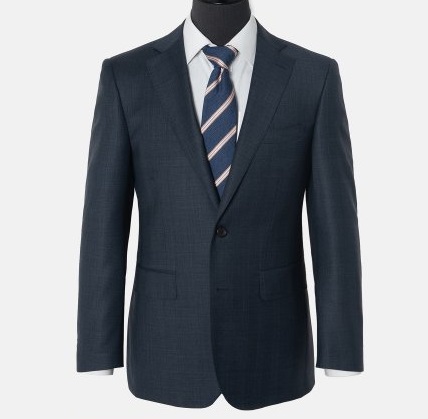
[Asia Economy Reporter Lim Hye-seon] The prestige of men's formalwear brands is declining. As the domestic industrial structure diversifies from manufacturing-centered to IT, fashion, cosmetics, pharmaceuticals, and bio sectors, the corporate culture that enforces suit-wearing for work is disappearing. Practicality is a given, and with the growing demand from younger generations to express individuality, autonomy over work attire has increased.
According to the distribution industry on the 3rd, Lotte Department Store Yeongdeungpo Branch, currently undergoing renovation, has decided to reduce the floor space for suits and shirts product categories by 20%. Earlier, Shinsegae Department Store reduced the floor space for suits and shirts product categories last year. Business withdrawals of brands related to men's formalwear are also continuing. Louis Quatorze Shirts is closing its business this year. 'Maeil24356,' a shirt-specialized brand by Shinseong Tongsang, ceased operations just over a year after its launch in March last year. Lotte Department Store's private brand (PB) shirt brand Herborn also closed after 14 years. Men's formalwear brands, which had been experiencing declining sales for several years, were hit hard by the COVID-19 pandemic. With the increase in remote work, purchases of men's formalwear plummeted. According to Lotte Department Store, sales of suits and shirts product categories from January to June this year decreased by 28% compared to the same period last year.
In the early 2000s, when not wearing a suit to work was taboo, men's formalwear brands in department stores often recorded daily sales exceeding 100 million KRW. On October 14, 2001, when the economy began to recover after overcoming the IMF financial crisis, the daily sales at Galaxy and Maestro stores in Lotte Department Store's main branch were 103.9 million KRW and 102 million KRW, respectively. Recently, men's formalwear stores that recorded 100 million KRW in sales 20 years ago are struggling to reach even 20 million KRW in daily sales on average.
According to the Korea Federation of Textile Industries, the domestic men's clothing market, which was worth 6.8668 trillion KRW in 2011, sharply declined by 40% to 4.0995 trillion KRW in 2018. Last year, the market size fell to the 3 trillion KRW range. Fashion companies have either closed or merged their men's formalwear brands. In the past five years, five major men's formalwear brands have disappeared domestically: Pal Zileri, Townzent, Eleventy, Belstaff, and Banhart Di Albazah. Including brands that have exited offline business or abandoned suit lines, the number exceeds ten.
A department store official explained, "Due to the liberalization of work attire, casual shirts are gaining attention over traditional dress shirts," adding, "In the case of suits, sales of custom-made products are increasing." The premium custom shirt brand operated by Shinsegae Department Store itself recorded a 4.5% sales increase in the first half of this year compared to the same period last year.
Fashion companies are reducing the proportion of suits and expanding casual product volumes to survive. LF's Maestro has recently focused on coordinated styling centered on combos and significantly increased the release of single-item jackets, shirts, and pants that can also be used for casual purposes. As a result, the product composition ratio of suits to casual wear, which was about 70:30 in 2009, has reversed to 30:70 this year, with the proportion of casual product lines increasing.
© The Asia Business Daily(www.asiae.co.kr). All rights reserved.
![Clutching a Stolen Dior Bag, Saying "I Hate Being Poor but Real"... The Grotesque Con of a "Human Knockoff" [Slate]](https://cwcontent.asiae.co.kr/asiaresize/183/2026021902243444107_1771435474.jpg)
















