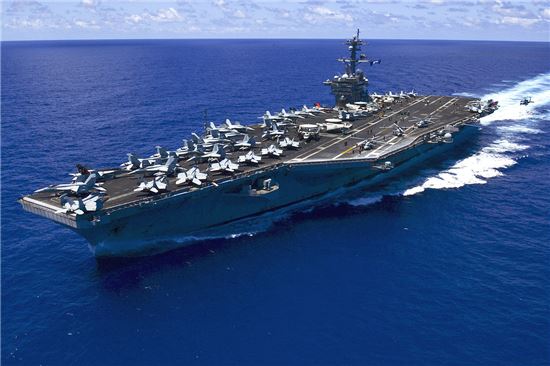
 US Nuclear-Powered Aircraft Carrier Carl Vinson
[Asia Economy Yang Nak-gyu Reporter] The United States has forward-deployed two aircraft carriers, its core power, to the 7th Fleet, which can operate in the Korean Peninsula area. In addition, South Korea and the United States have significantly increased reconnaissance activities for North Korean surveillance, dispatching eight reconnaissance aircraft simultaneously in one day. This appears to be a response to North Korea's announcement of large-scale leaflet distribution against the South and the reinstallation of loudspeaker broadcasting facilities, indicating a real possibility of military provocations.
According to the U.S. Indo-Pacific Command on the 23rd, the aircraft carriers USS Theodore Roosevelt (CVN-71) and USS Nimitz (CVN-68) have been conducting operations in the Philippine Sea since the 21st. The Philippine Sea is within the 7th Fleet's operational area, where it can check Chinese naval power as well as respond to North Korea's threats of military actions against the South. The U.S. military plans to carry out missions such as air defense training, maritime surveillance, long-range strikes, and maneuver training by deploying two aircraft carriers and their strike groups. James Kirk, commander of the 11th Carrier Strike Group, said, "Our operations send a strong message to protect freedom of navigation and lawful use of the seas for the benefit of all nations."
The other aircraft carrier, USS Ronald Reagan, is on standby in the Western Pacific. The USS Ronald Reagan entered waters near the Korean Peninsula in 2017 when North Korea launched the medium-range ballistic missile (IRBM) Hwasong-12 over Japan into the Pacific.
Along with this, surveillance against North Korea has been significantly strengthened. According to the aircraft tracking site 'No callsign,' on the 22nd, one South Korean Air Force airborne early warning aircraft 'Peace Eye,' one U.S. Air Force reconnaissance aircraft Rivet Joint (RC-135W), and six U.S. Forces Korea reconnaissance aircraft Guardrail (RC-12X) conducted surveillance flights against North Korea. It is very unusual for eight South Korea-U.S. reconnaissance aircraft to be dispatched on the same day for North Korean surveillance flights.
The U.S. Forces Korea reconnaissance aircraft belong to the 501st Military Intelligence Brigade under the U.S. 8th Army, responsible for North Korean intelligence. They can additionally deploy intelligence-gathering aircraft such as Guardrail and RC-7. The RC-7 collects COMINT (communications intelligence) and IMINT (imagery intelligence).
South Korean forces are also strengthening surveillance against North Korea through reconnaissance aircraft. They are increasing flight frequency of reconnaissance aircraft such as Geumgang and Baekdu (RC-800), and Saemae (RF-16), and are considering deploying the high-altitude unmanned reconnaissance aircraft Global Hawk (RQ-4). Initially, the Global Hawk was planned to be first operationally deployed in October, with operational guidelines to be supplemented based on operational experience, but due to the unusual movements of North Korea, this plan is being reconsidered.
© The Asia Business Daily(www.asiae.co.kr). All rights reserved.
![Clutching a Stolen Dior Bag, Saying "I Hate Being Poor but Real"... The Grotesque Con of a "Human Knockoff" [Slate]](https://cwcontent.asiae.co.kr/asiaresize/183/2026021902243444107_1771435474.jpg)














