Since North Korea blew up the Inter-Korean Joint Liaison Office, the geopolitical crisis on the Korean Peninsula has escalated again. After demolishing the liaison office in Kaesong on the 16th, North Korea has increased pressure by deploying military units to Mount Kumgang, the Kaesong Industrial Complex, and guard posts (GPs) within the Demilitarized Zone (DMZ). This is why defense industry-related stocks, which had been sidelined in the domestic stock market after the summit between President Moon Jae-in and North Korean State Affairs Commission Chairman Kim Jong-un at the Peace House in Panmunjom on April 27, 2018, have recently surged. Although the government, which is pursuing denuclearization and permanent peace on the Korean Peninsula, will not significantly increase defense spending, it has become difficult to exclude the defense budget from budget prioritization. Asia Economy examines the financial structure and future growth potential of pure defense contractors LIG Nex1 and VICTEK, whose stock prices rise first when inter-Korean tensions escalate.
[Asia Economy Reporter Park Hyung-su] LIG Nex1 leads the domestic defense industry in guided missile systems and defense electronics. It is a pure defense contractor with 100% of its sales generated from the defense industry sector. The sales composition by business segment consists of precision strike (60%), surveillance and reconnaissance (20%), electronic warfare and avionics (11%), and command and control and communications (9%).
◆ Defense contractors' performance affected by defense capability improvement budget = The defense industry is a technology-intensive sector requiring substantial facility investment, advanced complex technologies, and precision. The defense market, which heavily depends on the government, is influenced by the Ministry of National Defense's defense material requirements plan and the government's defense budget allocation. Generally, the defense budget that determines defense contractors' sales is set according to changes in national fiscal management plans and defense and foreign policies. When establishing the defense budget, the government considers inter-Korean relations and the security environment of neighboring countries in Northeast Asia.
This year's defense budget is 50.2 trillion KRW, a 7.4% increase from last year's 46.7 trillion KRW. Among the defense budget, the defense capability improvement budget, which directly affects defense contractors' performance, is 17 trillion KRW, up 8.5% from the previous year. Since defense contractors supply products to the government and the defense budget is steadily increasing, they have a high likelihood of stable growth.
However, defense products must meet high precision and reliability standards, requiring considerable time to secure advanced technology. It is common for new weapon systems to take 5 to 10 years to develop. Even if enormous funds are invested in research and development, success is not guaranteed. There are cases of development failure or government project cancellation. When impairment is recognized on development costs previously recorded as intangible assets, it can negatively impact financial statements.
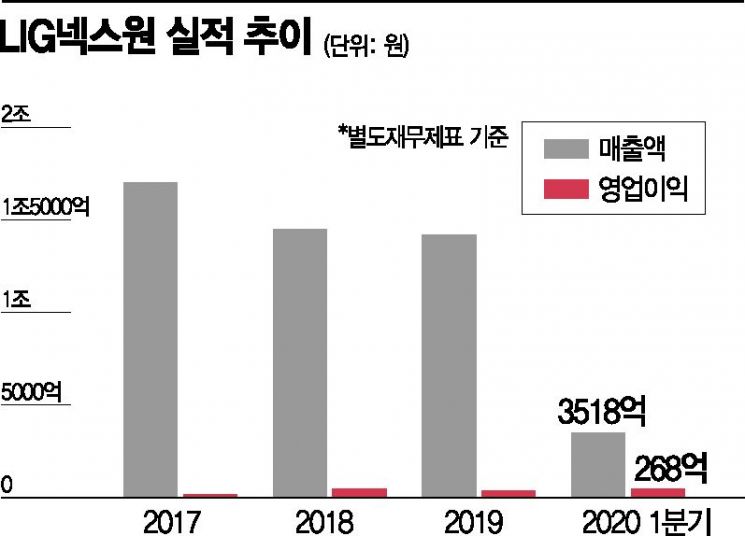
◆ Management capability and dominant position derived from long experience = LIG Nex1 has focused on defense for over 40 years, securing crisis management capabilities and a solid position in guided missiles and radar sectors. Consistent technology investment has also played a role in strengthening competitiveness. The ratio of research and development expenses to sales at LIG Nex1 rose from 2.0% in 2016 to 5.6% at the end of Q1 this year.
Since 2013, government orders related to guided missiles have increased, causing LIG Nex1's order backlog to surge. The order backlog grew from 3.3247 trillion KRW in 2013 to 5.7 trillion KRW in 2015. As the guided missile segment grew, LIG Nex1's sales increased at an average annual rate of 12.7% from 2012 to 2017.
Recent performance has been sluggish due to the termination of the long-range radar project at the end of 2017 and the end of the guided missile mass production project in 2018. Last year, profitability also deteriorated due to delivery delays caused by an explosion accident at a major raw material supplier's factory and the preemptive recognition of liquidated damages. Last year, LIG Nex1 recorded sales of 1.452 trillion KRW and operating profit of 18.1 billion KRW. While operating profit margins were maintained around 5% until 2016, they fell to 1.2% last year.
In Q1 this year, LIG Nex1 posted sales of 351.8 billion KRW and operating profit of 26.8 billion KRW, raising the operating profit margin to 7.6%. Ordinary profit margin was around 4-5%, and additional profits from exports due to the strong dollar exceeded market expectations. The proportion of overseas sales in total sales rose from 6.4% at the end of 2015 to 16.8% in Q1 this year. The company is conducting overseas business in the Middle East, South America, and Asia markets, leveraging its own solutions in various fields required by network-centric warfare (NCW), centered on its core precision strike business, command and control and communications, and surveillance and reconnaissance.
◆ Performance improvement expected as overseas proportion increases = Expectations for improved performance from this year are gaining momentum. Thanks to increased new orders over two years from 2018, the scale of sales to be recognized from the second half of this year has grown. Profitability is also expected to improve due to the domestic defense industry's price-setting structure, which adds profit to cost, the increase in export volumes with relatively high profit margins, and the expansion of mass production business sales ratio. Lee Sang-hyun, a researcher at IBK Investment & Securities, said, "As of Q1 this year, the order backlog is 6.2 trillion KRW," adding, "As the order backlog is reflected in sales, profits will also increase."
As sales increase, the scale of working capital inevitably grows. The defense business sector faces significant uncertainty in the timing of advance payments and accounts receivable collection due to defense budget execution and project schedule changes. Due to the nature of the defense industry, the debt ratio is high because of large advance payments arising from long-term large-scale project orders. LIG Nex1's debt ratio stood at 301.5% at the end of Q1 this year. The debt ratio increased by 36.3 percentage points from 265.2% last year due to an increase in current contract liabilities. Total borrowings slightly increased to 684.2 billion KRW from 631.8 billion KRW last year.
NICE Credit Rating assessed that considering the value of land and buildings exceeding 600 billion KRW, LIG Nex1 has excellent additional financing capability. It also evaluated that financial burden is not significant as the company holds high-quality accounts receivable with high payment ability from the Defense Acquisition Program Administration and the Agency for Defense Development, enabling financing using accounts receivable.
© The Asia Business Daily(www.asiae.co.kr). All rights reserved.
![Clutching a Stolen Dior Bag, Saying "I Hate Being Poor but Real"... The Grotesque Con of a "Human Knockoff" [Slate]](https://cwcontent.asiae.co.kr/asiaresize/183/2026021902243444107_1771435474.jpg)
















