[Asia Economy Reporters Inho Yoo and Yuri Kim] "Why can people who already own a house get jeonse loans, but those without a home trying to buy a 400 million won house cannot?"
The government's June 17 real estate measures have once again sparked controversy over fairness. The binary policy approach that categorically defines any purchase of a house without immediate residence as 'gap investment' and blocks loan access has caused widespread complaints, with many real demand buyers suffering losses. These protests have flooded various online communities as well as the Blue House's national petition board. The plan to deny reconstruction move-in rights unless one lives in a purchased rental house where direct residence is prohibited has led to legal conflicts, further confusing the market. This repeats the controversy over the constitutionality of the December 16 measures last year, which restricted mortgage loans on houses exceeding 1.5 billion won. The key points of the fairness controversy in the current measures are summarized below.
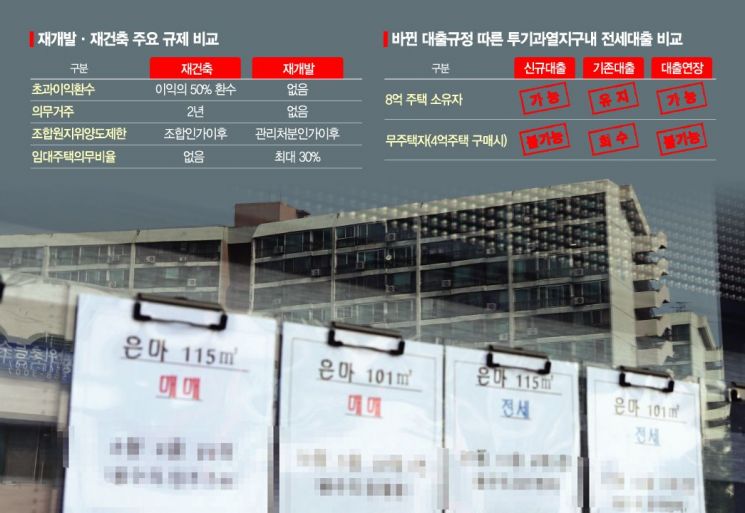
◆Jeonse loans allowed for homeowners with 800 million won houses but denied to non-homeowners= A representative issue drawing complaints from real demand buyers amid loan regulations is the recall of jeonse loans when purchasing houses priced over 300 million won. Non-homeowners who have existing jeonse loans and buy a house exceeding this price in speculative overheated districts face immediate loan recall. The problem is that even in these districts, homeowners with one house priced under 900 million won face no restrictions on maintaining, extending, or newly borrowing jeonse loans. This issue arose because the regulation focuses on blocking new home purchases. Young real demand buyers who planned to buy a house first due to insufficient funds and then cover the costs before moving in have been adversely affected. Experts point out that equating 'real demand' with 'actual residence' in an attempt to block gap investments has backfired on genuine buyers.
◆Two-year residence obligation for reconstruction despite prohibition on direct residence= The 'two-year residence obligation for reconstruction' causes legal conflicts. It requires living in the property for at least two years before applying for reconstruction member allocation to receive move-in rights for the reconstructed apartment. This will apply from the first project applying for association establishment approval after the December amendment to the Urban and Residential Environment Improvement Act. The problem is that this rule conflicts with the rental business registration system introduced in 2018 as part of the current government's housing stability measures. Rental business owners who registered reconstructed apartments as rental housing find it difficult to meet the residence obligation. If the owner lives in the property without renting it during the mandatory rental period, they face a fine of 30 million won for violating rental obligations. Considering the mandatory rental period can be up to eight years, the situation worsens. If a house registered in 2018 applies for member allocation before the rental obligation expires, the owner may lose move-in rights entirely. For example, in Eonma Apartment in Daechi-dong, Gangnam-gu, Seoul, 328 out of 4,424 units are registered as rental housing, with over 70% applying for eight-year rentals. In Seongsan-dong, Mapo-gu, Seongsan Shiyoung Apartments, over 13% (504 units) are registered rental housing.
◆Unequal regulations: only reconstruction faces overlapping restrictions in the same redevelopment projects= The government's regulations focus heavily on reconstruction projects in the Gangnam area, the epicenter of rising house prices, intensifying fairness controversies with redevelopment projects. Through these measures, the government is not only enforcing the reconstruction excess profit levy but also imposing residence obligations. In contrast, redevelopment projects are exempt from these rules. Despite being similar urban renewal projects, regulatory imbalances are expanding. Besides the current measures, restrictions on transferring reconstruction association member status after association establishment approval in speculative overheated districts apply only to reconstruction. Although redevelopment also has move-in rights resale restrictions, these apply later in the project, after management disposition plan approval, and are much less stringent.
◆Premature announcement followed by damage control... recurring policy confusion= The government's actions after announcing the measures clearly reveal these policy confusions. After issues with the reconstruction residence obligation and jeonse loan problems surfaced, the government belatedly began assessing the situation and preparing supplementary measures. This suggests the measures were hastily prepared without sufficient prior review or interdepartmental consultation. A Ministry of Land, Infrastructure and Transport official said that after concerns about rental business owners being harmed by the reconstruction residence obligation arose, "We have started fact-finding on project stages and the scale of apartments owned by rental business owners in reconstruction projects." This admits that even basic investigations necessary for policy formulation were not conducted before announcing the measures.
Regarding mortgage and jeonse loan issues, the Financial Services Commission, facing criticism over harm to real demand buyers, said it would "review supplementary measures to prevent harm to genuine buyers," showing a delayed response. An industry insider commented, "Real estate policy directly affects citizens' property rights. Rather than speed, careful consideration of conflicts of interest and side effects during policy formulation is essential."
© The Asia Business Daily(www.asiae.co.kr). All rights reserved.
![Clutching a Stolen Dior Bag, Saying "I Hate Being Poor but Real"... The Grotesque Con of a "Human Knockoff" [Slate]](https://cwcontent.asiae.co.kr/asiaresize/183/2026021902243444107_1771435474.jpg)















