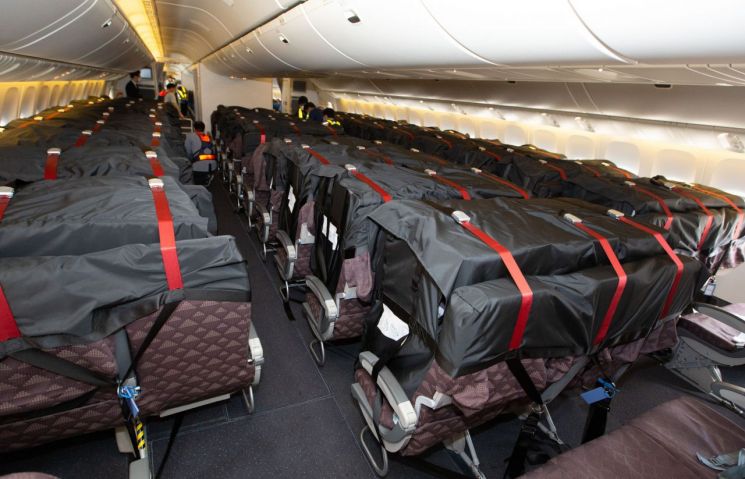
[Asia Economy Reporter Yu Je-hoon] The aviation industry, pushed to the brink of collapse due to the novel coronavirus disease (COVID-19) crisis, is making every effort to secure profitability by loading cargo onto empty passenger seats. This is a desperate measure in response to the surge in air cargo rates caused by the reduction in flight operations by global airlines.
According to the aviation industry on the 13th, Korean Air installed and operated 'Cargo Seat Bags' for the first time on flight KE037, a passenger flight that departed for Chicago, USA, on the morning of the 11th. Cargo Seat Bags refer to packaged bags that allow cargo to be loaded onto passenger seats.
Each Cargo Seat Bag can carry about 225 kg of cargo, mainly items that are not sensitive to damage. It is reported that Korean Air purchased enough Cargo Seat Bags to fill two passenger aircraft (B777-300).
The reason the aviation industry is considering loading cargo onto seats is due to the soaring air cargo rates. According to the International Air Transport Association (IATA), air cargo demand last year decreased by about 27% compared to the previous year, but the supply of belly cargo (cargo compartments in passenger aircraft) decreased by 75%, showing a larger decline.
Freight rates continue to soar. According to the TAC Air Freight Index, as of the 1st, the average air cargo rate on the Hong Kong-North America route was $6.73 per kg (approximately 8,200 KRW). This is about twice as high as the $3.41 per kg (approximately 4,100 KRW) recorded in the same period last year (first week of June).
In response to repeated requests from airlines, the Ministry of Land, Infrastructure and Transport has decided to temporarily allow in-cabin cargo transportation under conditions such as seat securing devices and special packaging.
The air cargo market is likely to continue favorable conditions for the time being. An industry official said, "As the mismatch between cargo demand and supply continues due to COVID-19, freight rates are expected to remain strong until the second half of the year," adding, "Each airline will focus more on the cargo sector, which is difficult to expect recovery in the short term, rather than on passenger services."
© The Asia Business Daily(www.asiae.co.kr). All rights reserved.
![Clutching a Stolen Dior Bag, Saying "I Hate Being Poor but Real"... The Grotesque Con of a "Human Knockoff" [Slate]](https://cwcontent.asiae.co.kr/asiaresize/183/2026021902243444107_1771435474.jpg)















