"Will Investment Be Recovered After 20 Years?"
REC Price Drop Causes Sighs Among Small Businesses
Industry Says "Government Only Focuses on Expanding Supply Rate"
Calls for Expansion of Power Generation Difference Support Arise
But Application Difficult Without Electricity Rate Realism
ESS Fire Safety Securing Also a Challenge
[Asia Economy Reporter Moon Chaeseok] Mr. Kim, who runs a medium-scale 495kW solar power project in a remote mountain village about 20 km from Cheonan-Asan Station, feels frustrated whenever he looks at the power generation facilities installed in his backyard these days.
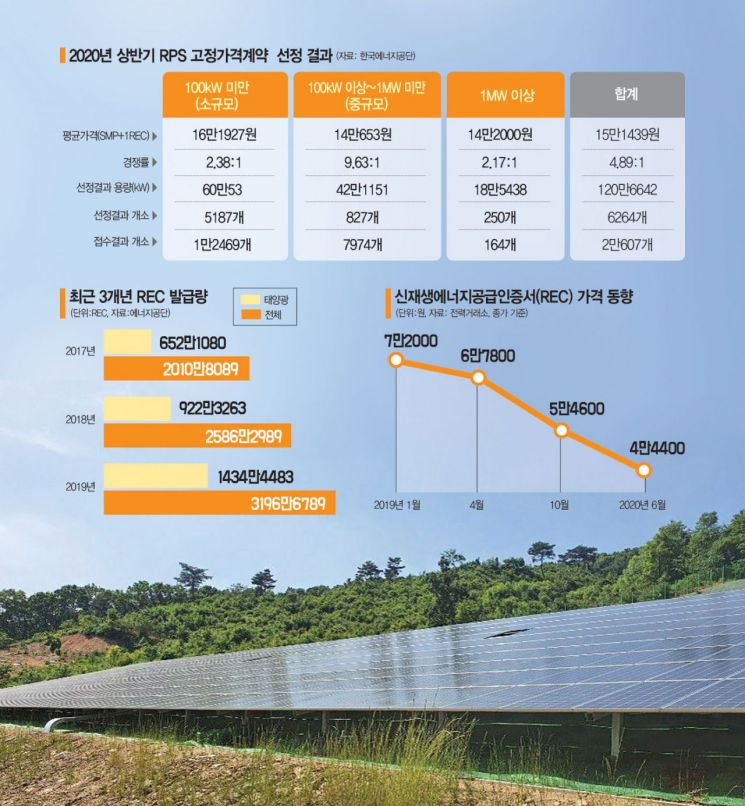
The spot price of Renewable Energy Certificates (REC), the key to profitability, keeps falling, while opportunities to secure fixed-price contracts for 20 years are repeatedly missed. On the 3rd, Mr. Kim sighed repeatedly, saying, "I invested 1.1 billion KRW in solar power, including a 700 million KRW bank loan," and added, "Even after waiting 20 years, it is uncertain whether the investment will be recovered."
◆ "At this rate, both solar panel manufacturers and small-scale power producers will perish" = As the government is eager to expand the renewable energy supply rate, 'the second Mr. Kim' is still being produced. Even after conducting 2 to 3 years of preliminary research with the determination to wait at least 15 years, the REC unit price continues to fall. There are many complaints that the government focuses solely on achieving power supply goals through renewable energy, while passively allowing Korea Electric Power Corporation (KEPCO) subsidiaries and large private power producers to lead low-price competition in a "black cat, white cat" manner.
Small and medium-sized operators, whose profitability has sharply declined, find it difficult to resist the temptation of cheap Chinese products to lower equipment costs. This leads to the reality of domestic solar panel manufacturers withdrawing from the business.
Industry insiders and experts point out that the government’s focus on expanding the supply rate rather than fostering a healthy renewable energy industry ecosystem is paradoxically causing the collapse of the domestic renewable energy industry. Mr. Kim said, "If the government continues to implement policies as it is now, the demand to secure the lowest-cost equipment, regardless of whether it is domestically produced, will expand, and neither manufacturers nor small operators will be able to grow."
◆ Directly linked to electricity rates, no breakthrough in sight = Small power producers argue that if it is difficult to stop the decline in REC prices, the Korean-style Feed-in Tariff (FIT) system should be expanded. FIT is a compensation scheme that provides subsidies to anyone who installs solar power facilities. The government abolished it in 2011 but revived it in 2018 with the announcement of the 'Renewable Energy 3020' policy. Currently, only individual operators with equipment capacity under 30kW (and cooperatives, farmers, livestock farmers, and fishermen under 100kW) benefit from the FIT system. Operators demand that the FIT system be expanded to at least cover individuals under 100kW, the 'small-scale operator' standard in RPS bidding. Mr. Kim said, "If the FIT system is expanded to guarantee some level of economic feasibility, new operators would also enter the market."
The problem is that without the realization of electricity rates, it is difficult to expand the FIT system. RPS calculates prices by combining the System Marginal Price (SMP) and REC, and among these, RECs must be purchased by KEPCO subsidiaries and private power producers. Since KEPCO must compensate for the deficit, calls for electricity rate adjustments arise. However, the government maintains a policy of no electricity rate increases.
Regarding this, Seongho Lee, senior researcher at the Korea Energy Technology Evaluation Institute, said, "Whether KEPCO compensates consumers directly (FIT) or through KEPCO subsidiaries and large private power producers (current REC system), the compensation cost is reflected in electricity rates. Like overseas cases, it is necessary to expand FIT application and establish price support measures that guarantee the national average return by reflecting market prices for each energy source such as solar, wind, and hydro."
◆ Ensuring renewable energy stability and ESS safety also challenges = To achieve the government's goal of 'renewable energy supply stabilization,' it is essential to solve the inherent intermittency problem (fluctuations in power generation due to weather and seasons) and the fire safety of energy storage systems (ESS).
If the sun does not shine (solar) or the wind does not blow (wind power), the intermittency reduces the stability of renewable energy power supply. To solve the intermittency problem, ESS, which stores generated electricity in batteries and releases it when needed, is essential. However, lithium-ion batteries used in ESS contain flammable organic substances called 'electrolytes,' which are prone to catching fire.
Since 2017, 29 ESS fires have occurred nationwide, but the government has not effectively controlled them. The solar power plant fire in Haenam, Jeollanam-do, on the 27th of last month (causing property damage of 460 million KRW) is a cause for concern, as it happened despite the 'ESS Fire Secondary Investigation Team' proposing strengthened safety measures for battery manufacturing, installation, and operation management in February.
Professor Deokhwan Lee, emeritus professor of chemistry and science communication at Sogang University, said, "If the plan is to increase renewable energy generation about fourfold over 14 years, there needs to be a concrete explanation of how ESS safety measures and intermittency issues will be resolved by then."
© The Asia Business Daily(www.asiae.co.kr). All rights reserved.
![Clutching a Stolen Dior Bag, Saying "I Hate Being Poor but Real"... The Grotesque Con of a "Human Knockoff" [Slate]](https://cwcontent.asiae.co.kr/asiaresize/183/2026021902243444107_1771435474.jpg)















