Current Account Balance Turns Negative After One Year, Deficit Largest in 9 Years and 3 Months
Large Foreign Dividend Outflows + COVID-19-Induced Export Slump Overlap
May Current Account Likely to Remain Surplus
But Recovery to Pre-COVID-19 Surplus Levels Remains Difficult
COVID-19 Resurgence and US-China Trade War Also Key Factors
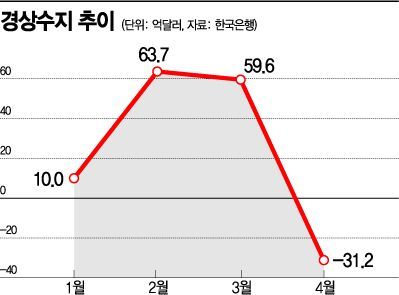
[Asia Economy Reporter Kim Eunbyeol] In April, when global lockdown measures peaked, South Korea's current account balance turned negative for the first time in a year. The deficit amounted to $3.12 billion, the largest in 9 years and 3 months. Although a surplus is expected again in May, the prolonged COVID-19 pandemic and the US-China trade war have contracted trade conditions, so the surplus itself is expected to remain diminished.
According to the "April 2020 Balance of Payments (provisional)" released by the Bank of Korea on the 4th, the current account balance in April recorded a deficit of $3.12 billion. This marks another deficit after a year since April last year (-$390 million), and the deficit size was the largest since January 2011 ($3.16 billion). Moon Sosang, head of the Bank of Korea's Financial Statistics Department, explained, "Every April, large foreign dividend settlements occur, and the goods balance worsened due to COVID-19." Exports in April decreased by 24.8% year-on-year, and imports fell by 16.9%, causing the goods balance to plunge from $5.61 billion in April last year to $820 million.
The decline in exports to the US and Europe, along with falling export prices for semiconductors and chemical products, had a significant impact. The sharp drop in oil prices reduced raw material imports, and imports of capital goods and consumer goods also decreased. However, the increase in capital goods imports, such as domestic semiconductor investments by Samsung Electronics, which have high growth potential, is a positive aspect. Park Dongjun, head of the Bank of Korea's Balance of Payments team, said, "Imports of capital goods like semiconductor manufacturing equipment are increasing, and the fact that investments are continuing is a positive factor for the future economy."
◆Current account surplus expected in May... recovery to pre-COVID-19 levels is difficult= The Bank of Korea expects the current account balance to turn positive in May. Moon said, "The trade balance in May is $440 million positive, so it is somewhat positive." The current account balance is larger than the trade balance because it includes overseas production such as ship exports, re-exports, and processing trade, which are not captured in customs trade statistics. Therefore, the feared two consecutive months of current account deficits are likely to be avoided.
However, it is uncertain whether the Bank of Korea and the government's forecast for this year's current account balance ($57 billion to $58 billion) can be achieved. According to the Bank of Korea, the current account surplus from January to April this year was $10.21 billion. To meet the Bank of Korea's first-half forecast of $17 billion, the current account balance for May and June must reach about $6.8 billion over two months. Considering last year's average monthly current account balance (about $5 billion), this is achievable, but how quickly the current account balance recovers remains to be seen.
Kim Soyoung, a professor in the Department of Economics at Seoul National University, said, "The current account balance in May is expected to show a slight surplus, but the rebound will not be as large as in previous crises," adding, "It will be difficult for the surplus to return to pre-COVID-19 levels." She also expressed concern that "if the current account surplus decline prolongs, dollar supply will decrease, and the foreign exchange market could be shaken as it was in March and April." In the Korean economy, which has a high export ratio, a current account surplus is a barometer of external credibility and the economy. If the macroeconomic stability indicators of our open economy are shaken, the won-dollar exchange rate may become unstable, and even the country's credit rating could be adversely affected.
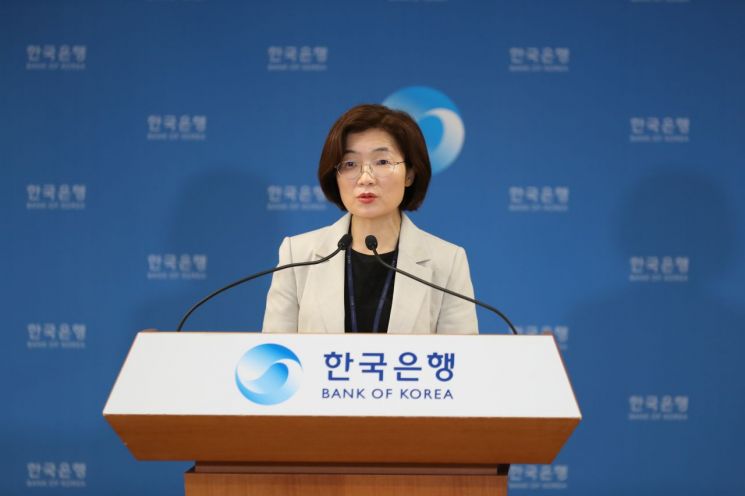 Munsosang, Head of the Financial Statistics Department at the Economic Statistics Bureau of the Bank of Korea, is presenting at the briefing on the April 2020 Balance of Payments (provisional) held at the Bank of Korea in Jung-gu, Seoul, on the morning of the 4th.
◆Dividend payments rank fifth largest ever... foreign investment in domestic bonds rises for four consecutive months= The service account deficit, which had been improving recently, widened by $150 million year-on-year to $1.42 billion. Due to COVID-19, the number of domestic residents traveling abroad drastically decreased, positively affecting the service account, but in April, royalties and license fees received by IT companies declined, turning the intellectual property rights usage fee account into a deficit. Dividend payments amounted to $4.52 billion, down from $6.7 billion a year ago. This was due to reduced dividend payments caused by deteriorating profitability of domestic companies.
As the financial market stabilized recently, domestic residents' overseas securities investment increased by $7.18 billion. Overseas stock investment rose by $5.43 billion, and overseas bond investment increased by $1.75 billion. Foreigners' domestic stock investment decreased by $3.14 billion, marking a decline for three consecutive months, but foreigners' domestic bond investment increased by $6.21 billion, rising for four consecutive months. The cash and deposits in April increased by $17.45 billion, including central bank won deposits from the Korea-US currency swap. The won withdrawn through the Korea-US currency swap by the US Federal Reserve (Fed) is deposited in the Fed account within the Bank of Korea, and the amount converted into dollars is similar.
© The Asia Business Daily(www.asiae.co.kr). All rights reserved.