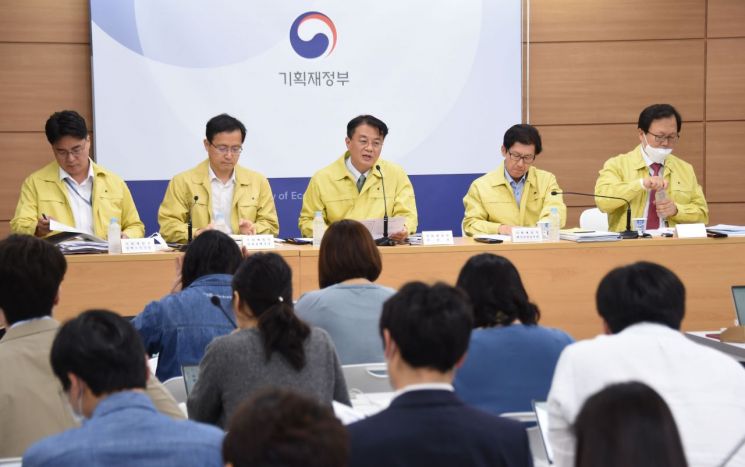
 Bang Gi-seon, Deputy Minister for Planning and Coordination at the Ministry of Economy and Finance (center), is giving a detailed pre-briefing on the "Second Half of 2020 Economic Policy Direction" at the Government Complex Sejong on the 29th of last month.
[Asia Economy Reporter Kwangho Lee] The core of the economic policy direction for the second half of 2020, announced by the government on the 1st, is tax benefits and investment support. To back this up, the government will actively promote fiscal support and high-intensity deregulation. While focusing all efforts on overcoming the national crisis caused by the novel coronavirus infection (COVID-19), the government plans to devote itself to establishing a leading economic foundation to pioneer the post-COVID era. Bang Gi-seon, Deputy Minister of Strategy and Finance, stated in a pre-briefing, "The goal of the economic policy direction for the second half of the year is to overcome the COVID-19 phase and establish a leading economic foundation." According to a survey conducted by the Korea Development Institute (KDI) targeting 1,000 general citizens and 362 economic experts on the economic policy direction for the second half of the year, the general public chose 'early overcoming of the economic crisis' as the top priority, while experts selected 'economic vitality recovery' as the foremost task.
◆ Overcoming the COVID-19 National Crisis and Establishing a Leading Economic Foundation = First, the government will strengthen tax incentive measures to increase corporate investment. The facility investment tax credit system will be completely restructured to actively encourage investment in the second half of the year. Nine tax credits, including those for productivity improvement facility investment, safety facility investment, environmental conservation facility investment, worker welfare facility investment, and pharmaceutical quality control facility investment, will be abolished and integrated with investment tax credits for small and medium enterprises (SMEs).
Along with this, the government plans to promote consumption worth 900 billion won by providing discount consumption coupons in eight major sectors including lodging, tourism, performances, movies, exhibitions, sports, and dining, totaling 168.4 billion won. The government will provide 30,000 to 40,000 won lodging discount coupons to 1 million people when booking through online lodging sites. For movies, discount coupons of 6,000 won per person (targeting 1.47 million people) will be provided.
Policies that received high responses, such as the issuance of local love gift certificates, reduction of individual consumption tax on automobiles, and rebates for high-efficiency home appliances, will also be expanded. The issuance scale of local love gift certificates will be increased from 60 trillion won to 90 trillion won, and the individual consumption tax reduction on automobiles, which is scheduled to end at the end of next month, will be temporarily revived until the end of this year, reducing the existing 70% benefit to 30%. The income deduction limit for credit and debit card usage will be raised. The annual card usage deduction limit is 3 million won for total salaries under 70 million won, 2.5 million won for 70 million to 120 million won, and 2 million won for over 120 million won. The range of additional limit increases will be included in the tax law amendment bill announced in July.
The government will also operate a phased support package to support the survival of self-employed and small business owners. It plans to smoothly complete a 16.4 trillion won program for self-employed and small business owners and is currently reviewing loans for supplying funds worth 10 trillion won through commercial banks. The plan is to execute this as quickly as possible.
Furthermore, to support low-income earners such as self-employed people who have difficulty securing living funds, the supply of low-income financial products will be expanded by 1.05 trillion won. Loan screening requirements will be temporarily relaxed this year to allow support for low-income policy funds even after temporary unemployment due to COVID-19 and reemployment. Additionally, the payment deadline for electricity bills for small business owners will be extended by three months until September, and rent burdens will be eased.
Programs such as the Industrial Stability Fund for protecting crisis and marginal companies, and livelihood and financial stability package programs will also be promoted. The government will promptly execute a financial stability package including a 40 trillion won main industry stability fund and a 20 trillion won corporate bond and commercial paper (CP) purchase institution, and support the establishment of bond and securities market stabilization funds to stabilize bond and stock markets and facilitate corporate funding. The bond fund is 20 trillion won, and the securities fund is 10.7 trillion won. In particular, considering the difficulties faced by export companies, rent for companies located in free economic zones, free trade zones, and foreign investment zones will be reduced by 30% for six months. Also, a plan to purchase SME products worth a total of 103.4 trillion won through public institutions within this year will be pursued.
Efforts to maintain and stabilize employment will also be supported. Tax audits will be deferred for up to three years for SMEs that sign employment retention agreements. However, if the employment retention agreement is not fulfilled or specific tax evasion suspicions are confirmed, the deferral will be canceled. The designation of the shipbuilding industry as a special employment support sector will be extended until the end of December, and additional designations for special employment support sectors such as the film industry will also be considered.
◆ Promotion of Three Core Projects Including the Korean New Deal = Based on strengthening the employment safety net, the government will promote the 'Korean New Deal' centered on two axes: digital and green. A comprehensive plan is scheduled to be finalized and announced in July. The government plans to invest a total of 76 trillion won over the next five years, with 31.3 trillion won by 2022 and 45 trillion won from 2023 to 2025. First, by 2022, it aims to invest 13.4 trillion won in the Digital New Deal, 12.9 trillion won in the Green New Deal, and 5 trillion won in strengthening the employment safety net, creating 550,000 jobs.
The Digital New Deal will focus on strengthening the 'DNA' ecosystem of data, networks, and artificial intelligence (AI). It plans to invest 6.5 trillion won by 2022 in building big data platforms, opening public data, transitioning national networks to 5G, 5G-AI convergence, and nurturing AI and software talent, creating 222,000 jobs.
Additionally, 4.8 trillion won will be invested in digitalizing social overhead capital (SOC), 1.4 trillion won in fostering non-face-to-face industries, and 800 billion won in building digital inclusion and safety nets.
The Green New Deal will spend the most, 5.8 trillion won, on green transformation of urban, spatial, and living infrastructure. The government will undertake green remodeling by reinforcing high-efficiency insulation materials and ventilation systems in old nationwide daycare centers (1,058 locations), public health centers (1,045 locations), medical institutions (67 locations), and public rental housing (186,000 units).
Furthermore, 5.4 trillion won will be invested by 2022 in spreading low-carbon and distributed energy, and 1.7 trillion won in establishing an innovative ecosystem for green industries.
Also, the government will invest 5 trillion won by 2022 to strengthen the employment safety net as the foundation for the Korean New Deal. This includes 2.7 trillion won for supporting employment insurance blind spots, 900 billion won for establishing a nationwide employment safety net, and 500 billion won each for supporting new entrants and transitions in the labor market and reforming future-adaptive vocational training systems.
In addition, to promote the development of pharmaceuticals and medical devices, a comprehensive plan for the medical device industry will be established in the second half of the year, and an innovative medical device company certification system will be introduced. Plans to foster bio-related industries such as green bio and advanced regenerative medicine will also be prepared.
Tax, location, and subsidy support for reshoring will be greatly expanded. Domestic returning companies will be prioritized for allocation within the metropolitan area under metropolitan regulations, subsidies for location, facility investment, and relocation costs will be increased, and the requirement to reduce production at overseas business sites to receive corporate and income tax reductions has been eliminated.
© The Asia Business Daily(www.asiae.co.kr). All rights reserved.
![Clutching a Stolen Dior Bag, Saying "I Hate Being Poor but Real"... The Grotesque Con of a "Human Knockoff" [Slate]](https://cwcontent.asiae.co.kr/asiaresize/183/2026021902243444107_1771435474.jpg)















