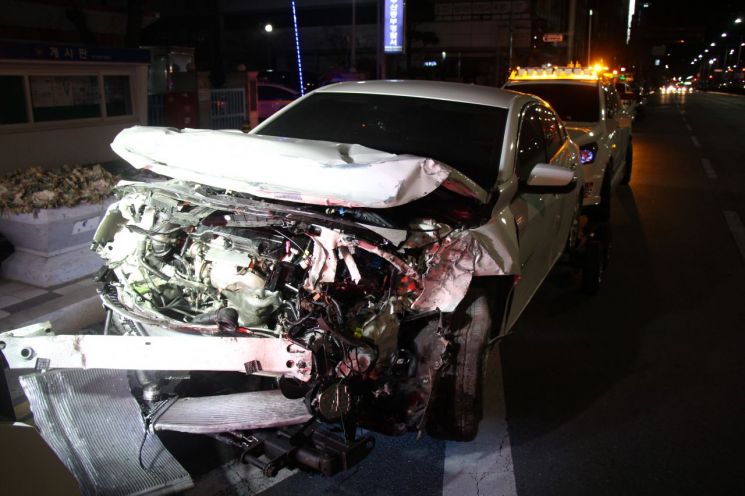
[Asia Economy Reporter Oh Hyung-gil] A claim has emerged that the deductible paid when repairing a vehicle using one's own insurance after a traffic accident cannot later be reimbursed by the other party's insurance company.
This is because claiming the deductible from the insurance company contradicts the purpose of the deductible system, which was introduced to prevent moral hazard.
On the 31st, Hwang Hyun-ah, a research fellow at the Korea Insurance Research Institute, stated in the report "Issues on the Refund of Deductibles in Own Car Insurance" that "If deductibles in own car insurance are to be refunded, the deductible agreement would become meaningless, potentially leading to disadvantages for all policyholders, such as increased insurance premiums."
Recently, some financial consumer groups have argued that policyholders can primarily claim subrogation rights for deductibles from the other party's insurance company, and that the other party's insurer must naturally pay the deductible when the policyholder requests reimbursement.
Their view that deductibles can be refunded is based on the Supreme Court ruling dated January 22, 2015 (2014Da46211).
The Supreme Court case 2014Da46211 involved a fire accident where, due to A's negligence, a fire occurred at B's warehouse causing damage worth 660 million KRW. B received 320 million KRW in compensation from the fire insurance they had subscribed to and then claimed damages of 340 million KRW from A.
The Supreme Court ruled that when calculating the liability for damages, the insurance payout received by B should not be deducted. If B has a "remaining damage amount," B can claim this within A's liability limit, and B's insurer can only exercise subrogation rights for the difference between A's liability and B's remaining damage amount.
Furthermore, A's liability was calculated as 400 million KRW by applying a 60% liability limitation ratio under the Actual Fire Liability Act to the total damage amount of 660 million KRW without deducting the insurance payout.
Accordingly, the insurer could exercise subrogation rights against A within the 60 million KRW difference between A's liability (400 million KRW) and B's remaining damage amount (340 million KRW). In other words, A must first pay B 340 million KRW of their 400 million KRW liability, and then pay the remaining 60 million KRW to the insurer.
Consumer groups interpret this as meaning "the insurer can only exercise subrogation rights within the remaining amount after the consumer has first been compensated for damages."
On the other hand, insurers have pointed out that in traffic accidents where the other party is at fault, they have been recovering the entire repair costs, including the own deductible, from the other party and have not been returning the deductible to consumers.
Research fellow Hwang stated, "own car insurance is a type of indemnity insurance like fire insurance, and the deductible is an amount not covered by insurance, so the own car insurance deductible could be considered the 'remaining damage amount' referred to in the Supreme Court ruling (2014Da46211)," adding, "However, the deductible is a special agreement where the insured agrees to bear this cost themselves, which must be taken into account."
He explained, "In cases where property damage occurs in a vehicle-to-vehicle accident, damages caused by the other party's fault should be compensated by the other party's property damage liability insurance. Own car insurance covers parts not compensated by the other party's property damage insurance, that is, insurance for 'accidents I caused,' so the deductible arising from own car insurance applies to damages from 'accidents I caused.'"
He further noted, "If deductibles were to be refunded, the final distribution of damages would differ depending on whether the own car insurance is processed first or not for the same accident. The advance processing of own car insurance is merely for the convenience of the insured, and the nature or scope of liability does not change depending on whether it is processed first. Therefore, the responsibility of the own car insurance company should not be increased due to advance processing."
Research fellow Hwang emphasized, "It is difficult to consider the deductible in own car insurance as the 'remaining damage amount' that can be claimed from the other party or their insurer," and urged that "the issue of deductible refunds should be judged by fully considering not only legal aspects but also the interests of the entire insurance community, the sound operation of the automobile insurance system, and the impact of automobile insurance premiums on the lives of the public."
© The Asia Business Daily(www.asiae.co.kr). All rights reserved.
![Clutching a Stolen Dior Bag, Saying "I Hate Being Poor but Real"... The Grotesque Con of a "Human Knockoff" [Slate]](https://cwcontent.asiae.co.kr/asiaresize/183/2026021902243444107_1771435474.jpg)















