Courier Industry Faces Surge in Orders Due to COVID-19
Citizens "Urgent Need for Better Treatment... Measures Must Be Taken"
Experts "High Infection Risk in Enclosed Spaces Like Elevators"
Government Recommends Protection Policies for Courier Workers
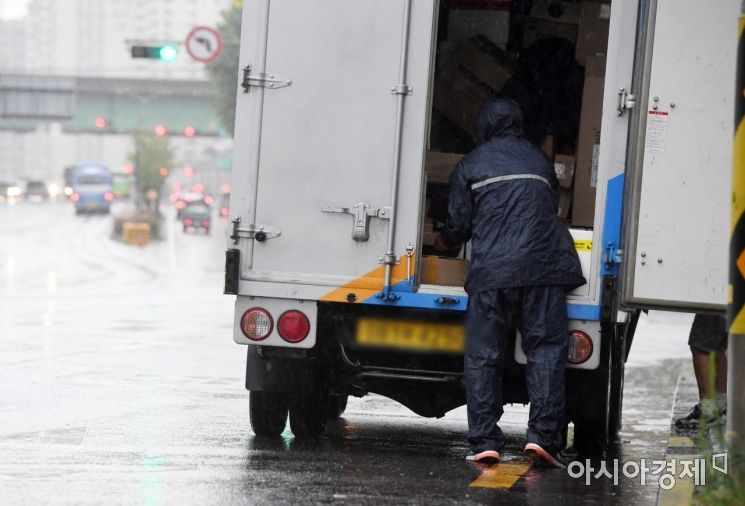 A delivery worker wearing a raincoat is busy working at the Mullae-dong intersection in Seoul.
 Photo by Mun Ho-nam munonam@
[Asia Economy Reporter Kim Suwan] "It's okay to come slowly, so please come safely.", "Please improve the treatment of delivery workers."
Recently, due to the surge in parcel volumes caused by the novel coronavirus disease (COVID-19), citizens' voices expressing concern over the excessive labor of delivery workers are growing louder. They are demanding that the safety of delivery workers be protected even if delivery times are somewhat delayed.
Experts pointed out that delivery workers working in confined spaces such as elevators have a high risk of COVID-19 infection and that improvements are necessary. Since they can be easily infected through droplets (saliva droplets), a safety system is needed.
According to the online shopping mall Coupang in March, the daily number of deliveries increased from 2 million at the end of last year to 3 million after COVID-19.
In particular, a delivery worker who was handling the surge in parcel volumes due to COVID-19 died while working the early morning shift. According to the Public Transport and Port Transport Headquarters of the Korean Confederation of Trade Unions, a 40-year-old non-regular delivery worker A at Coupang was found dead in a villa building in Ansan City, Gyeonggi Province, in the early morning of March 12.
The deceased A had joined Coupang last month and was recently assigned to delivery work. The villa had no elevator, and A was found in a state of cardiac arrest.
The union stated, "The recent surge in parcel volumes due to COVID-19 appears to have caused overwork leading to death," and pointed out, "In the case of the deceased A, he had to deliver to 20 households within an hour, which is a heavy workload for a new employee."
The Coupang branch of the Public Transport and Port Transport Headquarters of the Korean Confederation of Trade Unions held a press conference at the Public Transport Union in Yeongdeungpo-gu, Seoul, on the 18th of the same month, saying, "There are no people in the place where the increased volume and delivery due to COVID-19 are expressed only as data," and urged, "We must ensure that Coupang workers are not driven to endless running and inhumane labor in front of the greed of capital packaged in the name of someone's convenience."
They added, "The relentless overnight work of early morning delivery has been rationalized in the name of customer satisfaction," and criticized, "It is difficult to find workers' safety in this sophisticated scene called the 4th Industrial Revolution with better logic and efficient data management by artificial intelligence."
Given this situation, voices demanding improvement in the treatment of delivery workers are growing among citizens. Office worker A (29) said, "I am concerned about the excessive labor of delivery workers," and raised his voice, "The risk of COVID infection during delivery is also high. How can they follow quarantine rules while working? Improvement is urgent."
According to a survey, more than 7 out of 10 consumers are worried that delivery workers might be overworked.
According to a perception survey on delivery service use and treatment of delivery workers conducted by market research specialist Embrain Trend Monitor on the 27th, targeting 1,000 men and women aged 19 to 59 nationwide, 75.7% of consumers responded that "there is a need to improve the treatment of delivery workers."
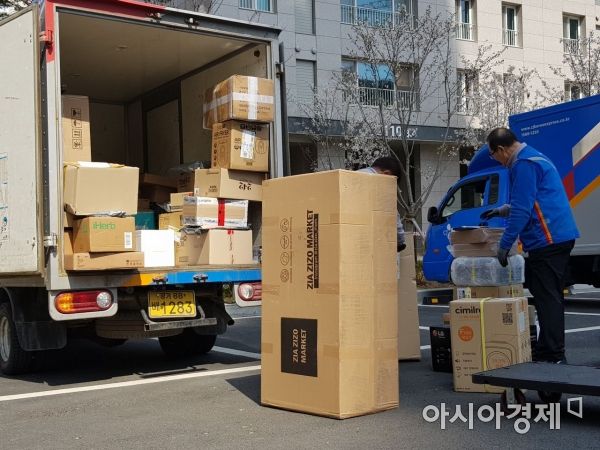 A delivery driver working busily. The photo is unrelated to specific expressions in the article. Photo by Asia Economy DB
Experts pointed out the need for improvement in working conditions and treatment. Professor Eom Jung-sik, an infectious disease specialist at Gachon University Gil Medical Center, said, "It is practically difficult to wear a mask and carry goods," and pointed out, "In such a situation, it would be even harder to follow quarantine rules."
He continued, "I think the probability of COVID infection is high in confined spaces such as elevators. Because of this, they are inevitably vulnerable to infectious diseases and epidemics," and advised, "If you are sick, you should follow preventive measures such as resting for 3 to 4 days. Improvement of working conditions and treatment is necessary."
Meanwhile, the government recommended the delivery industry, which has seen a surge in workload due to COVID-19, to assign only 60 to 70% of the average delivery volume to new delivery workers and to promptly supplement delivery vehicles and workers.
The Ministry of Land, Infrastructure and Transport announced that it held a meeting with the delivery industry on the 10th of last month to convey these contents to the industry. The Ministry's recommendations include quickly supplementing delivery vehicles and workers at delivery company offices (agencies) when the volume continues to increase, distributing cargo volumes for delivery, and if it is difficult to supplement vehicles and workers, supporting delivery work by supplementing auxiliary personnel to ride along delivery vehicles to transport goods.
In addition, referring to the Labor Standards Act, which requires a 30-minute break for every 4 hours of work, it was recommended to guarantee daily rest time for delivery workers.
Especially, when it is difficult to supplement delivery vehicles and workers at offices and the fatigue of delivery workers increases significantly, it was recommended to delay delivery by 1 to 2 days compared to the usual delivery schedule through consultation and understanding with customers.
The Ministry plans to check compliance with these recommendations through on-site inspections in the future and reflect this in the annual evaluation of delivery service by delivery transport operators.
© The Asia Business Daily(www.asiae.co.kr). All rights reserved.